
Last verified: September 15, 2026. I re-check the studio and kasbah entry prices each visit. The tourism and film figures are checked against the provincial tourism office, the Moroccan Cinematographic Centre and UNESCO, and I update the date above each time. Prices are what I paid or was quoted at the gate.
This Ouarzazate travel guide starts with a number most visitors never hear. Foreign film and television crews spent 1.21 billion MAD in Morocco in 2025 (Aujourd’hui le Maroc, 2026). Much of that work passes through the studios on the edge of this small town, on the southern side of the High Atlas. Morocco’s tourist board calls the region “the Hollywood of Africa” (Visit Morocco, 2026). I’ve driven the road in from Marrakech more times than I can count, and Ouarzazate always earns its stop.
Disclosure: Some links in this guide may earn us a commission, at no extra cost to you. It never changes what we recommend.
The town sits about 197 km and four hours from Marrakech over the Tizi n’Tichka pass. It works as a destination in its own right and as the hinge between the mountains and the Sahara. This Ouarzazate travel guide covers the studios, the two kasbahs, and the solar plant most itineraries skip. It also gives current entry prices and shows how to fit all of it into a wider desert trip.
Key Takeaways
- Foreign productions spent 1.213 billion MAD in Morocco in 2025, up from 497 million in 2017 (La Vie Éco, 2026). Atlas Studios has anchored that industry since 1983.
- Ait Benhaddou has held UNESCO World Heritage status since 1987. The listed ksar covers just 3.03 hectares (UNESCO, 2026).
- Ouarzazate sits 197 km (about 4 hours) from Marrakech and 360 km (about 6.5 hours) from Merzouga via the Dades Valley.
- Atlas Studios entry is about 80 MAD and Kasbah Taourirt about 20 MAD (Morocco Travel Life field pricing, 2026).
- Classified hotels logged 231,165 overnight stays to end-March 2026, up 27%, so spring rooms need booking ahead (MAP Express, 2026).
Table of Contents
Ouarzazate Travel Guide: How Do You Get There From Marrakech?
Ouarzazate sits roughly 197 km south of Marrakech, a drive of about four hours on the N9 over the Tizi n’Tichka pass. The pass is signed at 2,260 m. A 2022 GPS survey put the true summit at 2,205 m, and it remains the highest major road pass in North Africa (Wikipedia, 2026). The French military built the road along an old caravan trail in 1936. Snow can close it between November and March.
You have four ways over. CTM and Supratours coaches run the route daily in four and a half to five hours. Expect to pay roughly 100 to 130 MAD (Morocco Travel Life field pricing, 2026). Grand taxis leave when six seats fill. A rental car gives you the photo stops. A private driver gives you the photo stops without the switchbacks, and I cover all four options in my guide to getting around Morocco.
Flying is the option nobody mentions. Ouarzazate’s airport handles Royal Air Maroc Express flights from Casablanca. Ryanair and Transavia have also flown in from Barcelona, Marseille and Paris-Orly, so check current schedules before you assume you must transit Marrakech (Wikipedia, 2026). If you are coming from Europe and heading straight for the desert, that skips a day of driving.
I always build in an extra hour for this stretch. Roadworks and slow trucks add 30 to 45 minutes to whatever your map app promises, even with no photo stops. Every Ouarzazate travel guide should say it plainly: budget more time than the map promises. Why fight it? Leave Marrakech by eight and you reach Ait Benhaddou in time for lunch. The pass itself is part of the trip. Switchbacks climb through Amazigh villages past roadside walnut and saffron stalls. Then the views open back over the Ourika foothills, and the road drops onto the pre-Saharan plain.
What Makes Atlas Studios Morocco’s Hollywood?
Atlas Studios opened in 1983 about five kilometres from the centre. It is still described as the largest film studio in the world by land area (Wikipedia, 2026). The bigger story is the industry around it. Morocco hosted 48 foreign film and television shoots in 2025, worth 1.213 billion MAD, against 497 million MAD in 2017 (La Vie Éco, 2026). Series brought in 705.5 million of that and feature films 421.8 million (Aujourd’hui le Maroc, 2026).
Not all of that money lands here. Christopher Nolan’s The Odyssey, the biggest single production at 252 million MAD, shot across several regions. But Ouarzazate is where the standing sets are, and where a second lot, CLA Studios, opened in 2004 (Wikipedia, 2026). Locals call the town Ouallywood. The nickname is only half a joke.
Which Films and Shows Were Made Here?
The credit list is long. Gladiator, Kingdom of Heaven, Kundun, The Mummy, Babel and Prince of Persia all shot at or around the studios (Wikipedia, 2026). So did the Game of Thrones scenes set in Yunkai. Kingdom of Heaven left behind a Jerusalem set roughly 200 m long that you can still walk. CLA Studios built sets for the same film and for later biblical-era productions.
Most visitors expect a Universal Studios theme park. What they get is plywood columns, faded paint and sand drifting into empty temple doorways. That is the appeal, in my opinion. You are on a genuine working backlot, not a replica built for tourists, and a crew may be shooting three sets away.
What Does a Studio Tour Cost and Include?
Atlas Studios charges about 80 MAD for adult entry, with a guided walk through the main standing sets included in the price. The Kingdom of Heaven set is a separate 40 MAD add-on, or 110 MAD for both. The gates open at 8:30 and close at sunset (Morocco Travel Life field pricing, 2026). Budget two hours for the main lot and another hour if you add the Jerusalem set. CLA Studios runs cheaper, around 40 to 50 MAD, and gets a fraction of the visitors. Prices in this Ouarzazate travel guide are gate prices, not tour-package prices, so confirm them at the window.
Ait Benhaddou vs. Kasbah Taourirt: Which Kasbah Should You Visit?
Ait Benhaddou is a UNESCO World Heritage ksar about 32 km from town, inscribed in 1987 under criteria (iv) and (v). The protected core covers just 3.03 hectares inside a 16.32-hectare buffer zone (UNESCO, 2026). Kasbah Taourirt is a single grand residence in the centre of Ouarzazate, expanded by the Glaoui family in the late 19th and 20th centuries (Wikipedia, 2026). See both if you can. If you must pick one, this Ouarzazate travel guide picks Ait Benhaddou.
| Ait Benhaddou | Kasbah Taourirt | |
|---|---|---|
| Distance from Ouarzazate | ~32 km (~35 min) | In town |
| UNESCO status | World Heritage Site since 1987 | On Morocco’s UNESCO Tentative List |
| Typical entry/guide fee | ~100-150 MAD for a local guide across the river | ~20 MAD entry |
| Time needed | 1.5-2 hours | 45-60 minutes |
| Film credits | Lawrence of Arabia, Gladiator, The Mummy, Game of Thrones | Smaller supporting roles in several productions |
Prices are Morocco Travel Life field pricing, checked in 2026; entry arrangements at Ait Benhaddou are informal and vary by guide.
The ksar’s oldest buildings date from the 17th century. It once served as a trading post on the trans-Saharan caravan route to Marrakech via the Draa Valley and the Tizi n’Telouet (UNESCO, 2026). Only a handful of families still live inside the walls. Most residents moved to the newer village across the river decades ago, and UNESCO’s own assessment flags that abandonment as the main threat to the earthen buildings.
One detail is worth knowing before you go. The conservation body CERKAS still enforces earth and wood as the only building materials. The few concrete lintels that slipped through have been hidden under mud render (UNESCO, 2026). What looks like decay is often deliberate restraint. My guide to the kasbahs of the Atlas explains how these earthen buildings are made and why they crumble.
How Many Days Do You Need in Ouarzazate?
One day covers Atlas Studios and Ait Benhaddou back to back. Two days lets you add Kasbah Taourirt, the Noor solar viewpoint and a slower start down the Draa Valley. That is the pacing this Ouarzazate travel guide recommends after many runs of the route. The town is busier than it used to be. Classified hotels logged 231,165 overnight stays to the end of March 2026, up 27% (MAP Express, 2026). Visitor numbers rose 30% to 186,795, and occupancy climbed from 47% to 50%.
Does that change the plan? Only the booking. Spring rooms in the better kasbah hotels now go early, so reserve before you leave Marrakech rather than on arrival.
One-Day Itinerary
Start at Atlas Studios when the gates open at 8:30, before the tour coaches arrive. Continue to Ait Benhaddou for lunch and an afternoon walk through the ksar. Both sites sit on the same side of town, so there is no backtracking, and you still reach your hotel before dark.
Two-Day Itinerary
Add Kasbah Taourirt on day one, and the Cinema Museum opposite it if it has reopened. A fire in June 2024 destroyed much of the collection (SNRT News, 2024). Use day two for the Noor viewpoint at first light, then a slower drive south toward Agdz and the Draa Valley palm groves before the desert.
Is the Noor Solar Plant Worth the Detour?
Yes, for about twenty minutes, and this Ouarzazate travel guide gives Noor a stop rather than a morning. The complex sits about 10 km from town. It runs 510 MW of concentrated solar power plus 72 MW of photovoltaic panels across more than 3,000 hectares. That makes it the largest concentrated solar plant in the world (Wikipedia, 2026). It was built in four phases between 2016 and 2018. The landmark is the Noor III tower, whose receiver glows white when the mirror field focuses on it.
You cannot walk in. The site is a working power station, and access is by prior arrangement only. So the visit is a roadside viewpoint and a set of photos of a tower rising out of a plain of glass. Few guidebooks mention it, which is odd. I still stop every time. It is the one place in Morocco where you can watch the desert sun doing a day’s work.
Should You Combine Ouarzazate With a Sahara Desert Trip?
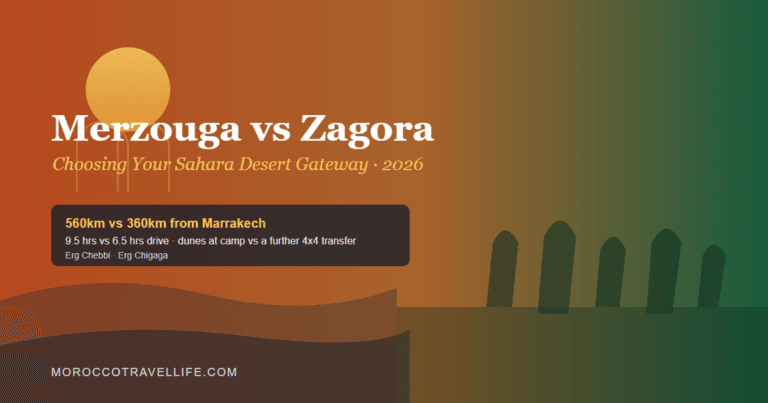
Yes, and the choice splits into two routes. The Draa Valley road runs south to Zagora, about 165 km and three hours. The Dades and Todra route runs east to Merzouga, about 360 km and six and a half hours. That is longer than a straight-line estimate because the gorge detours add time (Morocco Travel Life route planning, 2026). Ouarzazate is the last mountain stop before either desert, so decide which one you want before you leave Marrakech.
Heat decides the timing. July’s average high in Ouarzazate is 38.8°C and the town gets about 115 mm of rain a year (Wikipedia, 2026). From June to August I do the studios early and the driving after four. My month-by-month guide explains why spring and autumn suit this route best.
If you are still weighing the two deserts, my Merzouga vs Zagora comparison breaks down camp quality, dune scenery and drive time for each. My Sahara desert tour guide covers what the organised tours cost. The 7-day Morocco itinerary shows where this Ouarzazate travel guide fits into a full loop.
Where to Stay and Eat in Ouarzazate
Ouarzazate is not a nightlife town. Most travellers use it as a functional overnight between Marrakech and the desert, and this Ouarzazate travel guide treats that as a feature, not a failing. Boutique kasbah hotels in Ouarzazate and the Skoura oasis run about 800 to 2,000 MAD per room with half-board (Morocco Travel Life field pricing, 2026). The mid-range hotels along Avenue Mohammed V and near Taourirt sit well below that. My where-to-stay guide compares the kasbah hotels region by region.
I eat at the small local restaurants around the kasbah rather than the hotel dining rooms aimed at coach groups. Prices run lower and the tagines are, in my experience, better. The one Ouarzazate travel guide rule I never break? Eat before the coaches arrive at one, or after they leave at three.
Frequently Asked Questions
What is Ouarzazate famous for?
The town is best known for Atlas Studios, described as the world’s largest film studio by land area (Wikipedia, 2026). It is also the base for Ait Benhaddou, a UNESCO World Heritage ksar used in dozens of productions since the 1960s. Since 2016 it has been home to Noor, the largest concentrated solar plant in the world.
How much does it cost to visit Atlas Studios?
Entry runs about 80 MAD per adult with a guided walk included (Morocco Travel Life field pricing, 2026). The Kingdom of Heaven set is 40 MAD extra, or 110 MAD for both. The gates open at 8:30 and close at sunset. Prices are set by the studio and can shift year to year, so confirm at the ticket window.
Is Ait Benhaddou worth visiting if I’ve already seen the film studios?
Yes. Ait Benhaddou is a genuine UNESCO World Heritage Site, not a studio set, and it has held that status since 1987 (UNESCO, 2026). The two sites cover different ground: one is manufactured, the other is a living historic village.
Can you visit Ouarzazate as a day trip from Marrakech?
Technically yes, but it is a demanding one. The round trip alone is close to 400 km and eight hours of driving over the Tizi n’Tichka pass. That is why it sits at the bottom of my Marrakech day-trips ranking. Most travellers get more out of an overnight stop as part of a longer desert route.
Do you need a guide at Ait Benhaddou?
Not strictly, but a local guide at roughly 100 to 150 MAD is worth it. They know which sections are structurally safe to enter. They can also point out which corners appeared in which films, detail you would otherwise miss walking through alone.
Can you visit the Noor solar plant?
Not inside. Noor is a working power station of more than 3,000 hectares and access is by prior arrangement only (Wikipedia, 2026). The roadside viewpoint about 10 km from town gives a clear look at the Noor III tower and the mirror fields. Twenty minutes there is enough.
Conclusion: What Ouarzazate Adds Up To
Ouarzazate rewards the travellers who treat it as more than a fuel stop between Marrakech and the Sahara. Atlas Studios, Ait Benhaddou, Kasbah Taourirt and the Noor tower each tell a piece of the same story. This stretch of pre-Saharan Morocco became a stand-in for ancient Egypt, ancient Rome and half a dozen places it has never been. Then it became a power station for the real one. That is why this Ouarzazate travel guide gives the town two days whenever the schedule allows.
Give it one full day if you are passing through, two if you can spare them, and decide your onward desert route before you arrive. That is the whole point of this Ouarzazate travel guide: enough detail to plan properly without turning a stopover into homework. For the wider picture of how Ouarzazate fits alongside Morocco’s other cities and regions, start with my Morocco City & Region Guide.
First time in Morocco? Start with my complete first-trip planning guide for visas, budgeting, safety, and a full 7-day route before you build the rest of your itinerary.