
The first question travelers ask me before their desert night is some version of “will I actually be comfortable?” The honest answer depends on which tent they booked. A Sahara desert camp in Morocco is not one product. It is three, all wearing the same marketing photo. A shared mattress under canvas, a private tent with its own bathroom, and a heated suite with a dining pavilion and sometimes a plunge pool.
Disclosure: Some links in this guide may earn us a commission, at no extra cost to you. It never changes what we recommend.
I’ve slept in all three tiers across repeat trips south. I’ve planned dozens of desert nights for people traveling with me. I hear about it afterward when someone books the wrong one. The gap between a 300-MAD shared tent and a 4,000-MAD private suite is not really about luxury for its own sake. It comes down to three things.
Is your bathroom a shared block or your own? Is your bed a foam mattress on a rug or an actual bed frame? And at 3 a.m., are you fighting the desert cold under a thin blanket, or sleeping straight through it in a heated tent? This guide breaks down what you get and give up at each tier, in current 2026 MAD pricing. Book the camp that matches your trip, not the listing photo.
Key Takeaways
- Nationally, Morocco’s Ministry of Tourism recorded 43.4 million overnight stays in classified establishments in 2025, up 9% on 2024 (Ministry of Tourism, Handicrafts and Social & Solidarity Economy, Chiffres Clés, retrieved 2026-07-21). The Drâa-Tafilalet region is home to Merzouga and Erg Chebbi. It logged 2.36 million of those nights, ranking among Morocco’s four leading tourism destinations by volume (Premium Travel News, Drâa-Tafilalet 2025, citing regional tourism authorities, retrieved 2026-07-21).
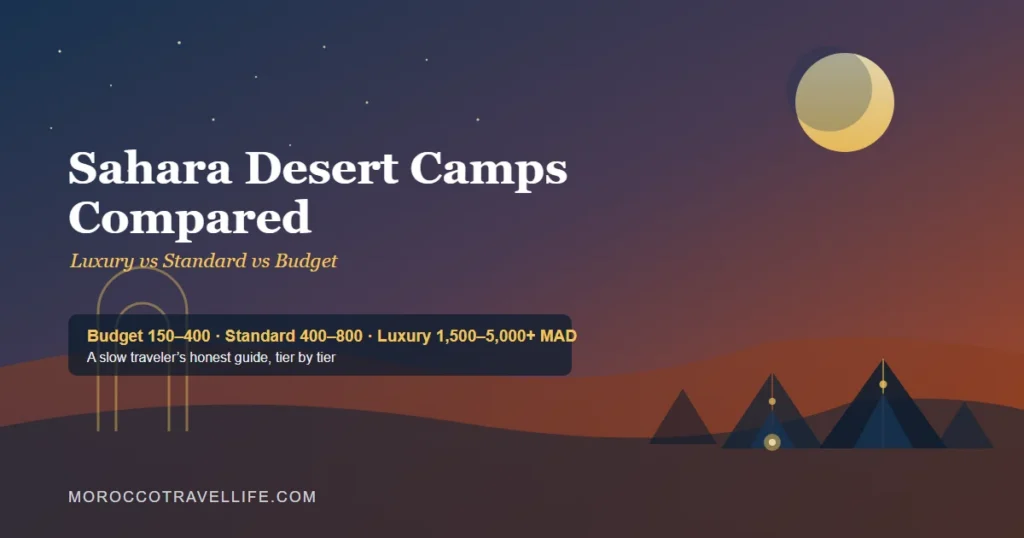
- Desert camp rates as of July 2026: budget shared camps run about 150–400 MAD ($15–40), standard private-tent camps about 400–800 MAD ($40–80), and luxury camps about 1,500–5,000+ MAD ($150–500+), all per person and half-board (Morocco Travel Life field pricing, July 2026).
- One Merzouga operator’s own published 2026 rate card runs from 104–195 MAD ($10–20) for a budget shared tent up to 1,040+ MAD ($104+) for a private luxury suite. Group size shrinks from 30–50 guests at budget down to just 2–6 at luxury (MerzougaWay, Marrakech to Merzouga Desert Camp, retrieved 2026-07-21). Those figures describe one operator’s own tiers, not a regional average.
- Errachidia’s official 1991–2020 climate normals average 39°C days and 26°C nights in July (Climatestotravel, Errachidia Climate, retrieved 2026-07-21). Merzouga’s more exposed dune camps run hotter and colder still, around 43°C days and 29°C nights (Weather-and-Climate.com, Merzouga Monthly Min/Max Temperature, retrieved 2026-07-21). January nights average around 3°C and can approach freezing.
- The tier matters more than the gateway town. Merzouga and Zagora both sell camps at all three tiers. Pick your comfort level first, then decide between the two dune fields (see my Merzouga vs Zagora comparison).
Table of Contents
Budget vs Standard vs Luxury: What Really Separates the Tiers
Sahara desert camp prices split into three bands, and three things separate them: bathroom privacy, what you’re actually sleeping on, and how many strangers you share the night with.
A budget camp gives you a shared tent and a communal bathroom block. A standard camp gives you your own tent and usually your own basic bathroom. A luxury camp gives you a proper bed, a private hot-water bathroom, climate control, and often a separate dining tent with table service.
As of July 2026, budget shared camps run 150–400 MAD ($15–40) per person, standard private-tent camps run 400–800 MAD ($40–80), and luxury camps run 1,500–5,000+ MAD ($150–500+). All are quoted half-board, with dinner and breakfast included (Morocco Travel Life field pricing, July 2026; dollar figures are rounded approximations at July 2026 exchange rates).
Every figure in this guide is per person, not per tent. A couple books two spots at the same nightly rate, rather than one room split in half the way a riad works.
What surprises first-timers most is how little the location changes between tiers. A 200-MAD shared camp and a 3,000-MAD luxury camp can pitch on the same stretch of dunes, sometimes a few hundred metres apart. What separates them is staffing, plumbing, and furniture, not the view out the tent flap.
So judging a camp by its drone-shot sunset photo is the most common mistake I watch people make. Every camp listing uses the same one. Ask about bathroom type and bed setup before you ask about the dunes.
What Do You Get and Give Up in a Budget Shared Desert Camp?
The cheapest camp option gets you into the real Sahara for 150–400 MAD ($15–40) a person, with dinner, breakfast, and a camel ride bundled in. The trade-off is a shared tent, a communal bathroom block, and a much bigger group around the fire. This tier suits backpackers, students, and anyone prioritizing the dunes over the details.
What You Get at the Budget Tier
Your tent is a canvas tent shared with several other travelers, and not always people you know. Mixed-traveler shared tents are standard at this tier. Your bed is a foam mattress or two on a rug, with blankets that are usually enough but not generous. A communal bathroom block sits a short walk from the sleeping tents.
Dinner is a shared tagine around a central fire, often with drumming and music afterward. A camel ride into or out of camp is close to universal. One Merzouga operator’s own 2026 published rates put its budget tier at 104–195 MAD ($10–20) for groups of 30 to 50 guests per camp, a genuinely communal setup (MerzougaWay, Marrakech to Merzouga Desert Camp, retrieved 2026-07-21).
What You Give Up at the Budget Tier
The honest downsides of the cheapest tier are privacy, temperature, and noise. You will very likely share your tent with strangers. The communal bathroom means a short, cold walk if you need it at 3 a.m. Blankets at this tier are rarely enough for a winter night. Bring your own liner or a warm layer regardless of what the operator promises.
Large groups also mean the fire-side music and chatter run later than at a quieter luxury camp. That’s either the best part of the night or the reason you don’t sleep well, depending on your mood.
None of this makes a budget camp a bad choice. It makes it a specific one. If you want the dunes, the camel ride, and the campfire without minding a shared tent, this tier delivers real Sahara for a fair price. If you’re a light sleeper, traveling as a couple who wants privacy, or visiting between November and February, move up a tier.
What’s Included in a Standard Private-Tent Desert Camp?
A standard private-tent camp costs roughly 400–800 MAD ($40–80) a person, and it’s where most bookings land. A tent to yourself (or just your group) and a private or semi-private bathroom are the default here, not a lucky upgrade.
This is the tier the pillar guide to where to stay in Morocco uses as its baseline desert-camp figure. It holds steady across both Merzouga and Zagora.
What You Get at the Standard Tier
At this price you get your own canvas tent, usually with two proper beds rather than mattresses on the floor. Your bathroom is a simple en-suite or semi-private setup, depending on the camp. Meals step up from a single shared pot to a proper multi-course Berber dinner: soup, tagine, and fruit. It’s served either communally or at your own table depending on group size.
A camel ride, sunset viewing, and music around the fire are included as standard, the same as at the budget tier. What changes is who you share the tent and bathroom with. MerzougaWay’s own published “Standard” tier prices 260–520 MAD ($26–52) for groups of 15 to 30 with semi-private bathrooms, sitting comfortably inside this band (MerzougaWay, Marrakech to Merzouga Desert Camp, retrieved 2026-07-21).
From planning dozens of these bookings, the biggest quality signal at this tier isn’t the tent photos. It’s whether the operator tells you upfront how many other tents are in camp. And whether your bathroom is truly private or shared with one or two neighboring tents.
A camp that answers that specifically, before you pay a deposit, is reliably the same camp that runs smoothly once you arrive. One that dodges the question is a coin flip. Usually it means the group size is bigger than the listing implies.
What You Give Up at the Standard Tier
The trade-offs here are minor but real. Electricity is often limited to a few evening hours from a generator or solar bank rather than round-the-clock. Hot water can be lukewarm by the last shower of the night. The walk to a shared bathroom, where one exists, still means stepping outside in the cold.
For most travelers doing one Sahara night as part of a bigger Morocco trip, this is the tier I recommend most often. It delivers the full desert experience without the “will I sleep at all” anxiety of the budget tier.
Luxury Desert Camp Pricing, and Whether It’s Worth It
Yes, if you want a real bed, a private hot-water bathroom, climate control, and a dedicated dining tent. A luxury camp is a different product, not an upgrade. A luxury camp at 1,500–5,000+ MAD ($150–500+) delivers a fundamentally different kind of night, not just a nicer version of the standard tent. The value case weakens if all you want is to say you slept in the Sahara and don’t mind roughing it for one night.
What You Get at the Luxury Tier
At the top of the range you’re paying for a handful of concrete swaps. Instead of a floor mattress, you get a proper bed frame and a real mattress. Instead of a shared block, you get a private en-suite bathroom with hot water on demand. Instead of extra blankets, you get heating for winter nights or air conditioning for summer ones.
Meals move to a separate dining tent with table service and a multi-course menu. The best luxury camps go further, adding a private lounge deck, sometimes a small plunge pool, and staff-to-guest ratios that border on private-villa service.
One Merzouga operator’s published rates for its top tier start at 1,040+ MAD ($104+) for groups of just 2 to 6 guests per camp (MerzougaWay, Marrakech to Merzouga Desert Camp, retrieved 2026-07-21). Full-service private-camp buyouts at the very top of the market can run well past 5,000 MAD per person.
What You Give Up at the Luxury Tier
Paying luxury prices doesn’t automatically buy you certainty. You still have to check the details yourself.
The luxury camps I’ve toured that genuinely earn their price all share one thing, and it has nothing to do with décor. It’s reliable heating or AC that works through the coldest or hottest hours of the night, not a space heater switched off at midnight. That’s the detail I ask about before recommending a camp. It’s also the easiest thing for a listing photo to hide.
Where I’ve seen people overpay is at the low end of the band. They book “luxury” and expect full private-camp service that only really shows up above 2,500 MAD. Read the inclusions line by line, not just the word “luxury” in the name.
Whether it’s worth it depends on what you value. For an anniversary trip, a honeymoon, or anyone visiting in the genuinely cold months, the extra cost buys comfort you’ll feel at 3 a.m. Take a backpacker who wants the photo and the camel ride, and expects to be tired enough to sleep through anything. A standard tent delivers most of the experience for a third of the price.
Do Desert Camps Have Electricity, Wifi, and Working Bathrooms?
Mostly no at the budget tier, sometimes at standard, and close to always at luxury. Camp sites run on generators or solar power, not the grid, so electricity and connectivity scale directly with the price tier you book. This is one of the most-asked questions I get from travelers planning to stay in touch with family back home.
Budget camps typically run lighting off a shared generator for a few hours in the evening, and offer no guest charging or wifi at all. Standard camps usually add a communal charging point near the dining area, running on solar or generator power for part of the evening. Wifi at that tier is inconsistent and often absent, so don’t count on it.
Luxury camps are where reliable electricity, in-tent outlets, and wifi become close to standard. Running climate control and hot-water pumps overnight requires a more serious power setup anyway. If staying connected matters, confirm directly with the specific camp rather than assuming your tier guarantees it. This detail varies camp to camp even within the same price band.
The practical fix is the same at every tier. Charge everything fully before you leave your last hotel or riad, and pack a small power bank.
Even a working luxury camp typically shares a limited number of outlets across all its tents. Generator power sometimes cuts off overnight to save fuel. Treat desert-camp electricity as a bonus, not a guarantee, and you won’t be caught with a dead phone camera at sunrise.
Does It Matter Whether You Book in Merzouga or Zagora?
Somewhat, but tier matters more than gateway town. Both Merzouga and Zagora sell camps across all three tiers in this guide, so the comfort decision and the destination decision are separate choices. What differs between the two towns is dune height, distance from Marrakech, and how remote your camp feels once you arrive.
Merzouga sits right against Erg Chebbi, Morocco’s tallest and most accessible dune field. The dunes right by Zagora are the modest Erg Lehoudi; the big ones, Erg Chigaga, sit beyond M’Hamid and need a further 4×4 leg. That extra effort buys far fewer neighboring camps and darker night skies. I cover that comparison in full in my Merzouga vs Zagora guide: distance, dune height, and how each changes your itinerary.
Would you rather have the whole multi-day route from Marrakech organized around camel treks and 4×4 transfers? My Sahara desert tour guide breaks down how those trips are typically structured and priced.
Why Is the Sahara So Cold at Night, Even in July?
Because dry desert air and a lack of cloud cover let the day’s heat escape fast. In the climate normals cited below, the day-to-night swing runs about 12–13°C in every season, which catches even travelers who researched the daytime heat carefully. This single fact does more to determine which tier you should book than anything else in this guide.
No camp site has its own weather station, so the nearest full long-term record is Errachidia, about 130 km from Merzouga. It averaged 39°C days and 26°C nights in July across its official 1991–2020 climate normals, and 16°C days dropping to 3°C nights in January (Climatestotravel, Errachidia Climate, retrieved 2026-07-21).
Merzouga’s own dune camps sit more exposed than the town and run hotter and colder still. Independently sourced averages put July around 43°C days and 29°C nights, and January around 19°C days and 6°C nights (Weather-and-Climate.com, Merzouga Monthly Min/Max Temperature, retrieved 2026-07-21). Shoulder-season nights in April and October land in between, typically 13–15°C, with days in the mid-to-high 20s.
I’ve watched more than one summer traveler show up with nothing but a t-shirt, having researched only the daytime heat. They shiver through dinner once the sun drops. Pack a proper layer for any month. Winter camps need a genuinely warm jacket, not a light sweater.
My Morocco packing list covers layering by season in more depth. If you’re still deciding when to go, my best time to visit Morocco guide weighs the desert’s shoulder-season sweet spot against summer crowds and heat.
Which Camp Tier Should You Actually Book?
Match the tier to how much you value privacy and warmth over price, and the decision gets easy fast.
Budget shared camps suit backpackers, solo travelers, and anyone who wants the dunes and the campfire without minding a shared tent and bathroom. Standard private-tent camps suit most couples and first-time visitors doing one Sahara night as part of a bigger trip. That’s the tier I recommend most often.
Luxury camps suit honeymooners, anniversary trips, and families wanting their own space. They also suit anyone visiting between November and February who wants heating that works through a cold night.
| Budget shared camp | Standard private-tent camp | Luxury camp | |
|---|---|---|---|
| Price per person, half-board | 150–400 MAD ($15–40) | 400–800 MAD ($40–80) | 1,500–5,000+ MAD ($150–500+) |
| Tent | Shared with other travelers | Private to your group | Private, furnished suite |
| Bed | Mattress on the floor | Two proper beds | Real bed frame, real mattress |
| Bathroom | Shared communal block | Private or semi-private, basic | Private, en-suite, hot water on demand |
| Electricity / charging | Rarely available | Limited evening hours, inconsistent | Reliable, often in-tent outlets |
| Climate control | None, blankets only | None, extra blankets provided | Heating and/or AC |
| Meals | Shared tagine around the fire | Multi-course dinner, communal or small-group | Separate dining tent, table service |
| Activities | Camel ride, music, campfire | Camel ride, music, campfire | Camel ride, music, sometimes sandboarding, private stargazing setups |
| Best for | Backpackers, budget-first travelers | Most couples and first-timers | Honeymoons, families, cold-season trips |
Sahara desert camp prices: Morocco Travel Life field pricing, July 2026; cross-checked against one Merzouga operator’s own published 2026 tier structure (MerzougaWay, Marrakech to Merzouga Desert Camp, retrieved 2026-07-21).
Activities are the one thing that barely changes between tiers. A camel ride, sunset viewing, and music around the fire are close to universal at every price point. They’re cheap for an operator to provide and central to what makes the Sahara worth visiting. Sandboarding is a common add-on at all tiers, sometimes included and sometimes a small extra charge, so ask rather than assume.
Across the whole range, what you’re really paying to upgrade is what happens between the campfire ending and breakfast starting. How you sleep, how warm you are, and whether the bathroom is yours alone.
How Fast Sahara Tourism Is Growing, and Why It Affects Availability
Fast enough that booking ahead matters, especially for a luxury camp stay. Nationally, Morocco’s Ministry of Tourism recorded 43.4 million overnight stays in classified establishments in 2025, up 9% on 2024 (Ministry of Tourism, Handicrafts and Social & Solidarity Economy, Chiffres Clés, retrieved 2026-07-21).
The Drâa-Tafilalet region, which includes Merzouga and Erg Chebbi, contributed 2.36 million of those nights. That ranks it among Morocco’s four leading tourism destinations by volume, driven partly by desert-tourism and luxury-camp demand (Premium Travel News, Drâa-Tafilalet 2025, citing regional tourism authorities, retrieved 2026-07-21).
Those 2.36 million nights landed against an average occupancy rate of just 42% across the region’s classified establishments, which sounds like plenty of spare capacity. Bivouacs, the desert-camp category this guide is actually about, logged a further 374,000+ arrivals on top of that classified-hotel count (Premium Travel News, citing regional tourism authorities, 2026).
But occupancy isn’t spread evenly across the year. Peak season, October through April, pulls well above that annual average, while the slow summer months drag it back down. That’s why the small luxury camps I recommend most often now book out weeks ahead in peak season. A few days’ notice used to be enough.
For the wider trip this desert night sits inside, my Morocco travel budget guide puts a camp night in context against riads, transport, and food. My full guide to things to do in Morocco covers where a Sahara night fits alongside hiking, cooking classes, and city time.
Frequently Asked Questions
What’s the difference between a standard and a luxury Sahara desert camp?
A standard desert camp booking gives you a private tent, two proper beds, and a basic private or semi-private bathroom for about 400–800 MAD ($40–80) a person. A luxury camp adds a real bed frame, a private en-suite bathroom with hot water on demand, heating or air conditioning, and often a separate dining tent. That runs roughly 1,500–5,000+ MAD ($150–500+) a person.
The core activities (camel ride, dinner, music around the fire) are included at both tiers. The difference is what happens between the campfire and breakfast.
How much does a desert camp cost in Morocco?
Desert camp rates split into three bands as of July 2026: budget shared camps about 150–400 MAD ($15–40) per person, standard private-tent camps about 400–800 MAD ($40–80), and luxury camps about 1,500–5,000+ MAD ($150–500+), all half-board and priced per person rather than per tent. A couple pays roughly double the headline per-person figure, not the same rate split in half.
Is it really that cold in the Sahara at night, even in summer?
Yes. Even at the height of summer, when Errachidia’s climate normals put daytime highs around 39°C (Merzouga’s dune camps run a few degrees hotter, near 43°C), nights still cool to roughly 26°C. In winter the swing is far more dramatic: January days average around 16°C, falling to about 3°C after dark and occasionally colder. Pack real layers for any month you visit, not just the warmest-sounding one.
Do budget desert camps have private bathrooms?
Generally no. Budget shared camps typically use a communal bathroom block a short walk from the sleeping tents, shared across a group of 30 to 50 guests. A private or semi-private bathroom becomes standard at the mid-range, standard private-tent tier. A fully private en-suite bathroom is a luxury-tier feature.
Should I book my desert camp in Merzouga or Zagora?
Book based on dune height and remoteness, not camp comfort. Both towns sell camps at budget, standard, and luxury level. Merzouga sits directly against Erg Chebbi’s taller, more accessible dunes. Zagora’s own dune field, Erg Lehoudi, is smaller. The far bigger Erg Chigaga lies beyond M’Hamid and needs a further 4×4 leg, which buys you fewer neighbouring camps. See my Merzouga vs Zagora guide for the full comparison.
Are camel rides and sandboarding included in the camp price, or extra?
A camel ride into or out of camp is included in almost every desert camp package, since it’s central to the experience operators sell. Sandboarding is often included but sometimes a small extra charge, so confirm with your specific camp rather than assuming. Bigger add-ons like private stargazing setups or professional photography sessions are typically priced separately at any tier.
Conclusion: Which Tier Fits Your Trip
A Sahara desert camp booking was never one product. It’s a tier, matched to how much privacy and warmth you actually want for one night in the dunes. A budget shared tent, a standard private tent, and a luxury suite with real heating are three different good answers to the same trip. Pick the tier that matches how you actually sleep. All three beat booking blind off a sunset photo.
If you’re still deciding which gateway town to book through, start with my Merzouga vs Zagora comparison. Once you know your town, my Sahara desert tour guide covers how the camel trek, 4×4 transfer, and camp night typically combine into one trip.
For the rest of Morocco’s accommodation options, my where to stay in Morocco pillar guide ties desert camps into riads, kasbahs, and hotels.
The Atlas Mountains or Dades Valley may also be on your route. My guide to boutique kasbahs in the Atlas Mountains covers the other distinctive stay type on the road south. First-timers weighing a desert night against a riad stay back in the city should read what a riad stay is actually like for the comparison in the other direction.