
Last verified: 8 September 2026. I re-check the fares, room rates and tour prices here against operator pages and Bank Al-Maghrib’s daily fixing, and update the date above each time. Dollar figures divide dirhams by 10 for simplicity. The real rate was 9.39 at the 8 September fixing.
Every Morocco travel budget question collapses into one number: how many dirhams leave your pocket per day. I track mine in a spreadsheet, updated on every trip. The honest range is wider than most guides admit. A backpacker and a honeymooner can both call Morocco “affordable” and mean completely different numbers.
Disclosure: Some links in this guide may earn us a commission, at no extra cost to you. It never changes what we recommend.
This is the itemized version of that spreadsheet: accommodation, food, transport, tours, and the small recurring costs that quietly add up, like SIM cards, tips and ATM fees. Every figure is in dirhams (MAD) first. The dollar conversion uses the rounded rate I explain in my currency guide, so you can build a real Morocco travel budget instead of guessing.
Key Takeaways
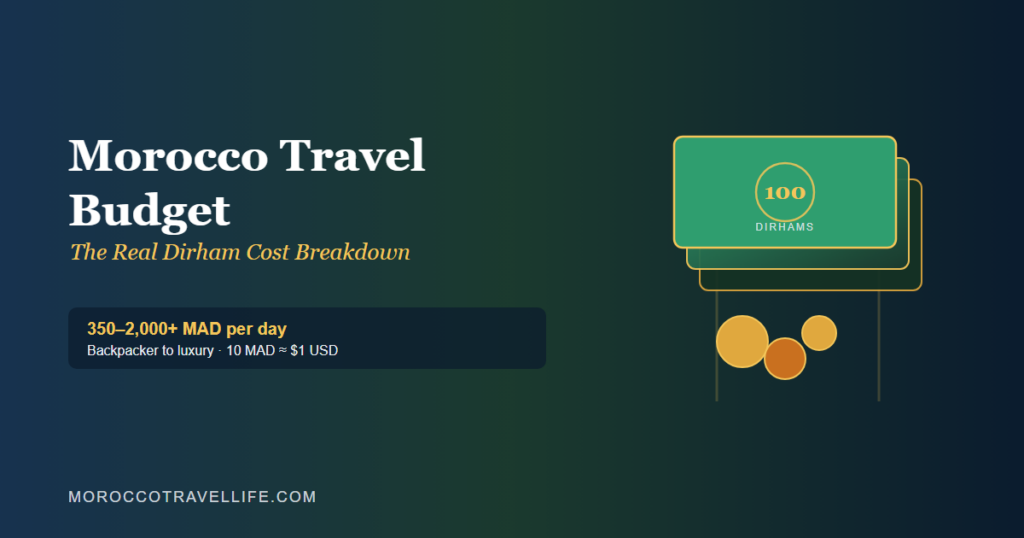
- A realistic Morocco travel budget runs 350–500 MAD backpacker, 1,000–2,000 MAD mid-range and 2,000+ MAD luxury per person per day, before flights (Morocco Travel Life field pricing, 2026).
- 1 USD bought 9.39 MAD at Bank Al-Maghrib’s 8 September 2026 fixing (Bank Al-Maghrib, 2026). I round to 10 across this site, so my dollar figures run a little high.
- Restaurant and hotel prices rose 3.3% in 2025, four times the overall inflation rate of 0.8%, so book rooms early (HCP, 2026).
- Flights are the big variable. A round trip from the US averages about $709; from the UK it averages £219, with November returns near £55 (Kayak, 2026).
- A 3-day Sahara tour runs from about 850 MAD per person on a shared minibus to 4,200–7,400 MAD private by 4×4 (Morocco Travel Life field pricing, 2026).
Table of Contents
How Much Does a Day in Morocco Cost, by Travel Style?
In 2026, a realistic Morocco travel budget breaks into three tiers. Backpackers spend 350–500 MAD a day, mid-range travelers 1,000–2,000 MAD, and a luxury pace starts at 2,000 MAD, all before international flights (Morocco Travel Life field pricing, 2026). These numbers cover a bed, three meals, local transport and one activity a day. They’re not a bare-minimum survival budget.
| Tier | Daily Budget (MAD) | Daily Budget (USD) | Covers |
|---|---|---|---|
| Backpacker | 350–500 MAD | $35–50 | Hostel dorm or budget riad, street food, buses/shared taxis |
| Mid-range | 1,000–2,000 MAD | $100–200 | Private riad room, sit-down meals, trains, occasional tour |
| Luxury | 2,000+ MAD | $200+ | Boutique or palace riad, fine dining, private drivers, guides |
Source: Morocco Travel Life field pricing, cross-checked against 2026 operator listings.
Most readers land between backpacker and mid-range. That’s the sweet spot I’d recommend for a first trip. Think a private room in a mid-range riad, a mix of street food and sit-down meals, and one paid activity every couple of days. Pure backpacker mode works. You’ll just spend real time hunting for the cheapest option instead of enjoying the trip.
How Much Does Accommodation Cost in a Morocco Travel Budget?
Morocco accommodation in 2026 runs from a 100 MAD hostel dorm bed to 4,000 MAD and up for a luxury riad (Morocco Travel Life field pricing, 2026). The widest choice sits in the 500–1,500 MAD mid-range. Prices are moving, too. Restaurant and hotel prices rose 3.3% in 2025 against overall inflation of just 0.8%, according to the national statistics office (HCP, 2026).
Why the pressure? Morocco welcomed a record 19.8 million visitors in 2025, and the best-located riads sell out weeks ahead in spring and autumn (Morocco World News, 2026). Book early if your dates fall in shoulder season.
| Accommodation Type | Price per Night (MAD) | Price per Night (USD) |
|---|---|---|
| Hostel dorm bed | 100–200 MAD | $10–20 |
| Budget riad or dar, double room | 250–500 MAD | $25–50 |
| Mid-range riad or 3–4 star hotel | 500–1,500 MAD | $50–150 |
| Luxury riad | 1,500–4,000+ MAD | $150–400+ |
Source: Morocco Travel Life field pricing, 2026.
A mid-range riad in Chefchaouen or Essaouira typically runs 30–40% less than an equivalent room in Marrakech or Fes. Shifting a few nights to smaller towns is one of the easiest ways to stretch a Morocco travel budget without downgrading comfort. Not sure which type of stay suits you? My guide to where to stay in Morocco compares riads, dars, kasbahs and desert camps city by city.
How Much Does Food Cost?
Food is where Morocco’s value really shows. A full tagine or couscous meal with bread and mint tea costs 50–100 MAD at a local restaurant (Morocco Travel Life field pricing, 2026). Street snacks start from 5 MAD. Even eating well three times a day, most travelers spend under 250 MAD on food if they stay outside the tourist-district restaurants.
- Street food / snacks: 5–20 MAD (msemen, harira soup, a grilled sandwich)
- Local restaurant meal: 50–100 MAD (tagine, couscous, bread, mint tea included)
- Tourist-district restaurant: 120–250 MAD per main course, often double the local price for similar food
- Coffee or fresh juice: 8–20 MAD
The price gap between a restaurant facing a main square and one a street behind it is often 2–3x for the identical dish. Walking an extra five minutes away from the tourist strip is the single highest-value habit for keeping a Morocco travel budget under control. Want to know what’s actually worth ordering? My Moroccan food guide covers the dishes region by region.
How Much Does Transport Cost in a Morocco Travel Budget?
Getting around Morocco is cheap by European standards. ONCF’s own promo fares start at 49 MAD for Casablanca–Marrakech and 89 MAD for Casablanca–Tangier on the Al Boraq high-speed line (ONCF Voyages, September 2026). Walk-up second-class fares run roughly 100–260 MAD depending on distance, CTM and Supratours buses 80–250 MAD, and a shared grand taxi seat 25–80 MAD (Morocco Travel Life field pricing, 2026).
| Transport Mode | Typical Cost (MAD) | Example Route |
|---|---|---|
| Grand taxi (shared seat) | 25–80 MAD | Fes–Meknes, Marrakech–Ourika Valley |
| CTM/Supratours bus | 80–250 MAD | Marrakech–Agadir, Marrakech–Merzouga |
| ONCF train, 2nd class | 49–260 MAD | Casablanca–Marrakech (from 49 MAD promo), Marrakech–Fes (from 260 MAD) |
| Al Boraq high-speed train, 2nd class | 89–225 MAD | Casablanca–Tangier |
| Petit taxi (in-city) | 10–30 MAD | Short rides within one city |
Source: ONCF Voyages promo fares, September 2026; Morocco Travel Life field pricing for buses and taxis, 2026.
Planning a multi-city route? My complete guide to getting around Morocco weighs trains against buses and car rental, city by city. If you’re set on driving, my guide to renting a car in Morocco covers the deposit, the permit and the road rules.
What Do Tours and Activities Add to a Morocco Travel Budget?
A 3-day Sahara tour from Marrakech to Merzouga is the biggest single activity most people buy. A shared minibus tour starts around 850 MAD per person, and a small-group version runs 1,900–3,250 MAD. A private 3-day trip by 4×4 costs 4,200–7,400 MAD per person (Morocco Travel Life field pricing, 2026). Camp tier drives the spread more than anything else.
- Shared minibus 3-day Sahara tour: from about 850 MAD ($85+) per person
- Small-group 3-day Sahara tour: 1,900–3,250 MAD ($190–325) per person
- Private 3-day Sahara tour by 4×4: 4,200–7,400 MAD ($420–740) per person
- Hammam visit: 20–100 MAD at a neighborhood hammam; 300–700 MAD for a riad or spa version
- Cooking class: 300–700 MAD per person, usually including a market visit
Most of this category is discretionary. You can absorb one Sahara trip and skip everything else, or layer in a hammam and a cooking class for a fuller week. I’ve priced each of these separately. The Sahara desert tour guide compares camp tiers and the camel-welfare question. The hammam guide explains what the 40 MAD and 600 MAD versions actually include, and the cooking class guide shows what a legitimate class covers.
What Are the Easy-to-Forget Costs?
Three recurring costs quietly inflate a Morocco travel budget if you don’t plan for them: SIM cards, tipping and ATM fees. A physical SIM from a city phone shop runs 30–50 MAD for 7–10 GB, while airport kiosks mostly push 100–200 MAD bundles (Morocco Travel Life field pricing, 2026). My Morocco SIM card guide compares the three operators and the eSIM options.
Tipping is expected but modest. Wise suggests 10–15% at restaurants, 5–10 MAD a day for housekeeping, and about 10% for guides and for drivers on longer journeys (Wise, 2026). Budget roughly 50–100 MAD a day for tips if you’re using guides, drivers or riad staff regularly.
ATM withdrawals are usually the cheapest way to get cash. Your home bank’s foreign transaction fee matters more than any Moroccan-side fee, so check that before you land. Dirhams can’t be bought outside Morocco, so plan your first withdrawal for the airport. The machine fees, the 2,000 MAD carry-out limit and how to change leftovers back are all in my Morocco currency guide.
How Much Do Flights Cost?
Flight cost is the most nationality-dependent line in any Morocco travel budget. A round trip from the United States averages about $709, with February the cheapest month at around $483 (Kayak, 2026). From the United Kingdom the average return is £219, November returns average about £55, and Ryanair fares start from £19 one way (Kayak UK, 2026).
That gap changes the trip math entirely. A UK traveler can sometimes fly to Morocco and back for less than one night in a luxury riad. A US traveler’s flight alone can exceed a full week of mid-range daily spending. If you’re flying from North America, book several months out and treat the flight as its own budget line, not part of the daily rate.
Does the season matter? Yes, in both directions. Winter is the cheap window from the US, while the UK’s school holidays push July fares up sharply. If your dates have any flexibility, price a shoulder-season trip first.
Sample 7-Day Morocco Travel Budget
Putting the categories together, here’s what a full week’s Morocco travel budget looks like at each tier, excluding international flights. The mid-range column assumes a riad room at 500–1,000 MAD a night and one small-group Sahara tour.
| Category | Backpacker (7 days) | Mid-range (7 days) | Luxury (7 days) |
|---|---|---|---|
| Accommodation | 700–1,400 MAD | 3,500–7,000 MAD | 10,500+ MAD |
| Food | 700–1,050 MAD | 1,050–2,100 MAD | 3,500+ MAD |
| Transport | 350–700 MAD | 700–1,400 MAD | 3,500+ MAD (private driver) |
| Tours/activities | 0–1,000 MAD | 1,900–3,250 MAD | 4,200–7,400+ MAD |
| Extras (SIM, tips) | 150–350 MAD | 350–700 MAD | 700+ MAD |
| Total (MAD) | ~1,900–4,500 MAD | ~7,500–14,450 MAD | ~22,400+ MAD |
| Total (USD) | ~$190–450 | ~$750–1,445 | ~$2,240+ |
Figures are per person, calculated from the category ranges above, 2026. Dollar totals divide dirhams by 10.
The totals line up with the daily tiers. At the backpacker end, 1,900–4,500 MAD a week is 270–640 MAD a day. In the middle, 7,500–14,450 MAD a week works out to roughly 1,070–2,060 MAD a day. If your own week comes out far above these, the culprit is almost always accommodation.
Frequently Asked Questions
Is Morocco cheap or expensive to visit?
Morocco is inexpensive by Western European standards. A realistic Morocco travel budget of 1,000–2,000 MAD ($100–200) a day covers comfortable mid-range travel (Morocco Travel Life field pricing, 2026). That’s well below the equivalent comfort level in Spain, France or Portugal.
How much cash should I bring to Morocco?
Carry enough dirhams for your first day or two, then rely on ATMs, which are widely available in every major city. You can’t buy dirhams before you land, because the currency isn’t traded abroad. My Morocco currency guide explains the rules and the cheapest way to withdraw.
Do prices change by season in Morocco?
Yes. Riad rates climb in the spring and autumn shoulder seasons (March–May, September–October) and around major holidays, then drop in the hot interior summer and in November. Building a Morocco travel budget around off-peak dates is one of the easiest ways to cut costs. My best time to visit Morocco guide has the month-by-month detail.
Can I use credit cards in Morocco, or do I need cash?
Cards work at riads, hotels and larger city restaurants, but souks, local eateries, grand taxis and small towns are largely cash-only. The Morocco currency guide covers card acceptance, contactless limits and ATM fees in detail.
How did you calculate these budget figures?
Every range here is cross-checked against at least two independent 2026 sources, such as operator fare pages, tour listings and the official price index. I then compare them against my own spending during extended stays in Marrakech. Dollar figures divide dirhams by 10 for simplicity. Ranges reflect real variation across cities and seasons, not one traveler’s receipts.
Conclusion
A Morocco travel budget doesn’t have to be a guess. Backpackers can plan around 350–500 MAD a day, mid-range travelers around 1,000–2,000 MAD, and luxury travelers 2,000 MAD and up, before flights. Flights deserve their own line, given how much they vary by departure country. Accommodation and food make up roughly 60% of a typical week, so that’s where trimming or splurging has the biggest effect.
Once your numbers are set, lock in the rest of the trip. Check Morocco’s visa requirements for your nationality if you haven’t already, then head back to the complete Morocco travel guide for timing, safety and a suggested route.