
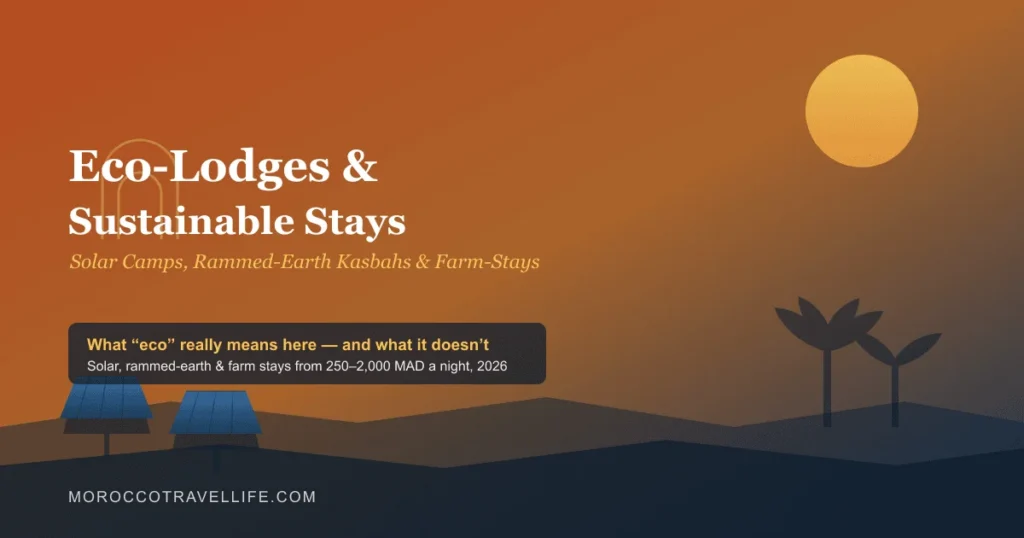
Every “eco-lodge” listing I’ve seen for Morocco uses the word a little differently. Almost none mean what a Scandinavian eco-certification program means. The eco-lodges travelers actually book in Morocco are defined by a building method and a few practical choices. Thick earthen walls. A solar water heater. A well instead of municipal mains. A badge issued by an inspector is rare. That isn’t a knock on the properties. It’s the honest starting point for booking one without disappointment.
Disclosure: Some links in this guide may earn us a commission, at no extra cost to you. It never changes what we recommend.
I get some version of the same question every few months. Readers planning a “green” Morocco trip want to know which hotels are actually certified. They also want to know which ones just slap “eco” on a listing because the walls are made of mud. Both exist. Telling them apart matters more than picking a region. This guide covers the four real types travelers can actually book, names properties in each, and gives honest 2026 pricing.
Key Takeaways
- Morocco has no dominant eco-label body. The international Green Key label reached just 70 accommodations in Morocco, and that count is from 2012: 29 hotels, 25 guesthouses, and 16 other properties. No larger, more current Morocco-specific figure is public. Meanwhile the global Green Key network passed 8,300 sites in 90 countries (Fondation Mohammed VI pour la Protection de l’Environnement, 2012 figures, retrieved July 2026; Hospitality Net, 2026).
- 85% of travelers say sustainable travel matters to them. Only about a third plan to book a certified-sustainable stay in the next twelve months. The same intention-to-action gap shows up in Morocco’s own thin label numbers (Booking.com Travel & Sustainability Report, January 2026 survey, retrieved July 2026).
- Among the four types, solar-powered desert eco-camps and rammed-earth eco-kasbahs run roughly 400–2,000 MAD ($40–200) a night. Simpler permaculture farm-stays and coastal guesthouses start around 250–400 MAD ($25–40) (Morocco Travel Life field pricing, July 2026).
- Morocco declared its seven-year drought over in January 2026 after exceptional winter rain, and dam reserves reached 75.7% by June (Ministry of Equipment and Water, January 2026). The structural picture didn’t move: per-capita availability is still about 600 cubic metres, far under the 1,000 mark for water stress (World Bank).
- Rammed-earth walls up to 50 centimeters thick give traditional Moroccan buildings genuine passive cooling. One Marrakech-region project is applying the technique to 200 houses across 7 hectares, framed explicitly as a climate response (Africanews, February 2025, retrieved July 2026).
Table of Contents
What Does “Eco-Lodge” Actually Mean in Morocco?
In Morocco, “eco-lodge” almost always means a property built from traditional low-impact materials. It usually runs on some mix of solar power, a private well, and greywater reuse. It rarely means a formally audited building. That distinction matters, because the word carries a specific promise in markets like Costa Rica and parts of East Africa. Morocco’s hotel sector mostly hasn’t formalized it yet. That is why two listings using the same word can deliver completely different things.
Here’s the honest pattern I’ve noticed over years of visiting these places. The truly low-impact ones rarely lead with the word “eco” at all. Picture a family-run rammed-earth guesthouse in the Atlas foothills. Thick mud walls. A solar water heater, added because diesel delivery is expensive out there. A vegetable garden, because trucking produce in is slow. That place beats a resort with a green-certified sticker and a rooftop array offsetting a pool and full air conditioning. Traditional technique plus practical necessity is where the best of them actually earn the name.
The underlying case for lower-impact travel here shifted in 2026, and it’s worth stating accurately. Morocco spent seven straight years in drought. Exceptional winter rain broke it. The water minister declared the drought over in January 2026, and dam reserves climbed from 28% to 75.7% by June (Ministry of Equipment and Water, January 2026).
That is not the same as solved. A wet year refills reservoirs without changing the arithmetic underneath. Per-capita water availability has slid from roughly 2,000 cubic metres in 1960 to about 600 today. That is well below the 1,000 threshold for water stress, and the World Bank still classes Morocco as structurally water-scarce (World Bank). Agriculture takes 87% of what gets used (EcoMENA, retrieved July 2026). The desalination programme launched alongside the good news says how the government reads it.
What Makes a Desert Eco-Camp Different From a Standard Sahara or Agafay Camp?
Desert camps are the easiest entry point. One is, in practice, a standard camp running on solar power instead of a diesel generator. That covers lighting, water heating, and sometimes charging points. The tent, the dinner, and the camel ride are usually identical either way. The “eco” premium buys quieter nights and a smaller fuel bill for the operator. It doesn’t buy a fundamentally different desert experience.
Solar has an easy case to make out here. Morocco built real solar capacity at national scale. The Noor Ouarzazate complex runs to 582 megawatts, 510 of that concentrated solar, which makes it Africa’s largest CSP complex and still one of the biggest anywhere. It serves over 1.1 million Moroccan households (African Development Bank, retrieved August 2026). A single off-grid camp’s rooftop panels are a rounding error next to that plant. But the same desert sun and a maturing local supply chain make small-scale solar an easy upgrade for operators near Merzouga, Zagora, and the Agafay.
I’ve stayed at camps in both the Agafay and near Merzouga. The only tell was a small panel behind the canvas and a battery pack charging by day. Nothing signals “eco” unless you ask. That’s worth knowing before paying a premium for a visibly different stay. Ask the operator what actually runs on solar, lighting only or water heating too.
Solar-powered eco-camps sit inside the same price bands I’ve already mapped for this region. They don’t command a separate tier. My Sahara desert camps guide covers the full budget-to-luxury range in Merzouga and Zagora. My Agafay desert guide breaks down the closer-to-Marrakech overnight tiers. Solar-equipped camps generally cluster in the standard-to-entry-luxury bands of both, roughly 400–1,930 MAD ($40–180) a night. Solar is common enough at that tier that it’s rarely a separate upcharge. That makes these the cheapest option in this guide (Morocco Travel Life field pricing, July 2026).
Are Atlas Rammed-Earth Kasbahs Naturally Eco-Friendly, or Just Old?
Both, honestly. These are the oldest type, and a rammed-earth kasbah is low-impact by construction accident more than design intent. That accident happens to work well. The technique, known locally as pisé, compacts a mix of clay, sand, and straw into walls up to 50 centimeters thick. That gives the building serious thermal mass. The wall absorbs heat slowly through the day and releases it slowly at night. That smooths out temperature swings a thin concrete wall would pass straight through (Africanews, February 2025, retrieved July 2026).
Step from a courtyard into a rammed-earth room at midday and the temperature drop is immediate, with no electricity behind it. That’s the entire case for these buildings. The walls do passive cooling work a modern building would spend on air conditioning.
This isn’t just heritage nostalgia. One current project in the Marrakech region is scaling rammed-earth building as climate adaptation. It plans 200 houses across 7 hectares, each 75–100 square meters, framed around passive cooling rather than tourist novelty (Africanews, February 2025, retrieved July 2026). That matters at scale. Building operations account for 26% of global energy-related CO2 emissions, with another 7% from the embodied emissions of construction materials (International Energy Agency, 2022 data, retrieved August 2026). Low-embodied-energy construction targets both halves of that number directly.
For where to actually book one of these stays, my guide to boutique kasbahs in the Atlas Mountains and Dades Valley covers the full regional breakdown. It runs through Imlil, Ouarzazate, Skoura, the Dades Valley, and Todra Gorge, with 2026 pricing from roughly 350–2,000 MAD ($35–200) depending on tier. My Moroccan architecture guide explains the pisé technique itself, and how a kasbah differs structurally from a riad.
The eco angle doesn’t add a new region or price band. It’s a lens for choosing among the same properties, favoring family-run mountain lodges built the traditional way over newer concrete-and-render construction dressed up with kasbah styling. These are the ones Morocco does best, and the least likely to advertise themselves that way.
What’s It Like to Stay at a Permaculture Farm-Stay Near Marrakech or Taroudant?
A permaculture farm-stay puts you in simple, often shared rooms on a working small farm. Think an olive grove, a saffron plot, or a mixed vegetable garden. Meals come from what’s growing that week. The day includes some amount of actual farm work if you want it. Of the four types, this is the one furthest from a hotel experience. It suits a very different kind of traveler.
The honest trade-off here is comfort for immersion. Rooms are simple: a private room with a shared or basic en-suite, sometimes a dome or converted outbuilding. There’s no pool or air conditioning. What you get instead is produce picked that morning, and a dinner table conversation about how the farm manages water. Afternoons are yours to spend weeding, harvesting, or learning a skill like natural building or beekeeping. Several of these operate partly through work-exchange platforms rather than standard booking sites. That’s worth knowing if you search Booking.com or Airbnb by default.
Two clusters get most of my recommendations. Farms in the foothills south of Marrakech are the easier logistical choice. Farms around Taroudant, near the Anti-Atlas, sit inside Morocco’s argan-growing region, which gives a stay there a real local crop and co-op economy to connect with. Expect roughly 300–1,200 MAD ($30–120) a night for a private room with meals included. The lower end buys a simple shared-bathroom setup; the upper end buys a dedicated eco-lodge-style room on the same land (Morocco Travel Life field pricing, July 2026).
This is the one type I steer families with young kids away from, and curious, flexible travelers toward. Say your idea of a good evening is a farm dog, a shared table, and truly dark skies. It delivers something none of the other three types can.
Are There Eco-Friendly Guesthouses on the Coast Near Essaouira and Taghazout?
Yes. The coast is where solar water heating and rainwater collection show up most casually. Atlantic sun is reliable nearly year-round, and a handful of smaller guesthouses in both towns were built or renovated around it. Neither town is marketed as an “eco corridor” the way the desert or the Atlas are. But the guesthouses that do lean into solar and water conservation tend to be quietly serious rather than performative. They are also the easiest to reach, since you don’t need a car.
My Essaouira riads and guesthouses guide covers the fuller lodging picture for that town. It includes the wind and neighborhood trade-offs, which matter more there than almost anywhere else in Morocco. The eco-leaning properties sit inside that guide’s existing 250–900 MAD ($25–90) medina-to-beachfront range, not a separate premium tier (Morocco Travel Life field pricing, July 2026). Taghazout runs a similar band, with smaller guesthouses built by surf-focused owners who installed solar water heating for operational reasons. Hot showers at dawn and dusk are a daily need there, not an environmental statement.
Here’s the tell I look for among coastal guesthouses. Ask whether hot water comes from a rooftop solar thermal panel, or from a full solar electric system running everything. The first is common, simple, and it works well given the coastal sun. Expect it as a baseline at a well-run guesthouse. The second is still the exception, and it’s worth confirming rather than assuming from a listing photo.
Which Eco Lodges Morocco Travelers Can Actually Name and Book
Most roundups stay vague, so here are specific properties you can name, book, and verify, one set per type. Verify current rates and practices directly with each property, since small operators change both more often than large hotels.
Certified and near-certified lodges. Of the properties travelers can verify on paper, Atlas Kasbah Ecolodge, about 5 km from Agadir, is the clearest case of a property that went through a formal audit. It sits inside the UNESCO-listed argan forest area and runs on solar power with motion-sensor lighting. It keeps an on-site kitchen garden and uses a saltwater pool rather than a chlorine one. It bills itself as the first ecolodge in Morocco and North Africa. It holds the Moroccan Ministry of Tourism’s responsible tourism award and the Green Key ecolabel.
Mountain kasbahs. Kasbah du Toubkal in Imlil is the best-known Atlas example, at 1,820 m altitude and roughly 60 km from Marrakech. It has fourteen en-suite rooms plus three family rooms, and it’s staffed and run by the local Berber community. It’s a useful reference point for what the top of this type looks like. My kasbahs guide covers the cheaper family-run alternatives in Skoura, the Dades Valley, and Ouarzazate.
Permaculture farm-stays. Oulad Chmicha is a working permaculture farm with a small number of clay-brick guest rooms, and it’s the clearest example of the farm-stay model described above. Fellah Hotel, on farmland outside Marrakech, sits at the opposite end: a much larger farm estate with villas, closer to an eco-resort than a farm-stay.
Coastal guesthouses. Le Jardin des Douars sits in the Ksob river valley outside Essaouira, sheltered from the Atlantic wind. It has 19 rooms, 6 suites, and 6 private villas across its grounds. In Taghazout, Munga Guesthouse is the surf-town equivalent of the small owner-run model described above.
A caution worth stating plainly. Only Atlas Kasbah on this list carries a verifiable third-party ecolabel. The others earn the description through building method, siting, food sourcing, or community employment. That’s exactly the pattern this guide describes. Across every type here, the questions in the next section matter more than the label.
Eco-Lodge Types Compared: Price, Setting, and Trade-Offs
The four types differ more in setting and comfort than in how “eco” they actually are. That’s exactly why matching type to trip matters more than chasing an eco label.
| Type | Typical price (2026) | What “eco” means here | Best for | Comfort trade-off |
|---|---|---|---|---|
| Solar desert eco-camp (Agafay/Sahara) | 400–1,930 MAD ($40–180) | Solar lighting/water heating instead of diesel generator | Desert scenery seekers wanting a quieter night | Tent living, shared facilities at lower tiers |
| Rammed-earth eco-kasbah (Atlas/Dades) | 350–2,000 MAD ($35–200) | Traditional pisé walls, passive cooling, often family-run | Trekkers, road-trippers, architecture-curious travelers | Remote, can be cold in winter, limited nightlife |
| Permaculture farm-stay (Marrakech/Taroudant area) | 300–1,200 MAD ($30–120) | Working farm, on-site food, water-conscious growing | Slow travelers, volunteers, curious food-focused guests | Simple rooms, no pool/AC, farm-day structure |
| Coastal eco-guesthouse (Essaouira/Taghazout) | 250–900 MAD ($25–90) | Solar water heating, sometimes rainwater collection | Surfers, coastal-town travelers wanting a lighter footprint | Small properties, book ahead in peak wind season |
Prices: Morocco Travel Life field pricing, July 2026, consistent with this cluster’s published Sahara desert camp, Agafay, kasbah, and Essaouira guides. Per room or per tent as noted in each linked guide.
Is Green Key or Formal Eco-Certification Common in Morocco?
No, not yet. Very few of the best properties carry a formal label at all. The country’s Green Key footprint is thin, and public reporting hasn’t produced a current national count in over a decade. The last specific figure I could verify is from 2012. That year, the Fondation Mohammed VI pour la Protection de l’Environnement reported 70 labeled establishments: 29 hotels, 25 guesthouses, and 16 other properties. They were assessed against a 95-criteria grid covering energy, water, waste, and staff practices (FM6E, 2012 figures, retrieved July 2026).
The practical lesson is simple. Don’t use “certified” as your filter here the way you might in a country with denser Green Key or LEED coverage. Ask direct questions instead. Where does hot water come from? What happens to greywater? Is produce grown on-site or trucked in? The places doing the most tend to be small and family-run, without the budget for a label audit. That is true of most places travelers end up recommending afterwards.
That gap mirrors a global one. A Booking.com survey of over 32,500 travelers across 35 markets found 85% say sustainable travel is important to them. Yet only about 35–36% of every generation plans to book a certified stay within twelve months. That figure barely moves across Gen Z, Millennials, Gen X, and Boomers (Booking.com Travel & Sustainability Report, January 2026 survey, retrieved July 2026). Travelers did book over 100 million room nights at certified-sustainable properties on that platform in 2025. That’s real demand, but still a fraction of overall stated concern.
Who Should Actually Book an Eco-Lodge in Morocco?
Book one of these four types if a lower-impact stay is part of what you want. It shouldn’t be an afterthought. Quiet solar-camp nights, a rammed-earth room’s natural cool, a farm dinner table: these deliver something a standard hotel can’t. If your non-negotiables are reliable air conditioning, a proper pool, and consistent wifi, treat these as an occasional detour rather than a base. Remoteness and simplicity are the actual product at every tier here.
The travelers I’ve watched enjoy this most treat it as one or two nights inside a longer trip, not the whole itinerary. For a first-timer, a farm-stay or eco-kasbah night bookended by riad nights in Marrakech or Fes lands better than five straight nights off-grid. My where to stay in Morocco pillar guide covers how these fit against riads, hotels, and standard desert camps. My family-friendly accommodation guide is the better starting point if a pool for young kids is a must. Several eco-stays here don’t have one at all.
What Should You Know Before Booking: Logistics, Remoteness, and Getting There?
Plan for a rental car or a private driver for almost every one of these. Coastal guesthouses are the one exception, and they are the only type that works on public transport alone. Desert camps, mountain eco-kasbahs, and farm-stays sit away from the bus and grand-taxi routes connecting Morocco’s main cities. Public transport usually reaches a nearby town. The final stretch is often unpaved, sometimes needs a 4×4, and is rarely realistic without arranged transport.
Every farm-stay and mountain eco-kasbah I’ve helped a reader book needed one of two things confirmed in advance. Either the property arranges a pickup from the nearest town, which is easier for a first visit. Or you drive the final unpaved kilometers yourself, on a route description that assumes local knowledge. Ask for one or the other. Don’t rely on a pinned map location alone, since several of these sit on unnamed tracks that map apps handle inconsistently.
Pack accordingly. Many of these stays run on solar that can’t guarantee constant device charging, well water runs cooler and differently mineralized than city tap, and heating is simpler than a hotel’s, especially in the mountains. My Atlas Mountains guide covers the trekking-region logistics in more depth if a mountain eco-kasbah is part of a Toubkal-adjacent trip. My what to pack for Morocco guide has the layering advice worth reading before a winter stay at altitude.
Book earlier than you think you need to, especially for the smaller properties. Morocco logged a record 19.8 million tourist arrivals in 2025, up 14% on 2024 (ATTA, 2025 figures, retrieved July 2026). A four-room farm-stay doesn’t absorb that growth the way a 200-room hotel does. The places with the most character sell out first.
Frequently Asked Questions
Are Morocco’s eco-lodges officially certified as sustainable?
Rarely. Most properties marketed as sustainable here carry no third-party certification travelers would recognize. The only verifiable nationwide Green Key count is from 2012, at 70 labeled properties, and no larger current figure is publicly tracked. Most truly low-impact stays here earn that description through traditional building and practical necessity rather than a formal audit. Ask direct questions about water, energy, and food sourcing instead of relying on a badge.
What’s the difference between a desert eco-camp and a regular Sahara or Agafay camp?
Usually just the power source. An eco-camp runs lighting and water heating on solar instead of a diesel generator. That mainly changes the noise level at night and the operator’s fuel costs. The tent, dinner, and camel ride are typically the same either way. Eco-camps sit inside the same published price tiers as standard camps rather than commanding a separate premium.
Do I need a car to stay at an eco-lodge in Morocco?
Almost always, yes, because most eco-lodges sit well outside town centers. The exception is coastal eco-guesthouses in towns like Essaouira or Taghazout, which sit inside walkable centers. Desert camps, mountain eco-kasbahs, and farm-stays are typically reached by a final unpaved stretch. A rental car, private driver, or the property’s own arranged pickup needs to cover it, because public transport alone won’t get you there.
How much does an eco-lodge stay cost in Morocco in 2026?
Expect roughly 250–2,000 MAD ($25–200) a night across the four types, depending on tier. Coastal eco-guesthouses and farm-stays start around 250–400 MAD at the simple end. Solar desert eco-camps and rammed-earth eco-kasbahs range from about 400 MAD at entry level up to 2,000 MAD for the more polished properties in each type.
Is an eco-lodge a good choice for a family with young kids?
Sometimes, but check the specifics first. Farm-stays and rammed-earth kasbahs rarely have a fenced pool or air conditioning, which matters more with young kids than with any other traveler type. Coastal eco-guesthouses are the easiest fit if a family still wants a lower-impact stay, since many sit close to a beach and modern comforts. My family-friendly accommodation guide is the better starting point if a pool is non-negotiable.
Are permaculture farm-stays only for volunteers, or can I just book a room?
Both exist. Some farms operate primarily through work-exchange platforms and expect guests to contribute a few hours of farm work daily in exchange for a reduced rate. Others simply take paying guests for a private room with meals and no work obligation. Confirm which model a property runs before booking, since the two experiences feel quite different.
Putting It Together
Morocco’s eco-lodges deliver real, if informal, sustainability. Solar power in the desert, passive-cooled rammed-earth walls in the mountains, food grown on-site at a farm-stay, solar water heating on the coast. It comes through traditional technique and practical necessity more than through paperwork. Pick the type that matches what you actually want. Budget a car into the plan for anything beyond the coast. And don’t let a missing eco-label talk you out of a place that’s quietly doing the right things.
For the full lodging landscape these stays sit inside, start with my where to stay in Morocco pillar guide. If the desert side is your priority, my Sahara desert camps compared and Agafay desert guide go deeper on tiers and logistics.
For the mountains, my boutique kasbahs in the Atlas Mountains guide covers the regions in full, and my Moroccan architecture guide explains the rammed-earth technique behind so many of these stays. Traveling with kids and set on a pool? My family-friendly accommodation guide is the better fit.