
The first time I walked a friend through the Marrakech medina, she asked why every house looked “kind of abandoned.” Blank ochre walls. One small studded door. No windows worth the name. Then we pushed through that door into a courtyard with a fountain, orange trees, and tilework climbing every surface. Her face did the thing every first-timer’s face does. That gap between the grim outside and the paradise inside is the biggest idea in Moroccan architecture. Once it clicks, half the vocabulary travelers keep hearing starts to make sense.
Disclosure: Some links in this guide may earn us a commission, at no extra cost to you. It never changes what we recommend.
I’ve spent years traveling around this country, and I keep meeting people who have the words jumbled. Riad, dar, kasbah, ksar, medina, medersa get used more or less interchangeably. They are not interchangeable. This guide to Moroccan architecture sorts out what each structure really is. It walks through the decorative crafts you’ll photograph obsessively, from zellige to tadelakt to carved plaster. And it tells you where to go to see the best example of each. No jargon for its own sake, just the words you need to read Moroccan architecture properly.
Key Takeaways
- The signature home of Moroccan architecture is the riad, an inward-facing courtyard house. The name comes from the Arabic for “gardens” (riyāḍ), and the classic form is a rectangular garden split into four quadrants around a central fountain. Both Marrakech and Fes medinas are UNESCO-inscribed largely for this urban fabric (UNESCO, Medina of Marrakesh, 2026).
- A kasbah is a fortified residence or citadel. A ksar (plural ksour) is a whole fortified village: earthen buildings crowded inside high walls with corner towers. The Ksar of Aït-Ben-Haddou, inscribed by UNESCO in 1987, is the textbook example of fortified Moroccan architecture (UNESCO, Ksar of Ait-Ben-Haddou, 2026).
- Zellige is hand-cut glazed mosaic, the most recognizable surface in Moroccan architecture. Clay from around Fes is fired near 900°C, glazed, fired again, then chipped into shapes with a hammer and set face-down in plaster (Morocco Travel Life workshop observation, Fes and Marrakech, 2026). Morocco filed a UNESCO intangible-heritage bid for the craft in November 2025 (Morocco World News).
- Morocco’s great madrasas are Marinid masterpieces: Fes’s Al-Attarine, commissioned in 1323 and finished in 1325, and Bou Inania (1350-55), which worked as both a college and a congregational mosque (Archnet, 2026; Archnet, 2026). Marrakech’s Saadian-era Ben Youssef, finished in 1564-65, is an almost perfect square about 42 metres a side, turned off the street grid to face qibla (Archnet, 2026).
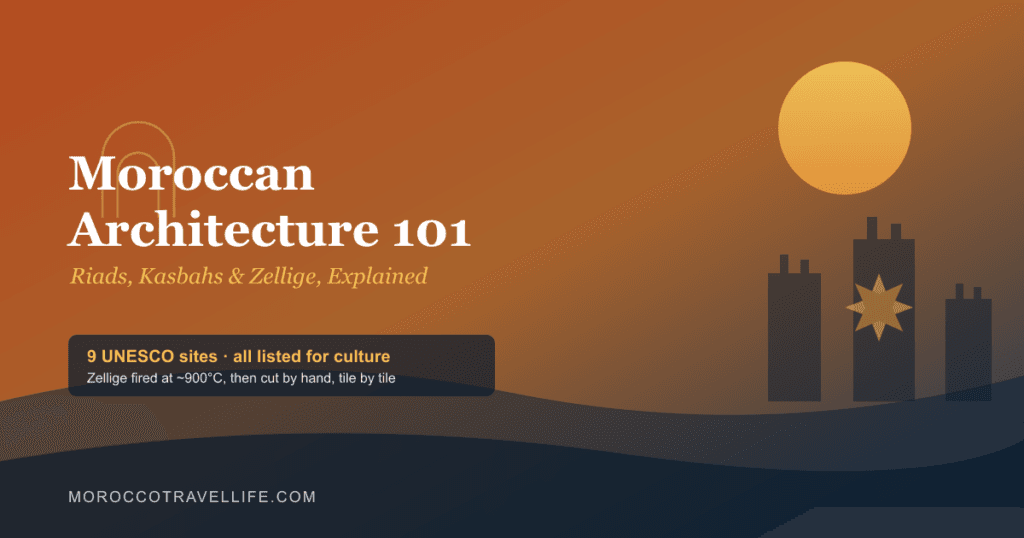
- Morocco holds nine UNESCO World Heritage sites in 2026, and every one is listed for cultural value. That listing protects most of the Moroccan architecture you’ll actually visit, and the handicraft trades behind the tilework employed over 2.7 million people in 2025 (UNESCO, 2026; The North Africa Post, 2025).
Table of Contents
What Is a Riad in Moroccan Architecture?
A riad is a traditional Moroccan house built around an interior courtyard or garden. The rooms look inward, and almost nothing faces the street. It is the most photographed form in Moroccan architecture, and the one you’re most likely to sleep in.
The word itself is the clue. Riad (also spelled riyad) comes from the Arabic riyāḍ, meaning “gardens.” The classic layout is a rectangular garden cut into four quadrants by two crossing paths, with a fountain where they meet. That four-part plan isn’t a local invention. It descends from the Persian chahar bagh, the paradise garden that spread across the Islamic world.
So why the blank walls and the missing street-facing windows? Privacy, mostly. Traditional Moroccan homes turned family life away from the public street and the eyes of passing strangers. The beauty all points inward instead. The street sees a wall. The family sees fountains, fruit trees, and zellige. It’s a building that puts a social value into stone.
Here’s the distinction almost every traveler gets wrong. A riad technically has that interior garden. A dar is the plainer and far more common courtyard house, usually with a tiled central light-well and no planted garden. Most “riads” marketed to tourists are really dars. That’s fine, because the word has drifted to mean “old medina house turned guesthouse.” If a listing says riad but the photos show a small tiled patio and no greenery, it’s a dar. Neither is better. Knowing the difference just tells you what you’re actually booking.
The guesthouse boom is recent. For centuries these were private family homes. Only in the last few decades did foreign buyers and Moroccan entrepreneurs start restoring them into boutique stays. That’s why so much hidden Moroccan architecture is now something you can sleep inside. Two nights in one is the cheapest architecture lesson you’ll get in Morocco. I go through the trade-offs in my riad vs hotel comparison.
What Do Dar, Kasbah, Ksar, and Medina Actually Mean?
Before we go monument by monument, here’s the core vocabulary of Moroccan architecture in one place. These are the 8 building types you’ll meet again and again. Keep this table handy, because it clears up most of the confusion I hear from visitors.
| Term | What it actually is | Where to see it |
|---|---|---|
| Riad | Inward-facing house built around a four-part garden | Marrakech & Fes medinas (many now guesthouses) |
| Dar | Simpler courtyard house, usually a tiled light-well, no garden | Throughout every medina |
| Kasbah | Fortified residence or citadel | Kasbah of the Udayas (Rabat); Telouet & Taourirt (south) |
| Ksar (pl. ksour) | Fortified village of packed earth | Aït Benhaddou; the Draa and Dades valleys |
| Medina | The old walled city itself | Fes el-Bali, Marrakech, Chefchaouen |
| Fondouk / funduq | Caravanserai: a merchants’ inn plus warehouse | Funduq al-Najjarin, Fes |
| Medersa / madrasa | Quranic college | Bou Inania & Al-Attarine (Fes); Ben Youssef (Marrakech) |
| Minaret | The mosque tower for the call to prayer | Koutoubia (Marrakech); Hassan Tower (Rabat) |
What Is a Kasbah, and How Is It Different From a Ksar?
A kasbah is a fortified residence or citadel. Historically it was the stronghold of a local ruler, a powerful family, or a garrison, with thick walls and towers at the corners. A ksar (plural ksour) is bigger and more communal. UNESCO describes it as a group of earthen buildings surrounded by high walls, a traditional pre-Saharan habitat where the houses crowd together behind defensive walls reinforced by corner towers (UNESCO, Ksar of Ait-Ben-Haddou, 2026). Put simply: a kasbah is one fortified building, and a ksar is a fortified town.
Both are the signature buildings of the south. Both are built from the ground they stand on. The material is pisé, or rammed earth, sometimes called tabia. It’s a mix of compacted earth and straw. It costs little, keeps interiors cool, and needs constant re-plastering, because rain slowly eats it. UNESCO lists Aït Benhaddou precisely as a showcase of this pre-Saharan earthen technique (UNESCO, Ksar of Ait-Ben-Haddou, 2026). That erosion is why these earthen towers always look a little like they’re melting. It’s also why you’ll see fresh mud repairs along their lower walls.
The most famous ksar in the country is Aït Benhaddou, on the old caravan route between the Sahara and Marrakech. UNESCO inscribed it in 1987 as a prime example of southern Moroccan architecture in earth. Film crews have worked here since David Lean shot Lawrence of Arabia in 1962, with Gladiator, Kingdom of Heaven, and Game of Thrones among the productions since. You’ll see totals quoted anywhere from 20 to 80-plus productions. No authoritative count exists, so treat any specific number you read with suspicion, including mine.
Aït Benhaddou anchors most Sahara road trips out of Marrakech. My Ouarzazate travel guide covers the ksar and the studio town beside it, and the kasbah-lined valleys further along are in my Atlas Mountains guide.
For a kasbah in a city rather than the desert, go to Rabat. The Kasbah of the Udayas sits on a bluff above the Bou Regreg river. Its monumental gate, Bab Oudaia, went up in the late 12th century under the Almohad caliph Ya’qub al-Mansur. It’s a horseshoe arch framed in carved geometric bands and a Kufic Quranic inscription, and it is routinely called one of the finest Almohad gates anywhere (Archnet, Aga Khan Documentation Center at MIT, 2026). Rabat’s historic core carries its own UNESCO inscription (UNESCO, Rabat, 2026).
What Are Medinas, Fondouks, and Madrasas?
The rest of the Moroccan architecture vocabulary lives inside the old cities. A medina is the old walled city, the pre-colonial urban core of narrow lanes and dead-end alleys. In most Moroccan cities it sits beside a newer French-built ville nouvelle.
Fes el-Bali is the giant among them, and one of the world’s largest car-free urban areas. Getting lost in it is the point. My Fes travel guide covers navigating it without losing your afternoon. Chefchaouen’s medina is the one everyone photographs for its blue-washed walls, and the Chefchaouen guide explains how that came to be.
Tucked inside these medinas you’ll find fondouks (also spelled funduq), and they’re my favorite overlooked buildings in Morocco. A fondouk is a caravanserai: a merchants’ inn built around a courtyard, with stables and storage on the ground floor and rooms for traveling traders upstairs. Fes’s beautifully restored Funduq al-Najjarin shows the type at its finest. It was built in 1711 by Amin Adiyil, during the reign of the Alaouite sultan Moulay Ismail, with three floors of rooms around a central courtyard. It was completely restored between 1990 and 1996 before reopening as a woodcraft museum (Archnet, 2026).
Most fondouks aren’t museums, though. Plenty still work as artisan workshops, and ducking into one to watch a coppersmith or weaver costs nothing. It beats another souvenir stall.
A medersa (or madrasa) is a Quranic college, and this is where the decorative side of Moroccan architecture reaches its peak. Fes has the two showstoppers. The Al-Attarine Madrasa was commissioned by the Marinid sultan Abu Sa’id in 1323 and completed in 1325, taking its name from the spice-and-perfume market at its door (Archnet, 2026). The larger Bou Inania Madrasa, founded by Abu Inan al-Mutawakkil in 1350-55, is the celebrated one. It worked simultaneously as a teaching college and a congregational mosque, with shops built along its front façade (Archnet, 2026). Both are dense with zellige, carved plaster, and cedar screens.
Marrakech’s answer is the Ben Youssef Madrasa, rebuilt by the Saadians and completed in 1564-65. It was among the largest madrasas in the Maghreb, its roughly 130 tiny dormitory cells housing several hundred students. The plan is an almost perfect square of about 42 metres a side, rotated off the street grid so the prayer hall faces qibla (Archnet, 2026). My Marrakech travel guide maps where it sits in the medina.
Why Are Moroccan Minarets Square?
Because the Almohads made the square shaft the regional standard in the 12th century, and Morocco never switched. The square minaret is the easiest marker of Moroccan architecture to spot from a distance, and you won’t see the round or pencil minarets common further east. Non-Muslims generally can’t enter working mosques here, but the minarets are public landmarks you can study from the street.
Marrakech’s Koutoubia is the model. The mosque was founded in 1147, the minaret was topped off around 1195, and it stands roughly 77 metres tall (Britannica, 2026). It’s a near-twin of the Giralda in Seville. Its unfinished sibling is Rabat’s Hassan Tower, halted in 1199 when Ya’qub al-Mansur died. It stands 44 metres today, and was meant to go far higher as the tallest minaret in the world, fronting what would have been one of the largest mosques in the western Islamic world. It anchors Rabat’s UNESCO inscription (UNESCO, Rabat, 2026).
What Are Zellige, Tadelakt, Gebs, Zouak, and Muqarnas?
Moroccan architecture is never just painted. Every important room layers several hand-crafts, and each one has a name worth knowing.
| Craft | What it is | Signature spot |
|---|---|---|
| Zellige | Hand-cut glazed mosaic set face-down in plaster | Al-Attarine Madrasa, Fes |
| Gebs | Hand-carved plaster/stucco: arabesque and calligraphy | Bou Inania Madrasa, Fes |
| Zouak | Hand-painted cedar ceilings, doors, and shutters | Bahia Palace, Marrakech |
| Tadelakt | Polished lime plaster sealed with olive-oil soap | Hammams and riad bathrooms |
| Muqarnas | Honeycomb / stalactite vaulting overhead | Saadian Tombs, Marrakech |
Zellige is the one that stops people in their tracks: those geometric mosaics of eight-point stars and interlocking shapes. It is the most recognizable surface in Moroccan architecture, and it is genuinely handmade, not printed.
Clay (tafla) from around Fes is kneaded, cut into squares, dried, and fired near 900°C. Each tile is then hand-glazed and fired a second time. Finally a master (maalem) chips it into precise shapes with a sharpened hammer, working from memory. The pieces are laid face-down into the pattern and locked in place with plaster (Morocco Travel Life workshop observation, Fes and Marrakech, 2026). The word itself traces to the Arabic zulayj, “little polished stone.” Because the geometry has to be cut by eye, a single square metre of intricate zellige can take days.
Zellige’s heritage status is currently a live question, which almost no guide mentions. Morocco’s culture ministry formally launched a bid in November 2025 to inscribe the zellige traditions of Fes and Tetouan on UNESCO’s Representative List of Intangible Cultural Heritage. The file has since become a point of dispute with Algeria over the craft’s origin (Morocco World News, November 2025). Nothing is inscribed yet. The tilework you photograph in a Fes madrasa is, right now, being argued over at treaty level.
That labour is exactly why real zellige costs what it costs. It’s also why so much “Moroccan tile” sold abroad isn’t zellige at all. From what I see in Marrakech and Fes workshops, authentic hand-cut zellige runs several times the price of the machine-printed ceramic designed to imitate it. The printed stuff is flat, perfectly repeating, and dead on close inspection. Real zellige has slight colour variation and hand-cut edges that catch the light. The chart below shows the rough per-square-metre gap I quote to friends who ask whether to buy the real thing.
The other crafts stack on top of the tile. Gebs is carved plaster, or stucco. Once the wall is up, artisans carve lacy arabesques and Quranic calligraphy into it while it’s still soft. It’s the frothy white band above the zellige in any madrasa. Zouak is the hand-painted woodwork, especially the geometric cedar ceilings and doors that glow in old palaces like Marrakech’s Bahia.
Muqarnas is the honeycomb or stalactite vaulting that drips from arches and domes. The showpiece is the gilded muqarnas dome over the Chamber of Twelve Columns in Marrakech’s Saadian Tombs. The necropolis is older than most guides say. It was begun in the mid-16th century under Sultan Sidi Abdullah al-Ghalib. Ahmad al-Mansur then greatly expanded it between 1591 and 1603, bringing in the Carrara marble (Archnet, 2026). It was walled off for centuries and only opened up again in 1917.
The one craft in Moroccan architecture you’ll actually touch is tadelakt, the seamless waterproof plaster on hammam and bathroom walls. It’s lime plaster that’s rammed on, polished with a smooth stone for hours, then sealed by rubbing in sabun beldi, the soft olive-oil soap. The soap reacts with the lime to form a water-repellent layer, which is why traditional hammams are lined with it. Ask a maalem in any Marrakech workshop and they will show you the soap step, since that is the part that turns ordinary plaster into a waterproof surface (Morocco Travel Life workshop observation, 2026).
Run your hand over a good tadelakt wall in a riad bathroom and it feels like cool stone, not plaster. Every crack-free curved corner is someone’s afternoon of polishing. And the recurring shape that ties Moroccan architecture together is the horseshoe or keyhole arch, wider than a semicircle before it curves back in. It’s the single most Moroccan silhouette there is.
Where Can You See the Best Moroccan Architecture?
The good news for travelers is that the best Moroccan architecture is protected and visitable. Morocco holds nine UNESCO World Heritage sites in 2026, and unusually, every single one is listed for cultural rather than natural value. They run from the medinas of Fes (inscribed 1981) and Marrakech (1985) to the Ksar of Aït-Ben-Haddou (1987) and Rabat (2012) (UNESCO, 2026). The pillar culture guide carries the full nine-site table. Rather than repeat it, here’s how I’d match each Moroccan architecture idea in this article to the single best place to see it.
- Riad living: book one in the Marrakech or Fes medina and simply stay a few nights.
- Kasbahs and ksour: Aït Benhaddou and the Ounila, Draa, and Dades valleys south of Ouarzazate.
- Madrasa decoration: Al-Attarine and Bou Inania in Fes; Ben Youssef in Marrakech.
- Almohad minarets: the Koutoubia in Marrakech and the Hassan Tower in Rabat.
- Saadian craft at its peak: the Saadian Tombs and El Badi Palace, Marrakech.
- Colonial-era Morocco: Casablanca’s Mauresque and Art Deco downtown, where French architects fused Moroccan architecture motifs with 1920s-30s European style.
That last one is easy to overlook. After France imposed its protectorate in 1912, its architects built entire new districts in a hybrid “Mauresque” style: European massing dressed in Moroccan arches, zellige, and carved plaster. Casablanca has the densest concentration. The Rabat vs Casablanca comparison gets into that early-20th-century layer, and the deeper backstory of how the imperial medinas grew is in my history of Marrakech’s medina.
Frequently Asked Questions
What is Moroccan architecture?
Moroccan architecture is the building tradition of Morocco, shaped by Amazigh, Arab, Andalusian, and later French influence. Its core idea is inward-facing design: blank exterior walls, and all the beauty turned toward a private courtyard. The main types are the riad, the dar, the kasbah, the ksar, the medina, the fondouk, the madrasa, and the minaret. The surfaces are layered hand-crafts, above all zellige mosaic, carved plaster, painted cedar, and tadelakt.
What is a riad?
A riad is a traditional Moroccan house built around an interior courtyard or garden, with rooms facing inward and blank walls facing the street. The name comes from the Arabic riyāḍ, “gardens,” and the classic version has a four-part garden with a central fountain. Many old riads in the Marrakech and Fes medinas have been restored into guesthouses. That’s why the word now doubles as a type of boutique accommodation.
What is the difference between a riad and a kasbah?
They’re the two best-known forms in Moroccan architecture, and they answer different needs. A riad is a peaceful courtyard home in a medina, built for privacy and inward-facing beauty. A kasbah is a fortified residence or citadel, usually built of rammed earth in Morocco’s south, designed for defense with thick walls and corner towers. In short: a riad is about seclusion and comfort, a kasbah is about protection and status.
What is the difference between a kasbah and a ksar?
Scale. A kasbah is a single fortified building or compound, one family’s or ruler’s stronghold. A ksar (plural ksour) is a whole fortified village enclosing many homes, granaries, and often a mosque behind shared walls. Aït Benhaddou is a ksar. The individual fortified houses inside and around it are kasbahs.
What is zellige and why is it expensive?
Zellige is Moroccan mosaic tilework made from hand-glazed clay tiles that are chipped into geometric shapes by hand and set into plaster. It’s costly because it’s slow, skilled labour. Each tile is fired twice and then cut piece by piece by a master craftsman, so an intricate panel can take days per square metre. Machine-printed “zellige-look” ceramic tiles are far cheaper, but they lack the hand-cut edges and colour variation of the real thing.
Can non-Muslims go inside these buildings?
Mostly yes, with one exception. Riads, kasbahs, madrasas, fondouks, palaces, and tombs are open to all visitors, and madrasas like Ben Youssef and Bou Inania charge a small entry fee. Working mosques, however, are generally closed to non-Muslims in Morocco, so you admire minarets like the Koutoubia from outside. The Hassan II Mosque in Casablanca is the notable exception that offers guided tours.
Putting It Together
Once the vocabulary clicks, Moroccan architecture reads differently. You stop seeing a jumble of old buildings and start seeing a system. Inward-facing riads and dars fill the medina. Fortified kasbahs and ksour hold the south. Madrasas and fondouks thread through the old cities.
All of it wears the same hand-crafts, from zellige and gebs to zouak, tadelakt, and muqarnas, under the same keyhole arches. The blank wall and the paradise behind it isn’t a quirk. It’s the organizing idea behind a thousand years of Moroccan architecture.
If you want the wider cultural picture Moroccan architecture sits inside, the crafts economy, the dynasties, the living traditions, start with my Understanding Moroccan Culture: A Traveler’s Guide. And when you’re choosing where to base yourself, remember that the single best way to understand a riad is to sleep in one.