
Every June, the same message lands in my inbox from readers planning a trip: “we’re thinking of coming out for Gnaoua, is that a good idea?” It usually is. But not for the reason they expect. What catches first-timers out isn’t the music. It’s the room math. Essaouira’s medina swells to several times its normal size during festival week, and the riad that had rooms a month ago is suddenly full.
Disclosure: Some links in this guide may earn us a commission, at no extra cost to you. It never changes what we recommend.
For a lot of visitors, Morocco’s festival calendar isn’t a footnote to the trip. It’s the whole reason they pick their dates. This guide covers 17 Morocco festivals across the full 2026 year: what the summer’s big three actually drew, the seven events still ahead between September and November, and the booking timing that matters once you’ve chosen one to build a trip around. Where a date still isn’t locked, I say so rather than inventing one.
Key Takeaways
- Seven festivals are still ahead in 2026, all between mid-September and the end of November: Imilchil, L’Boulevard, Tanjazz, Moga, the Erfoud Date Festival, Visa For Music, and the Marrakech International Film Festival.
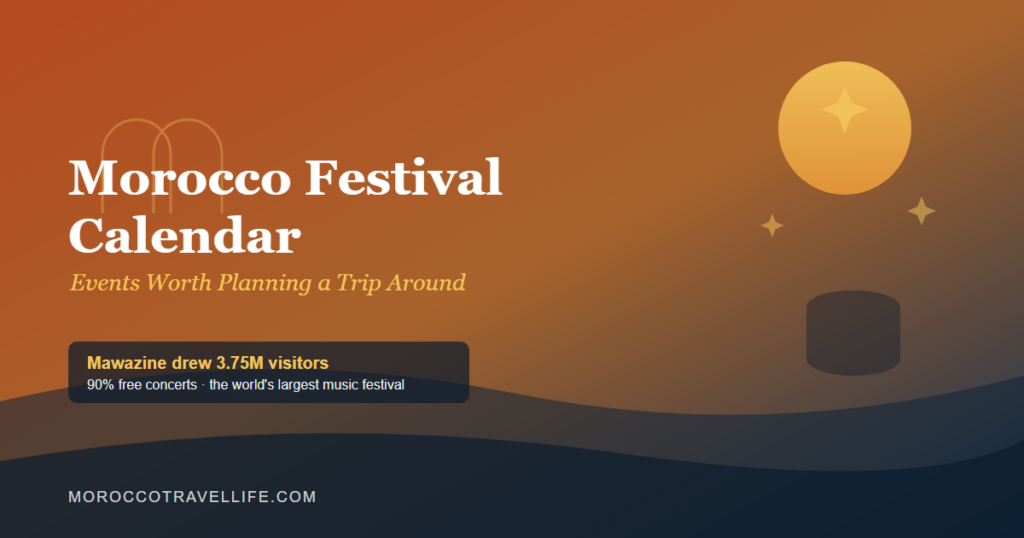
- Mawazine’s 21st edition ran June 19-27, 2026 in Rabat and Salé and drew close to 3.6 million festival-goers, just under the 3.75 million its 2025 edition posted. Roughly 90% of its concerts are free (Aujourd’hui le Maroc, 2026; Maroc.ma, 2025).
- Gnaoua’s 27th edition brought more than 300,000 people to Essaouira over three days in June, with 460 artists including 43 Gnaoua maâlems across 52 concerts (Yabiladi, 2026).
- L’Boulevard’s dates are now settled: September 17-20, 2026 at Casablanca’s R.U.C stadium, free to attend, after months of conflicting listings (Telquel, 2026).
- Book early for the big ones. Essaouira’s medina riads fill three to four months ahead of Gnaoua week, and festival-week rates run close to double the baseline.
Morocco Festival Calendar
Why Plan a Trip Around Morocco’s Festivals?
Because the scale is different here. Mawazine pulled close to 3.6 million festival-goers to Rabat and Salé across nine days in June 2026, after a record 3.75 million in 2025, which keeps it among the biggest music festivals in the world (Aujourd’hui le Maroc, 2026; Maroc.ma, 2025). Roughly 90% of its concerts are free. Tickets buy you the front-of-stage pens and seated areas, not entry itself.
Morocco festivals run on one of the densest calendars in North Africa. The pattern only becomes obvious once you track a full year of it. Three separate weeks in 2026 fall inside a single month: Fes, Mawazine, and Gnaoua. A similar cluster repeats in July, then again in September.
Here’s what I’d flag before anything else. Almost nobody plans a Morocco trip around only a festival. The pattern I see repeatedly is travelers bolting a festival weekend onto a trip that was already taking shape. A Sahara loop that happens to end in early June. A Marrakech week that happens to overlap with the Popular Arts Festival. Treat the calendar below as a filter for when to travel, not as a reason to visit a city you otherwise wouldn’t.
Haven’t settled on dates yet? My Best Time to Visit Morocco: Month-by-Month Weather & Crowd Guide covers the climate side of that decision. This guide is the Morocco festivals layer on top of it.
Morocco’s Full 2026 Festival Calendar, Month by Month
Below is every 2026 Morocco festival I could verify or find credible reporting on, in chronological order, with what’s already happened marked as held. A handful track a bloom cycle or a lunar calendar and still aren’t locked. Those are flagged rather than given an invented date.
| Festival | City / Region | 2026 Dates | Status |
|---|---|---|---|
| Marrakech International Marathon | Marrakech | January 25 | Held (36th edition, 16,000 runners) |
| Almond Blossom Festival | Tafraoute | Mid-February (typical) | Held; bloom-dependent, never fixed |
| Rose Festival | El Kelaâ M’Gouna | May 6-9 (reported) | Held; bloom-dependent each year |
| Moussem of Tan-Tan | Tan-Tan | Mid-May (2025 edition ran May 16-18) | 2026 dates never clearly published |
| Fes Festival of World Sacred Music | Fes | June 4-7 | Held (29th edition) |
| Mawazine Festival | Rabat / Salé | June 19-27 | Held (21st edition, ~3.6M attendance) |
| Gnaoua World Music Festival | Essaouira | June 25-27 | Held (27th edition, 300,000+ attendance) |
| National Festival of Popular Arts | Marrakech | July 2-6 | Held (55th edition) |
| Jazzablanca | Casablanca | July 2-11 | Held (19th edition) |
| Timitar Festival | Agadir | July 23-25 | Held (21st edition) |
| Imilchil Marriage Festival (Moussem) | Imilchil, High Atlas | Mid-to-late September (reported Sept 18-21) | Upcoming; approximate, lunar-linked |
| L’Boulevard | Casablanca | September 17-20 | Upcoming, confirmed (24th edition) |
| Tanjazz | Tangier | September 18-20 | Upcoming, confirmed (23rd edition) |
| Moga Festival | Essaouira | September 30-October 4 | Upcoming, confirmed |
| Erfoud Date Festival | Erfoud | Typically third week of October | Upcoming; 2026 dates not yet published |
| Visa For Music | Rabat | November 18-21 | Upcoming, confirmed (13th edition) |
| Marrakech International Film Festival | Marrakech | November 20-28 | Upcoming, confirmed |
Laid out this way, the shape of the year is obvious in a way no single-festival page shows you. June is the real peak. Not because any one event there outsizes Mawazine’s July neighbors, but because three big, separate festivals stack inside four weeks. I compiled the chart below from the sources cited throughout this guide to make that density visible at a glance.
Which Morocco Festivals Run in Winter and Early Spring?
Only two worth traveling for. Morocco’s festival calendar has a real off-season, and it runs roughly December through April. The Marrakech International Marathon’s 36th edition ran January 25, 2026, drawing more than 16,000 runners through the medina and Palmeraie (Morocco World News, 2026). Useful to know if you’re chasing a race bib rather than a music stage. Also useful if you’d rather not share medina streets with a road closure.
The other is the Almond Blossom Festival in Tafraoute, in the Anti-Atlas south of Agadir. It usually lands in mid-February, when the region’s almond trees bloom. Like the Rose Festival further east, it has no fixed calendar date. It moves with the bloom, and organizers confirm it only as the season approaches. Building a winter itinerary and want a genuine local event rather than just good hiking weather? This is the one to check closer to travel, and it’s the single best reason I know to put Tafraoute on a February route.
Why Is May Morocco’s Rose and Nomad-Heritage Season?
Because Morocco’s two most harvest-linked festivals both land here, and neither has a truly fixed date. That’s worth understanding before you book flights around either one.
The Rose Festival in El Kelaâ M’Gouna sits in the Valley of Roses, east of Ouarzazate. It celebrates the Damascena rose harvest with parades, rose-water traditions, and a crowned “Miss Rose.” The 2026 edition ran in the May 6-9 window, and in the months beforehand published dates ranged from May 6-9 to May 8-11 depending on which listing you read. That spread is itself the honest signal. The date tracks the actual bloom, not a fixed calendar slot, and organizers typically confirm only six to eight weeks out.
The Moussem of Tan-Tan is harder still to pin down. It’s a UNESCO-inscribed nomadic gathering in the pre-Saharan south. Its 2025 edition, the 18th, ran May 16-18 (ICESCO, 2025), continuing a mid-May pattern. A 2026 edition was never clearly announced in any source I’d trust, and some event aggregators listed it as a December event instead. Rather than paper over that, I’ll say it plainly: I could not verify what Tan-Tan did in 2026. If its camel markets and tribal gathering are the draw for next year, confirm with UNESCO’s Intangible Cultural Heritage listing or a Tan-Tan-based operator before booking around it.
I’ve had readers get burned by exactly this kind of bloom-dependent date. They booked a fixed flight around “early May” and landed a week before the roses opened. My advice for anyone targeting the Rose Festival or Tan-Tan in 2027: build a flexible three-to-four-day window into your plan around the reported dates. Don’t fly in for a single specific day.
Why Is June Morocco’s Busiest Festival Month?
Three separate major festivals landed inside a four-week span in 2026, and each drew a different crowd. No other month comes close, and the pattern repeats reliably enough to plan a 2027 trip around it.
It opened with the Fes Festival of World Sacred Music’s 29th edition, June 4-7, 2026. More than 160 artists from four continents performed at venues including Bab Makina and the Jnan Sbil Gardens, themed that year around Fes’s master artisans (Telquel, 2026). It’s the calendar’s quietest major event, and the least crowded. Sufi chant, sacred dance, and world-music fusion in a medina setting, not a stadium concert. Haven’t nailed down the city itself yet? My Fes Travel Guide covers navigating the world’s largest car-free medina.
Two and a half weeks later, Mawazine’s 21st edition took over Rabat and Salé, June 19-27, 2026. It’s the outlier of the entire calendar in scale. The 2026 edition drew close to 3.6 million festival-goers across nine days, adding the Grand Théâtre Royal and the Prince Moulay Abdellah stadium to its venue list, and ran alongside the FIFA World Cup with fan zones screening the Atlas Lions between sets (Aujourd’hui le Maroc, 2026).
One honest footnote on that number, since organizers billed 2026 as a record edition. At roughly 3.6 million it actually came in a little under the 3.75 million reported for 2025 (Maroc.ma, 2025). Either way the takeaway for planning is identical: this is a multi-million-person event, and roughly 90% of it is free.
Overlapping Mawazine’s final days, the Gnaoua World Music Festival took Essaouira for its 27th edition, June 25-27, 2026. It fuses Gnaoua spiritual music with jazz, blues, and world genres across the coastal medina’s squares (Festival Gnaoua, 2026). The 2026 edition drew more than 300,000 people over three days, with 460 artists including 43 Gnaoua maâlems across 52 concerts, plus a Human Rights Forum running alongside the music (Yabiladi, 2026). My Essaouira Travel Guide covers the town itself, medina layout and all, beyond just festival week.
The overlap between Mawazine’s tail end and Gnaoua’s opening is a genuine planning opportunity, and I point it out to almost every reader who asks. In 2026 the two shared three calendar days, which is the normal pattern rather than a fluke. It’s realistically possible to catch Mawazine’s last weekend in Rabat, then drive to Essaouira in time for Gnaoua’s opening night. One flight, two very different festivals. The drive runs roughly five to six hours depending on where in Rabat you start, so treat it as a full travel day rather than an afternoon.
Morocco’s July Festival Rush: Popular Arts, Jazz, and Timitar
July runs a close second to June. And unlike some of the spring events, every major July festival in 2026 held to its published dates rather than drifting.
The National Festival of Popular Arts held its 55th edition in Marrakech, July 2-6, 2026. Five evenings of traditional dance, song, and regional folklore, performed at the Badiî Palace, the Ben Youssef Medersa, and Jemaa el-Fna itself (Xinhua, 2026). My Marrakech Travel Guide covers the medina and souks where most of this festival actually happens. Because it has already run, it’s a clean example of a festival with zero date ambiguity. Useful if you’re planning 2027 around the same July slot.
Running the same week in Casablanca, Jazzablanca’s 19th edition spanned July 2-11, 2026. Further south, Timitar’s 21st edition ran July 23-25, 2026 in Agadir, drawing roughly 30 Moroccan and international artists around Amazigh music and its fusion with global genres (Telquel, 2026).
Are Morocco’s Fall Festivals Worth Planning Around?
Yes, if your interest runs toward tradition and heritage rather than headline acts. September and October have a different flavor from the June-July music run, and as of now they’re the next thing on the calendar rather than a plan for next year.
The Imilchil Marriage Festival is Morocco’s most written-about moussem. It’s held in the High Atlas village that gives it its name: a multi-day gathering rooted in Ait Haddidou Berber tradition, historically tied to courtship and marriage customs, alongside markets, music, and dance. 2026 reports cluster around September 18-21, though independent calendars still disagree between September 18-20 and 18-21, and no official programme had confirmed the window as of this update. As a moussem tied partly to the lunar calendar, treat that as an approximate target rather than a locked date, and confirm locally before you commit non-refundable travel.
The same month brings one event that was a genuine mess to pin down, and is now settled. L’Boulevard, Casablanca’s long-running urban, rock, and rap festival, was reported anywhere from September 4-6 to September 17-20, 2026 depending on which listing you read. The 24th edition is confirmed for September 17-20 at the R.U.C stadium, free to attend, with an opening night built around Moroccan rap (Telquel, 2026). If you find a page still listing early September, it’s stale.
More reliably dated in the same window: Tanjazz in Tangier, September 18-20, 2026, and Essaouira’s Moga Festival, September 30-October 4, 2026. My Tangier Travel Guide covers the city if Tanjazz is your anchor.
October’s other anchor is the Erfoud Date Festival, in the Tafilalt oasis region. It crowns a Date Queen and brings Berber dance and horseback performances to celebrate the date harvest, in a region growing over a million date palms. It typically lands in the third week of October, tracking the harvest, and 2026’s exact dates still weren’t published as of this update. It runs officially as the Salon International des Dattes, so the Drâa-Tafilalet regional tourism listings under that name are the place to check as October approaches, rather than the third-party festival roundups that tend to recycle last year’s dates.
The fall cluster gets a fraction of the foreign-visitor attention that June’s music festivals do. That’s exactly what makes it interesting once you’ve already done the Sahara-and-imperial-cities loop. Imilchil and Erfoud in particular are events I’d point a returning visitor toward before I’d repeat Gnaoua with them.
How Reliable Are the Fall Festival Dates?
It varies more than you’d like, and it’s worth saying so plainly. The city-based events are solid: L’Boulevard, Tanjazz, and Moga all have confirmed dates from Moroccan press or their own organizers. The moussems are the soft spot.
Imilchil and Erfoud have no official programme confirming exact 2026 dates, and the windows above come from regional listings rather than a government or festival-organizer source. Morocco’s National Tourist Office (ONMT) tends to lock them only a few weeks out. Treat them as directional, not fixed, and confirm locally or through ONMT before booking non-refundable travel around either one. That gap between a confirmed city festival and an approximate rural moussem is the single most useful thing to understand about planning a fall trip here.
Late-Year Festivals: Visa For Music and the Marrakech Film Festival
Two events close out the 2026 calendar, and both are firmly confirmed. Visa For Music runs November 18-21, 2026 in Rabat for its 13th edition. It’s a showcase for African and Middle Eastern artists and industry professionals, so it’s more a trade event than a festival built for casual tourists. Still a strong pick if you’re chasing new music before it breaks internationally.
Closing the year is the Marrakech International Film Festival, November 20-28, 2026, bringing international premieres and red-carpet screenings to the city (official festival site, 2026). Between the two, Rabat and Marrakech both see a genuine, if smaller, room squeeze in the back half of November.
How Far Ahead Should You Book Accommodation for a Festival Trip?
Earlier than you’d think for the big Morocco festivals. Essaouira’s medina riads fill three to four months ahead of Gnaoua week, and with more than 300,000 people arriving for a three-day festival in a town of roughly 78,000, the pressure lands on every riad, restaurant, and taxi in the medina (Yabiladi, 2026).
The gap between festival-week and normal pricing is real, not marketing hype. I spot-checked booking platforms for Essaouira and Rabat/Salé across a normal week versus a festival week in 2026. A standard riad room running roughly 400 MAD a night outside festival season pushes toward 750 MAD during Gnaoua week. That’s nearly double. Rabat and Salé see a smaller but still noticeable jump during Mawazine, because the city’s hotel-heavy inventory has more room supply to absorb the surge.
The practical takeaway is simple. If a specific festival is the anchor of your trip, book the moment your dates are firm. Aim for three months out or more for Gnaoua or Mawazine. Treat anything inside six weeks of the festival as a real risk of paying peak rates for whatever’s left. For the September events still ahead this year, that window has already closed, so expect slim pickings in Casablanca around L’Boulevard and in Essaouira for Moga.
Which Morocco Festivals Are Free, and Which Need a Ticket?
This splits cleanly, and it’s worth knowing before you budget. The biggest Morocco festivals lean heavily free-to-attend, funded through government and sponsor backing rather than ticket sales. Smaller, hand-picked events charge for premium access or set venues.
| Festival | Free or Ticketed |
|---|---|
| Mawazine | Mostly free; front-of-stage and seated areas ticketed |
| Gnaoua World Music Festival | Free main-stage concerts; some smaller venue sets ticketed |
| National Festival of Popular Arts | Free public performances |
| Fes Festival of World Sacred Music | Ticketed across most venues |
| Timitar Festival | Free main stages |
| Jazzablanca | Mixed; some free stages, main headline stage ticketed |
| Marrakech International Film Festival | Ticketed screenings and events |
| Imilchil Marriage Festival | Free to attend (a public moussem, not a ticketed event) |
| Rose Festival | Free public event |
Here’s the pattern I’d point out. The free festivals, meaning Mawazine, Gnaoua, Popular Arts, and the moussems, are also the ones where your bed, not your ticket, is the real cost. The ticketed festivals, meaning Fes Sacred Music and the Film Festival, put less strain on rooms. They draw a smaller, more predictable crowd rather than a multi-million-person free-for-all.
Which Morocco Festivals Fit First-Timers vs. Superfans?
First Morocco trip, and a festival happens to line up with your dates? Gnaoua or the Popular Arts Festival are the easiest entry points. Both are free, outdoors, and walkable within a city you’d likely visit anyway, Essaouira and Marrakech respectively. Neither needs festival-specific planning beyond booking a room early. Mawazine works too. But Rabat isn’t a typical first-timer anchor city the way Marrakech or Essaouira are, so it asks you to build more of the trip around the festival itself.
For returning visitors and genuine music or culture superfans, the niche Morocco festivals reward the extra effort. The Fes Festival of World Sacred Music for its historic-venue programming. Timitar for Amazigh music you won’t find this well chosen elsewhere. Imilchil or Tan-Tan for a moussem well off the standard tourist circuit. None are hard to reach. But none are built for a rushed one-night detour either, so budget at least two full days once you’re on site.
Frequently Asked Questions
What is Morocco’s biggest festival in 2026?
Mawazine, held June 19-27, 2026 in Rabat and Salé, is Morocco’s largest festival by a wide margin. Its 21st edition drew close to 3.6 million festival-goers over nine days, following a record 3.75 million in 2025, and roughly 90% of its concerts are free to attend (Aujourd’hui le Maroc, 2026).
When is the best month for Morocco festivals?
June is the densest month. The Fes Festival of World Sacred Music (June 4-7), Mawazine (June 19-27), and the Gnaoua World Music Festival (June 25-27) all landed within a single four-week span in 2026, and that clustering repeats year to year. July runs a close second, with the National Festival of Popular Arts, Jazzablanca, and Timitar. For the rest of 2026, September is the month to target.
Are Morocco festivals free to attend?
Many of the largest ones are. Most Mawazine concerts are free, with tickets covering front-of-stage and seated areas only. The Gnaoua World Music Festival’s main stages are free, and the National Festival of Popular Arts is a free public event. Smaller, hand-picked festivals like Fes Sacred Music and the Marrakech International Film Festival are ticketed.
How far ahead should I book a hotel or riad for a festival trip?
For Gnaoua or Mawazine specifically, book as soon as your dates are firm. Riads in Essaouira’s medina commonly fill three to four months ahead of Gnaoua week, and prices for what’s left climb noticeably inside the final six weeks before the festival.
Are the Rose Festival and Tan-Tan Moussem dates reliable this far ahead?
Not fully, and 2026 proved the point. The Rose Festival follows the actual rose bloom and ran around May 6-9 after months of listings disagreeing by up to a week. Tan-Tan’s 2026 edition was never clearly announced at all, despite its 18th running May 16-18 in 2025. For 2027, treat any early-to-mid May date you see as a planning target rather than a booking commitment, and confirm six to eight weeks out.
Putting It Together
Morocco festivals fall into a real shape once you lay the whole 2026 year out. A quiet winter. A bloom-dependent May. A packed June. A strong July follow-up. A heritage fall, then a quiet close in Rabat and Marrakech through November.
If you’re reading this with the year already half gone, the practical shortlist is short: L’Boulevard and Tanjazz in mid-September, Moga at the end of it, then Erfoud in October and the Rabat and Marrakech pair in late November. Everything else on this page is now a 2027 planning document, and the June cluster is the part worth building next year’s dates around.
If a festival is the actual anchor of your trip, book your room the day your dates are firm, not the month before. Essaouira and Rabat both show real, measurable price and room pressure well ahead of Gnaoua and Mawazine.
I revisit this calendar as official dates lock in through the year, since a festival guide is only useful while its dates are current. For the planning basics underneath all of this, meaning visas, budget, and timing, start with my Best Time to Visit Morocco: Month-by-Month Weather & Crowd Guide. For everything worth doing beyond the festival calendar, see my Best Things to Do in Morocco: Experiences Worth Your Time.