
Last verified: 29 September 2026. I measured the new road legs on OpenStreetMap routing, checked train times and lead-in fares on ONCF’s booking site, and took airport traffic from ONDA’s published figures. Dirham prices are approximate.
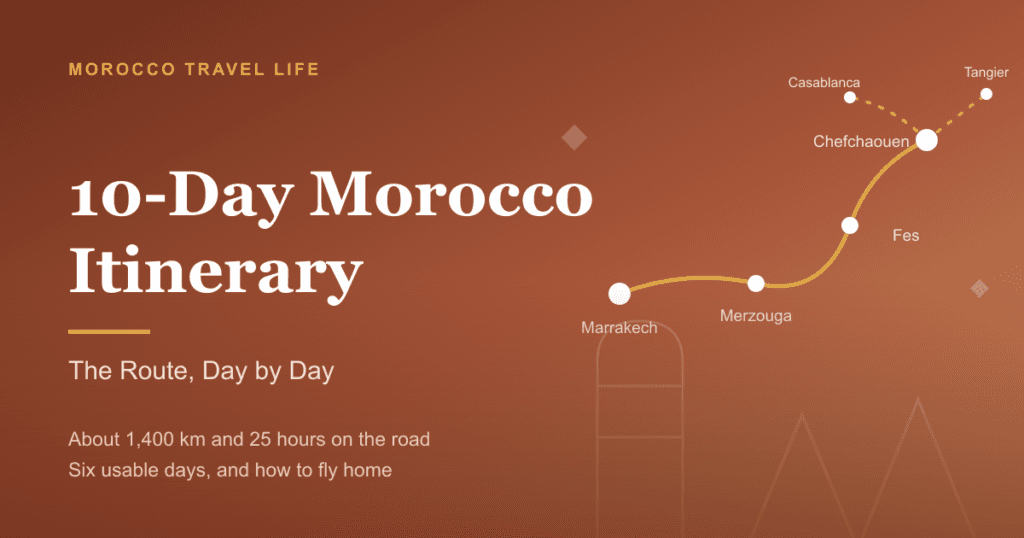
A 10-day Morocco itinerary is the classic seven-day loop plus one region and one spare day, and that’s the whole trick. The extra three days add roughly 300 km and six hours of road, and in return they lift your usable time from about four days to about six. There’s a catch, though: add Chefchaouen and your trip ends in a town with no airport and no railway. So the real decision is your exit airport, not your favourite region. Here’s the route, the exit decision and two alternatives.
Disclosure: Some links in this guide may earn us a commission, at no extra cost to you. It never changes what we recommend.
Key Takeaways
- Ten days is the 7-day loop plus one region and a buffer day: about 1,400 km, 25 hours of road and six usable days.
- From Europe, exit via Tangier, which handled 2.8 million passengers in 2025 (ONDA via Hespress, 2026).
- From long haul, exit via Casablanca: Al Boraq takes 2 hours 10 minutes, from 89 MAD (ONCF Voyages, 2026).
- Give Fes three nights and Chefchaouen two.
- In July, Merzouga averages 43C, so drop the Sahara (weather-and-climate, 2026).
Table of Contents
What Do the Extra Days in a 10-Day Morocco Itinerary Buy You?
The extra three days buy one region and one buffer day, and they take you from about four usable days to about six. Fes to Chefchaouen is 195 km, about 3 hours 54 minutes by car. Chefchaouen to Tangier adds 112 km, about 2 hours 5 minutes (measured on OpenStreetMap routing, September 2026).
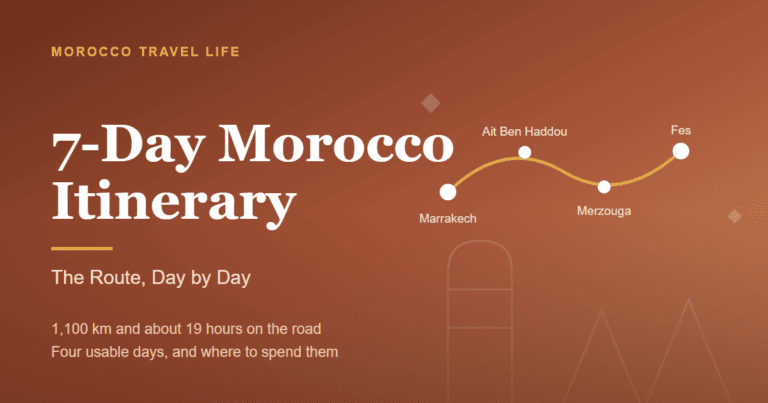
Start with the week you’d have anyway. My 7-day Morocco itinerary, day by day runs about 1,100 km and 19 hours in a vehicle. Days 1 and 7 are half-days around your flights, and days 3 and 5 are long drives. That leaves days 2, 4 and 6 plus two half-days, or about four.
Now add three days. Day 7 becomes a full, unhurried Fes day, and day 8 is a four-hour morning bus to Chefchaouen that still leaves you the afternoon. Day 9 is all yours. Your flight home moves to day 10, which is still a half-day. Net, you gain two to two and a half usable days, so ten days gives you 43% more calendar than seven but about 50% more trip.
That efficiency is why I’d call ten days the best length for a first visit. If you’re still deciding whether ten is right for you, my comparison of 7, 10 and 14 day trips handles that question. This guide assumes you’ve settled it.
Book early either way. In 2025, Morocco received 19.8 million tourists, up 14% (Ministry of Tourism via Hespress, 2026). By the end of August 2026 the count stood at 14.1 million, up 4.5%, and August was the first month ever above 2 million (Hespress, 2026).
Which Airport Do You Fly Home From?
Fly home from Tangier if you’re flying to Europe, and from Casablanca if you’re flying long haul. In 2025, Casablanca Mohammed V handled 11.5 million passengers, 31% of national traffic (maroc.ma, 2025). Tangier handled 2.8 million, almost all of them flying within Europe.
This is the decision that shapes the whole trip, and it has to come before the riads. Chefchaouen has no airport and no train station, so every northern route ends with a transfer. The only question is where that transfer takes you.
Tangier is the easy exit from Europe. Ibn Battouta is two hours from Chefchaouen by road, and its traffic rose 17.1% in 2025 to 2,812,029 passengers (ONDA via Hespress, 2026). Ryanair and Vueling both fly there direct from Europe, as my Tangier guide notes, so a midday flight on day 10 is realistic.
Casablanca is the long-haul exit, and on a northern route it’s the natural one. On a one-week trip I tell North American readers to book a Marrakech return, because the loop ends in Fes and the return is usually simpler and cheaper. Once the route runs north, Casablanca sits on the way home. You reach Tangier and board Al Boraq, Morocco’s high-speed train.
Al Boraq runs to Casablanca in 2 hours 10 minutes (Wikipedia, Al Boraq, 2026). Lead-in fares between Tangier and Casablanca start at 89 MAD, and the airport shuttle train from Casablanca starts at 50 MAD (ONCF Voyages, checked 29 September 2026). Royal Air Maroc flies nonstop to North America from there. It added Los Angeles on 7 June 2026, three flights a week on a 787 (Médias24, 2026).
What about going back to Marrakech? From the north it’s about 6 hours 30 minutes by train today. The high-speed line from Kenitra to Marrakech is only about 30% built and isn’t due until the end of 2029 (Hespress, 2026). If a Marrakech return is all you can book, use Route B further down instead.
| Exit | From Chefchaouen | Flights | Best for |
|---|---|---|---|
| Tangier (TNG) | 112 km, about 2 h by road | Europe, incl. Ryanair and Vueling | Flying from Europe |
| Casablanca (CMN) | 2 h road, then 2 h 10 min on Al Boraq | Long haul, incl. North America | Flying long haul |
| Fes (FEZ) | 195 km, about 4 h back south | Europe and the Middle East | A cheaper Fes fare |
| Marrakech (RAK) | About 8 h 30 min in total | Widest schedule | Nobody. Use Route B |
My Tangier travel guide covers the city if you’d rather add a night there. Every other rail and bus option is in my guide to getting around Morocco.
Days 1 to 6: The 7-Day Route, Unchanged
The first six days are the one-week loop exactly, covering about 1,100 km of road. You spend two nights in Marrakech, one on the road and one in a desert camp, then move on to Fes. I’ve written every stop out, with drive times and dirham costs, in my 7-day itinerary. Here’s the short form.
| Day | Where you sleep | Road | Hours |
|---|---|---|---|
| 1 | Marrakech | Airport transfer | Under 1 h |
| 2 | Marrakech | None | 0 |
| 3 | Dades or Tinghir | Over the Tizi n’Tichka | About 8 h |
| 4 | Merzouga desert camp | Gorges, then the dunes | About 3.5 h |
| 5 | Fes | About 470 km | 7 to 8 h |
| 6 | Fes | None | 0 |
Days 3 and 4 cover about 560 km between them (MerzougaWay, 2026).
Two rules carry over. First, spend day 2 inside one pocket of the medina. My three-day Marrakech sequence shows which one. Second, never book a Sahara tour that leaves on day 2. It turns your only Marrakech day into a driving day. A shared three-day tour to Fes runs roughly €135 to €169 per person (marrakech-desert-trips, 2026), and my Sahara tour comparison prices every format.
Day 7: Why Does Fes Get a Third Night?
Fes gets a third night because day 5 is a write-off. You reach Fes at dusk after about 470 km and seven to eight hours on the road. With two nights, Fes gets one real day, while a third night gives it two and turns it into the buffer for the whole trip.
I’ve learned to protect this day. Desert camps run late and drivers stop longer than planned. Something always slips on the Merzouga leg, and day 7 absorbs it without costing you anything that matters.
If nothing slips, you have two good options. You can take a second, slower day in Fes el-Bali, which has been on the UNESCO list since 1981 (UNESCO). My Fes travel guide covers what to prioritise.
Or you can make the day trip west to Volubilis and Meknes. The Roman ruins at Volubilis were inscribed in 1997 (UNESCO), and the historic city of Meknes in 1996 (UNESCO). That’s two World Heritage sites in one day, with a riad bed waiting back in Fes. The main new cost on day 7 is that extra night. A mid-range riad in the Fes medina runs about 500 to 1,200 MAD (Morocco Travel Life field pricing, July 2026).
What goes wrong here? People try to “save time” by pushing on to Chefchaouen on day 7. It feels efficient, but it isn’t. You arrive tired, you lose the buffer, and one slow camp morning then eats your Chefchaouen evening.
Days 8 and 9: Is Chefchaouen Worth Two Nights?
Yes. The CTM bus from Fes takes about 4 hours 15 minutes and costs around 110 MAD (Morocco Travel Life field pricing, 2026). Leave on the morning bus and you’ll arrive while the day-trip crowds are still in town, with the whole evening ahead of you. Two nights give you two evenings and a morning, which a day trip never does.
That’s the real case for staying. Tour buses from Fes and Tangier arrive around 11am and are gone by early evening, and after they leave the blue lanes go quiet. I’ve come in on the morning bus several times now, and the first hour after the buses leave is still the best part of the visit.
For the leg itself, my Chefchaouen to Fes guide compares the bus, the grand taxi and a private car. Don’t take an afternoon departure, because it puts you on Rif mountain roads after dark.
Day 9 is free, so walk the medina at dawn and then climb to the Spanish Mosque for the view. If you want something bigger, the Akchour waterfalls are about 45 minutes by grand taxi. My Chefchaouen guide covers both.
Rooms are cheaper than in Marrakech or Fes. When I checked 12 properties in July 2026, budget guesthouses started at about 180 MAD a night. Mid-range riads averaged 450 MAD, and upscale riads ran above 700 MAD. Book them early, though. The Tanger-Tetouan-Al Hoceima region logged about 4 million overnight stays in 2025, up 14%, against 9% for Morocco as a whole (FNH, 2026). The north isn’t a quiet secret any more.
Day 10: Getting Out of the North
Chefchaouen to Tangier is 112 km and about 2 hours by road (OpenStreetMap routing, 2026). A midday flight from Tangier works if you leave after breakfast. The Casablanca exit needs the whole day, and the transfer to Tangier is the simple part.
For Tangier, book a private car through your riad for a door-to-door run to the airport. Coming the other way, from Tangier, a shared grand taxi seat costs about 25 to 40 MAD and CTM about 40 to 70 MAD (Morocco Travel Life field pricing, July 2026). Budget about the same in reverse. Both leave you in town, not at the terminal.
For Casablanca, the sequence is road to Tangier, Al Boraq to Casa Voyageurs, then the airport train, from 89 MAD plus 50 MAD in fares. That’s roughly six hours door to door once you add the waits. An afternoon or evening long-haul departure is fine, but a morning one isn’t.
So what if your only long-haul flight leaves in the morning? Then you have two honest choices: fly on day 11, or cut Chefchaouen to one night and sleep near Casablanca or Rabat on night 9. I’d choose the extra day off work every time.
What If You Have to Fly Home From Marrakech?
If you must fly home from Marrakech, keep Fes, take the train back and put your spare nights on the Atlantic coast. ONCF runs direct Fes to Marrakech trains in 6 hours 52 minutes to 7 hours 2 minutes, from 260 MAD in second class (ONCF Voyages, checked August 2026). That’s Route B, and it keeps every highlight of the core loop.
Days 1 to 6 don’t change. On day 7 you ride the train south and sleep in Marrakech. Day 8 is the bus to Essaouira, 185 km and about 2 hours 42 minutes by road (OpenStreetMap routing, 2026). Supratours and CTM both run it in about two and a half to three hours for 100 to 140 MAD. Days 8 and 9 are Essaouira. On day 10 you return to Marrakech for the flight.
Be honest about the cost, because Route B gives up Chefchaouen and spends a whole day on a train. It also drops Fes back to two nights, so you lose the day-7 buffer. In exchange you get a simple Marrakech return and two nights of sea air. My Essaouira travel guide covers the medina, the port and where to stay.
Would you rather climb than swim? Swap Essaouira for Imlil, 68 km and about 1 hour 22 minutes from Marrakech (OpenStreetMap routing, 2026). From there, Mount Toubkal rises to 4,167 m (Wikipedia, 2026). The standard two-day trek fits days 8 and 9 exactly. My Mount Toubkal hike guide explains the licensed-guide checks in place since 2019 and prices the trek at roughly 900 to 1,100 MAD per person in a group of three. For a first trip, I’d still pick the coast or the north.
How Does a 10-Day Morocco Itinerary Change in July and August?
Drop the Sahara, because in July Merzouga averages 43C by day and 29C at night (weather-and-climate, 2026). Essaouira averages 26C and Tangier 29C in the same month. The camel ride and the camp night are the whole point of the desert leg, and at 43C you endure them rather than enjoy them.
Ten days is long enough to rebuild the trip without the desert, and seven days isn’t. Here’s the summer shape I’d use, flying into Tangier from Europe:
| Days | Where you sleep | Getting there |
|---|---|---|
| 1 to 2 | Chefchaouen | 2 h from Tangier airport |
| 3 to 5 | Fes | About 4 h by CTM |
| 6 to 7 | Marrakech | About 7 h by direct train |
| 8 to 9 | Essaouira | About 2 h 42 min by road |
| 10 | Fly from Marrakech | About 2 h 42 min back |
That’s about 18 hours in transit, less than Route A, and seven of those hours are a comfortable train. Fes still reaches 35C and Marrakech 36C in July, so plan the medinas for early morning. Want the desert anyway? Then book it for spring or autumn instead. My guide to the best time to visit Morocco lays out the months.
Frequently Asked Questions
Should I fly into Marrakech or Casablanca for a 10-day trip?
Fly into Marrakech, then out of Tangier from Europe or out of Casablanca from long haul. Casablanca handled 11.5 million passengers in 2025 and carries the North American nonstops. Al Boraq reaches it from Tangier in 2 hours 10 minutes, from 89 MAD (ONCF Voyages, checked September 2026).
Can I do a 10-day Morocco itinerary without a car?
Yes. A shared desert tour covers the only leg that really needs a driver, and trains and buses handle everything else on the route. CTM runs Fes to Chefchaouen in about 4 hours 15 minutes for around 110 MAD. If you’d still rather drive, my guide to renting a car in Morocco covers the roads and the paperwork.
Should I add Chefchaouen or Essaouira on a 10-day trip?
Choose by your flight home first, and then by the season. Chefchaouen suits a Tangier or Casablanca exit and ends 112 km from Tangier airport. Essaouira suits a Marrakech return, at 185 km from the city. In midwinter the Rif is colder and wetter than the coast. My Essaouira guide puts winter days there at around 12C to 13C, so Essaouira makes the stronger case from December to February.
How much does a 10-day Morocco trip cost per person?
Roughly 10,500 to 13,500 MAD mid-range, excluding international flights. Start from about 7,500 MAD for one week with a shared desert tour. Then add 3,000 to 6,000 MAD for the extra three days (Morocco Travel Life field pricing, 2026). My Morocco budget breakdown goes line by line.
Is the Sahara worth it on a 10-day trip in summer?
Not in July or August. Merzouga averages 43C by day and 29C at night in July, and the camel ride and the camp night become something to endure. Ten days gives you room for a desert-free route through Chefchaouen, Fes, Marrakech and Essaouira instead, where Fes, Marrakech and Essaouira average 26C to 36C.
The Short Version
- Ten days means one region plus one buffer day, which gives you about six usable days.
- From Europe, fly into Marrakech and out of Tangier. From long haul, fly out of Casablanca by Al Boraq.
- Three nights in Fes, two in Chefchaouen, and don’t leave Fes early.
- Locked into a Marrakech return? Take the train back from Fes and finish in Essaouira.
- Travelling in July or August? Skip the Sahara and use the summer route.
Pick your exit airport before you book a single riad, because it decides which region you add. Once that’s fixed, the rest of the trip mostly falls into place around it. For visas, money and everything else a first trip needs, start from my full Morocco travel guide.