
Last verified: 26 August 2026. Entry fees and opening hours checked directly against each site’s own ticketing pages, including Morocco’s Ministry of Culture portal. Confirm current rates at the gate.
3 days in Marrakech is enough. But it’s remarkably easy to waste, and the waste rarely happens inside the monuments themselves. It happens in transit, in taxi haggling, and at a locked gate on the one afternoon you’d set aside for it. Most three-day plans group the sights by theme. So they scatter you across a city that was never built on a grid. I’ve walked these routes across several return trips and timed them. What follows is the order that works, what each stop costs in dirhams, and the two booking rules to settle before you fly.
Disclosure: Some links in this guide may earn us a commission, at no extra cost to you. It never changes what we recommend.
Key Takeaways
- Marrakech’s sights fall into three walkable clusters. Give each day one cluster and you’ll save close to an hour a day.
- The three Kasbah-district monuments now cost 100 MAD each for foreign adults, not the 70 MAD still quoted widely (Ministry of Culture, 2026).
- Jardin Majorelle sells tickets online only, in timed slots, and the Yves Saint Laurent Museum closes Wednesdays (Fondation Jardin Majorelle, 2026).
- Budget roughly 1,250 to 4,600 MAD per person for three days, plus a per-night tourist tax collected at your riad.
- A desert overnight doesn’t fit. Ait Benhaddou is about four hours each way.
Table of Contents
Is 3 Days Enough for Marrakech?
Yes for the city itself, and no if you also want a night in the Sahara. Marrakech recorded about 6.05 million overnight stays through the end of May 2026, up 10% year on year, running at roughly 78% occupancy in May (Observatoire du Tourisme, 2026). So that’s the honest reason to book the timed-ticket sites before you arrive, not after.
3 days in Marrakech comfortably covers the medina core, the Kasbah monuments, one garden or museum cluster, and one slower thing like a hammam or a cooking class. And that’s a full trip, not a rushed one.
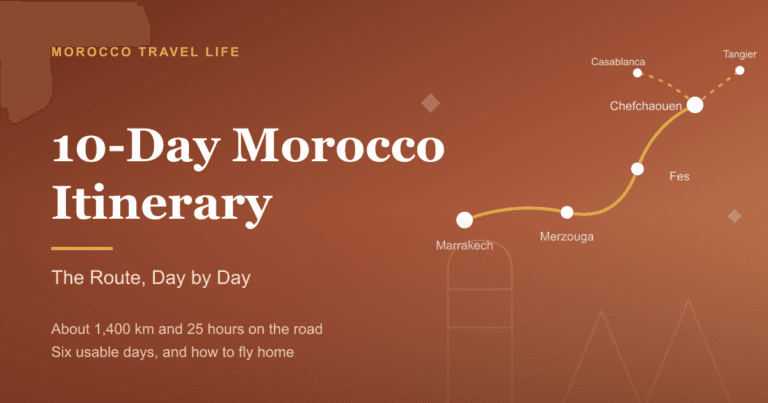
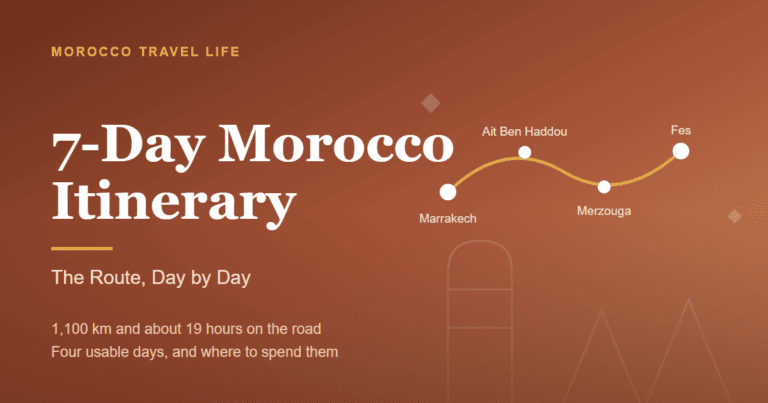
What it doesn’t cover is anything past the High Atlas passes. Merzouga needs two nights at least. Ait Benhaddou sits four hours’ drive each way over the Tizi n’Tichka. So a day trip there costs you eight hours in a vehicle and most of your third day. If the desert is the point of your trip, you need more days. My Morocco itinerary length guide works through the trade-offs, and if you have a full week rather than a long weekend, my 7-day Morocco itinerary runs the whole Marrakech to Fes loop day by day.
Still deciding on the city generally rather than the sequence? My full Marrakech travel guide covers the medina, the souks and the current scams in more depth than an itinerary can.
How Should You Split 3 Days in Marrakech?
Split 3 days in Marrakech by geography, one cluster per day. The sights sit in 3 pockets, and inside each one you walk 5 to 10 minutes between stops. But cross between pockets and it’s a 15 to 20 minute taxi, plus the haggling to get in it. Do that twice a day and the overhead runs close to an hour. That’s a monument you didn’t see (timings taken on foot across return trips, 2026).
Here’s how the pockets actually break down:
| Day | Cluster | Anchor sites | Getting around | Taxi needed |
|---|---|---|---|---|
| 1 | Medina core and north | Ben Youssef Madrasa, souks, Le Jardin Secret, Jemaa el-Fna | On foot | No |
| 2 | Kasbah district, south | Saadian Tombs, El Badi Palace, Bahia Palace | On foot, roughly 10 minutes between sites | No |
| 3 | Gueliz and the Ville Nouvelle | Jardin Majorelle, Yves Saint Laurent Museum, Berber Museum | Outside the walls | Yes |
Now the part almost nobody plans for. A three-day trip has no slack. So one closed door removes a third of your itinerary. These are the fixed constraints worth checking before you book anything:
| Site | Constraint |
|---|---|
| Yves Saint Laurent Museum | Closed Wednesdays. Open 10:00 to 18:30, last entry 18:00 |
| Jardin Majorelle | Tickets online only, timed slots, QR code required |
| Villa Oasis private garden | Closed Wednesdays |
| Bahia, El Badi, Saadian Tombs | 9:00 to 17:00. Free for Moroccan nationals on Fridays, so expect more company |
| Ben Youssef Madrasa | 9:00 to 19:00, shortening to 16:30 during Ramadan |
So the practical upshot is this: if you land on a Tuesday, run Gueliz on your second day and the Kasbah on your third. Otherwise your Gueliz day falls on a Wednesday and the YSL museum is shut.
One more planning input, and it inverts the conventional advice. Marrakech averages 37.7C in July and 37.4C in August on the 1991 to 2020 climate normals. So from June through September, the conventional “souks in the morning, palaces in the afternoon” order is backwards. After all, the open courtyards at El Badi and the gardens have no meaningful shade. Do those early instead, and let the covered souks soak up the worst of the day.
Day 1: The Medina Core, Souks and Jemaa el-Fna
Budget about seven hours, and above all don’t leave the walls. Start at Ben Youssef Madrasa the moment it opens at 9:00, because it’s the finest interior in the medina and it fills up. Entry is 50 MAD for a foreign adult, 10 MAD for children under 12, and it stays open until 19:00 outside Ramadan (Medersa Ben Youssef, 2026).
The madrasa reopened in April 2022 after roughly four years of restoration, and the difference shows. So give it an hour. The courtyard is the photograph everyone wants, but the student cells upstairs are the part I’d come back for.
From there the souks are a five-minute walk south. For now, treat day one as a wander, not a shopping mission. Instead, get your bearings, note which lane you came in by, and save the serious buying for later. If you want to arrive knowing what things should cost, I’ve broken that down in how to haggle in the Marrakech souks.
Then, mid-afternoon, duck into Le Jardin Secret for the heat break. Standard entry is 100 MAD, with the tower a further 40 MAD, and it’s open from 9:30 with closing shifting by season (Le Jardin Secret, 2026).
After that, let the evening come to you at Jemaa el-Fna. The square earned its UNESCO listing on 18 May 2001, as one of the first nineteen Masterpieces of the Oral and Intangible Heritage of Humanity. It moved onto the Representative List in 2008 (UNESCO). Either way, it’s a different place at 8pm than at 10am, and the evening version is the one worth waiting for.
What goes wrong here: walking into the souks without a return anchor. If a stranger tells you the way ahead is closed, or that the square is the other direction, it usually isn’t. So keep walking toward the noise.
Day 2: The Kasbah District Palaces and Tombs
This is your only taxi-free day, and it’s the one where fees have quietly changed. The Saadian Tombs, El Badi Palace and Bahia Palace now each cost 100 MAD for a foreign adult (Ministry of Culture, 2026). Children aged 7 to 13 pay 50 MAD, and all three open 9:00 to 17:00. A great deal of travel writing, including an earlier version of my own city guide, still quotes 70 MAD. But it’s 100.
Two things follow from that, though. The Ministry sells tickets through its own portal, so you can book ahead officially rather than through a reseller. And entry is free for Moroccan nationals on Fridays, which makes Friday the busiest day at all three.
So go in this order. Saadian Tombs first, at opening, because the burial chamber is a single narrow corridor and the queue moves slowly once tour groups arrive. Then El Badi, five minutes’ walk north, where the ruin is mostly open sky and storks nest on the walls. Finish at Bahia Palace, whose painted ceilings and zellige courtyards are the most intact of the three.
Altogether, allow four to five hours for all three at an unhurried pace. And if you want a fourth, Dar Si Said is nearby, though it’s shut on Tuesdays.
Day 3: Gardens and Gueliz, or a Day Trip?
Default to Gueliz, and book it before you fly. Jardin Majorelle sells tickets online only, in timed slots tied to a QR code (Fondation Jardin Majorelle, 2026). And the foundation says plainly that tickets from other sites will not get you in. Even so, same-day slots sell out in peak season. The garden runs around 170 MAD. The Yves Saint Laurent Museum is priced separately, and combined passes are available. But those figures only appear inside the official booking flow. So budget generously and confirm there.
The museum is closed Wednesdays and otherwise open 10:00 to 18:30, last entry 18:00 (Musée Yves Saint Laurent Marrakech, 2026). In practice, that single closure is the most common way a three-day plan falls apart.
If you’d rather leave the city, keep it to a genuine half-day. Ourika Valley and the Agafay stone desert both work; Ouzoud, Ait Benhaddou and any desert overnight do not. I’ve ranked all of them, with drive times and prices, in the day trips worth taking from Marrakech.
There’s a third option, and it’s a real one. On a short trip, dedicating your last day to a hammam or a cooking class beats a fourth set of monuments. By then you’ve already seen the city. Sitting still in it is a different thing, and it’s the day people tend to remember.
What goes wrong here: booking a full-day excursion on your departure day and then racing an evening flight through Friday traffic.
What Do 3 Days in Marrakech Cost?
Plan on 1,250 to 4,600 MAD per person for 3 days in Marrakech, excluding flights (Morocco Travel Life field pricing, checked August 2026). Entry fees for the whole route come to about 520 MAD if you do everything. So the monuments are a smaller share of the trip than most people expect. Instead, accommodation and food carry the real weight.
| Per person, 3 days | Budget | Mid-range | Comfort |
|---|---|---|---|
| Accommodation | 450 | 1,050 | 2,250 |
| Entry fees | 350 | 520 | 620 |
| Food | 300 | 600 | 1,200 |
| Transport | 150 | 280 | 500 |
| Total (MAD) | 1,250 | 2,450 | 4,570 |
Mid-range and comfort assume two people sharing a room, since riads price per room rather than per person. Travelling alone, expect to pay close to the full room rate. A comfortable mid-range riad in the medina runs 500 to 900 MAD a night, and my Morocco travel budget guide puts those numbers in national context.
One line item almost nobody mentions: the tourist tax. Moroccan municipalities charge a per-person, per-night fee on licensed accommodation. In Marrakech it arrives as two items, a municipal tax plus a tourism promotion levy. Together they land around 15 to 30 MAD per person per night, depending on the establishment’s grade. You pay it at check-in, and it’s rarely in the rate you booked. So over three nights for two people, that’s a real number to have in your pocket.
For rough conversion I use 10 dirhams to the dollar. It isn’t the exact rate, but it’s close enough to check a price while you’re standing in front of it.
How Do You Get Around During 3 Days in Marrakech?
Across 3 days in Marrakech, the airport transfer is the only leg worth arranging in advance. Everything after it is walkable or a short ride. Marrakech Menara sits about 6 km from the medina, and it’s busier than it used to be. The airport handled 10,197,736 passengers in 2025, its first year above ten million and up 10.09% on 2024. It took another 5,636,776 in the first half of 2026 alone. That’s roughly 28% of Morocco’s air traffic, second only to Casablanca (ONDA figures, 2026).
So you have three sensible options. ALSA line 19 runs from the airport to near Jemaa el-Fna for about 30 MAD one way, every 30 minutes or so, taking 25 to 40 minutes. Meanwhile a metered petit taxi is quicker. Or pre-book a transfer, which I’d do for a late arrival, because your first hour shouldn’t be spent negotiating.
About that haggling. A fair daytime petit taxi from the airport into the medina runs 70 to 80 MAD on the meter. If a driver tells you the meter’s broken, that’s the opening move, not a fact. Ask for the meter. If it stays broken, take the next taxi. Night fares legally carry a surcharge. So a 100 MAD ride after dark is reasonable, though a 200 MAD one isn’t.
Uber works in Marrakech again. It returned to Morocco in November 2025 after an eight-year absence, and now covers five cities. It’s metered, tracked and cashless, so there’s no negotiation at all. I’d use it. But I’ll be straight with you: ride-hailing still sits in a legal grey zone, and the Ministry of Transport declined to license app-based services in October 2025. It works today. Its legal status remains unresolved.
In any case, inside the medina nothing needs a vehicle. My guide to getting around Morocco covers the intercity picture if Marrakech is one stop on a longer trip.
Frequently Asked Questions
Is 3 days enough for Marrakech?
Yes for the city itself. Three days covers the medina, the Kasbah monuments, a garden cluster and one slower experience at a comfortable pace. It isn’t enough to add a Sahara overnight, which needs two nights minimum, or Ait Benhaddou at roughly four hours’ drive each way.
Can you do a desert trip in 3 days from Marrakech?
Not a real one. Merzouga and Zagora both require an overnight, and Ait Benhaddou costs about eight hours of driving for a single day. What does fit is a half-day trip to the Ourika Valley or the Agafay stone desert, both of which return you to Marrakech by evening.
What is the best order to spend 3 days in Marrakech?
Give each day one geographic cluster. Day one covers the medina core, day two the Kasbah district monuments, and day three Gueliz for Jardin Majorelle and the Yves Saint Laurent Museum. If you arrive on a Tuesday, swap days two and three, because the YSL museum closes Wednesdays.
How much does 3 days in Marrakech cost?
Budget roughly 1,250 MAD per person at the low end and about 4,570 MAD for a comfortable trip, excluding flights. Entry fees total around 520 MAD for the full route. Add a per-person tourist tax of roughly 15 to 30 MAD per night, collected at your accommodation and rarely included in the booked rate.
Do you need to book Marrakech attraction tickets in advance?
Jardin Majorelle and the Yves Saint Laurent Museum sell tickets online only, in timed slots, and same-day availability disappears in peak season. The Kasbah monuments can be bought at the gate or through Morocco’s Ministry of Culture portal. Ben Youssef Madrasa and Le Jardin Secret are walk-up.
The Short Version
In the end, 3 days in Marrakech goes furthest when you stay still. The city’s sights sit in three walkable pockets, and once you stop crossing between them, three days stops feeling tight and starts feeling generous.
- Split 3 days in Marrakech by cluster: medina core, Kasbah district, then Gueliz.
- Check two things before you book: Wednesday closures, and Majorelle’s online-only timed tickets.
- Budget 1,250 to 4,570 MAD per person, and expect a tourist tax at check-in.
- Skip the desert. It doesn’t fit, and pretending otherwise costs you a day in a van.
If you’re building the rest of the trip around this, my full Marrakech travel guide goes deeper on the medina, the souks and the scams. And the day trips worth taking covers what to add if you find yourself with a fourth day.