
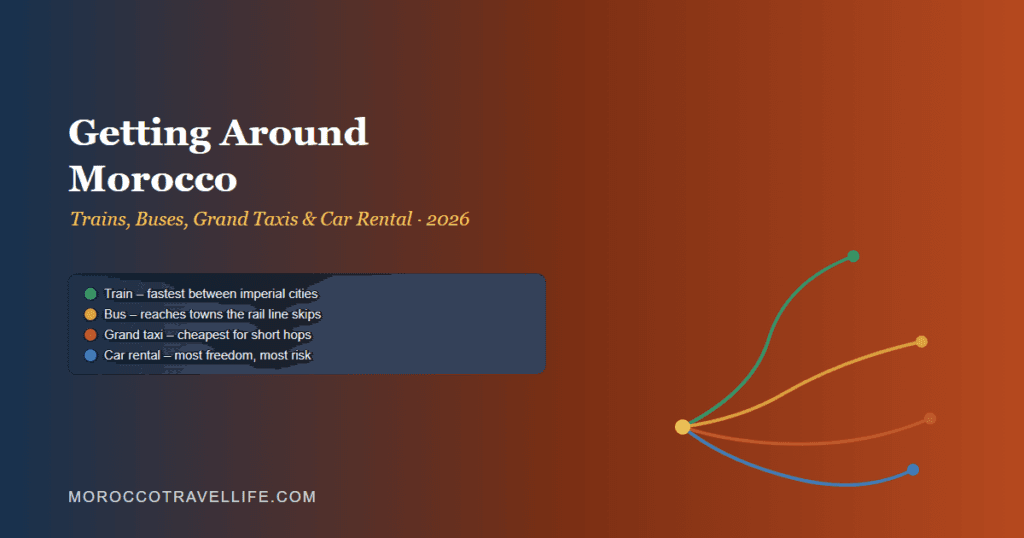
Working out how to get around Morocco comes down to four real options, not two: ONCF trains, CTM and Supratours buses, shared grand taxis, and rental cars. Picking the wrong one for your route is the fastest way to lose a full day of a short trip. In 2026, ONCF is mid-way through a 430-km Kenitra–Marrakech expansion that will eventually bring Al Boraq high-speed service south. Until it opens, each mode still covers genuinely different ground (Morocco World News, 2026).
Disclosure: Some links in this guide may earn us a commission, at no extra cost to you. It never changes what we recommend.
I’ve used all four ways of getting around Morocco, often on the same trip. There’s the train between imperial cities, a grand taxi to a village with no bus stop, and a rental car for an Atlas Mountains detour no public transport reaches. This guide breaks down how to get around Morocco by cost, speed, coverage, and how easy each option is to book as a foreign visitor.
Key Takeaways
- Trains win for comfort and reliability between Morocco’s major cities; the Al Boraq high-speed line covers Tangier–Casablanca in 2 hours 10 minutes at up to 320 km/h (Morocco World News, 2026).
- Grand taxis are the cheapest way to get around Morocco for short regional hops, with shared seats typically running 25–120 MAD (Morocco Travel Life field pricing, 2026).
- CTM and Supratours buses reach towns trains don’t: Chefchaouen, Essaouira, and the Sahara gateways all depend on bus, not rail, access.
- Car rental gives the most freedom but carries real risk: Morocco recorded 4,024 road traffic deaths in 2024, up 5.37% year-over-year (Morocco World News, 2025).
- No single mode covers the whole country; most experienced travelers mix at least two, typically train or bus between cities plus a rental car or private driver for mountain and desert detours.
Table of Contents
How to Get Around Morocco: Comparing the Options at a Glance
Each mode wins on a different dimension, so the “best” option depends entirely on your route. Trains are the most comfortable and reliable but only reach seven cities on the current network. Grand taxis and buses fill in almost everywhere else, and a rental car is the only way to genuinely go off-script.
| Category | Grand Taxi | Bus (CTM/Supratours) | Train (ONCF) | Car Rental |
|---|---|---|---|---|
| Best For | Short regional hops, village access | Towns off the rail network | Imperial city-to-city travel | Mountain/desert detours, flexibility |
| Typical Cost | 25–120 MAD/seat | 80–250 MAD | 50–220 MAD (2nd class) | 250–2,700+ MAD/day |
| Booking | Cash, in person, no advance booking | Website/app, advance seats | oncf.ma or app, e-ticket | International sites, credit card |
| Comfort | Basic, no seatbelts common | Reserved seats, A/C | Air-conditioned, spacious | Depends on vehicle |
| Route Coverage | Very high (village-level) | High (most towns) | Limited (7 major cities) | Unlimited (self-directed) |
| English Ease | Low; need basic French/Arabic | Medium | High | High |
| My Verdict | Win on price and reach | Win on network breadth | Win on comfort and speed | Win on freedom, loses on safety |
Sources: Morocco Travel Life field pricing, cross-checked against ONCF, CTM, and 2026 rental-platform published fares.
Which Is Cheapest for Getting Around Morocco?
Grand taxis win on price, undercutting every other option for short-to-medium regional routes. A shared seat in one of Morocco’s six-passenger sedans or minivans runs 25–120 MAD depending on distance: a Fes–Meknes hop lands around 30–50 MAD, while Casablanca–Rabat runs 40–60 MAD per seat (Morocco Travel Life field pricing, 2026).
Buses come next, with CTM and Supratours fares running 80–250 MAD depending on distance and whether you book an overnight route. ONCF second-class train tickets sit in a similar 50–220 MAD band for most inter-city routes. Car rental is the priciest baseline option, starting around 250 MAD/day before fuel, tolls, and insurance.
Grand taxi fares are fixed per route and rarely negotiable once you find the right rank, so the “tourist tax” people worry about mostly applies to private charters, not shared seats. Ask your riad the going rate before you go, then confirm it with two drivers at the stand; it should match almost exactly.
Which Is Fastest for Long-Distance Travel?
The Al Boraq high-speed train wins decisively on its own corridor. It covers Tangier to Casablanca in 2 hours 10 minutes at speeds up to 320 km/h, making it Africa’s only high-speed rail line (Morocco World News, 2026). The same route takes a CTM or Supratours bus roughly 5-6 hours, and a self-drive car around 4 hours via the toll autoroute, more once you account for fuel stops and Casablanca traffic.
Outside the Al Boraq corridor, standard ONCF trains still beat buses on comfort and reliability for routes like Marrakech–Casablanca, typically 2h45-3h versus 3.5-4h by bus. Grand taxis aren’t built for distances this long; they’re a regional tool, not an inter-city one.
Which Option Reaches the Most Places?
Grand taxis and buses win on coverage, together reaching almost every town and village the train network skips entirely. ONCF trains connect only seven major cities along a roughly 2,000+ km spine: Tangier, Rabat, Casablanca, Marrakech, Fes, Meknes, and Oujda. Chefchaouen, Essaouira, and the Sahara gateway towns have no rail access at all (Wikipedia, 2026).
CTM and Supratours together control roughly 80% of Morocco’s express intercity bus market, and Supratours in particular is built to extend ONCF’s reach, connecting train stations to towns the rail line doesn’t serve. Grand taxis go a level deeper still, running fixed routes between towns and villages that don’t get scheduled bus service at all.
The pattern I’d point first-timers to: train for the spine of your trip, bus for the well-known detours like my Chefchaouen travel guide covers, and grand taxi for the last leg nobody plans for. That’s the 20-minute hop from a bus station to a trailhead, or a rural riad that no scheduled service touches.
Which Gives You the Most Freedom, and What Does It Cost?
Car rental wins on flexibility, and it’s the only mode that lets you stop wherever you want: a viewpoint in the Atlas Mountains, a roadside argan oil cooperative, a detour that isn’t on any tour itinerary. Economy cars like a Dacia Sandero start around 250 MAD/day. Midsize SUVs like a Dacia Duster run from about 500 MAD/day, and peak summer season (July-August) can push rates for larger or luxury vehicles as high as 2,700 MAD/day (Morocco Travel Life field pricing, cross-checked against 2026 rental listings).
An International Driving Permit isn’t strictly mandatory if your home license is printed in the Roman alphabet. Police at checkpoints routinely ask for one anyway, though, and it’s worth the roughly $20 cost for peace of mind. My full guide to renting a car in Morocco covers the documents, the deposit and the road rules.
The freedom comes with a real trade-off. Morocco recorded 4,024 traffic deaths in 2024, up 5.37% from the year before, and authorities rolled out an emergency summer road safety program in response to the spike (Morocco World News, 2025). Mountain-pass driving, unlit rural roads at night, and unpredictable overtaking are the specific hazards first-time renters underestimate most; read my Morocco safety guide before you book a self-drive itinerary.
Which Is Easiest to Book as a Foreign Tourist?
Trains win on booking ease, with an English-language website and app (oncf.ma) that accept international cards and issue a phone e-ticket: no queuing, no cash, no language barrier. Buses come second: CTM and Supratours both run bookable websites, though seat selection and station pickup details are less polished than the train app.
Grand taxis are the hardest to book precisely because they aren’t bookable at all. You show up to the rank, confirm the fare, and wait for the vehicle to fill, or pay for the empty seats yourself to leave immediately. Car rental sits close to trains for ease, since international booking platforms and major agencies process cards and English-language paperwork the same way they would at home.
Who Should Choose What?
- First-timers sticking to the imperial cities: Choose trains for the spine of your trip (Casablanca, Rabat, Fes, Marrakech), with a grand taxi or petit taxi for the last mile. It’s the lowest-friction combination for a first Morocco trip.
- Budget backpackers: Choose buses and grand taxis. CTM/Supratours covers the well-known routes cheaply, and grand taxis fill every remaining gap for a fraction of a rental car’s daily cost.
- Families and comfort-focused travelers: Choose trains between cities. Then book a private driver (not a self-drive rental) for the Sahara desert tour or Atlas Mountains legs. You get the flexibility of a car without taking on the driving risk yourself.
- Independent road-trippers with driving experience: Choose car rental, but budget real time for mountain-pass driving and avoid night driving on rural roads entirely; that’s where the accident risk concentrates.
Frequently Asked Questions
Do I need to rent a car to get around Morocco?
No. This guide already covers how to get around Morocco without a rental car: trains connect the major imperial cities, CTM and Supratours buses reach towns the rail network skips, and grand taxis fill in the rest. A rental car adds flexibility for mountain and desert detours but isn’t necessary for a standard first-time itinerary.
Is the Al Boraq high-speed train worth the extra cost?
Yes, for the Tangier–Casablanca corridor specifically: it covers the route in 2 hours 10 minutes versus 5-6 hours by bus, for a fare of roughly 100–320 MAD depending on how far ahead you book (ONCF published fares, 2026). Outside that corridor, standard ONCF trains are the better comparison, not Al Boraq.
Are grand taxis safe for tourists?
Generally yes for short, well-established routes, though older vehicles sometimes lack seatbelts and driving standards vary. Confirm the fare before boarding, and consider sitting up front if that’s more comfortable; many women travelers prefer it. Private charters cost 5-6 times the shared-seat price but let you skip waiting for the vehicle to fill.
Do I need an international driving permit to drive in Morocco?
Not strictly, if your home license is printed in the Roman alphabet, but police at checkpoints routinely ask for one anyway, and it costs only about $20 from your home country’s automobile association. Licenses in non-Latin scripts need an official translation or an IDP.
What’s the best way to get from the airport into the city?
For Marrakech and Casablanca, ONCF trains or a pre-booked petit taxi are the most reliable options; agree the fare before getting in if the meter isn’t used. Ride-hailing coverage is limited outside the biggest cities, so don’t count on an app-based pickup everywhere.
Verdict: Which Should You Choose?
Here’s how to get around Morocco reduced to a single table, mode by mode:
| Category | Winner |
|---|---|
| Cheapest | Grand taxi |
| Fastest (long-distance) | Al Boraq / train |
| Widest coverage | Bus + grand taxi |
| Most freedom | Car rental |
| Easiest to book | Train |
| Overall (first-timer) | Train + grand taxi combination |
There’s no single answer to how to get around Morocco. There’s only the right combination for your route. Trains are the backbone for city-to-city travel, buses and grand taxis fill in almost everywhere else, and a rental car earns its cost only if your itinerary genuinely needs mountain or desert detours a driver can’t provide more safely.
Build your transport plan around your Morocco itinerary length and price it against the real dirham budget breakdown before you commit to a rental car; for most first trips, the train-and-taxi combination costs less and adds less stress. Start from the complete Morocco travel guide if you’re still working out the rest of your trip.