
Last verified: 26 August 2026. I re-check the camel trek tiers, the 4×4 quote ranges and the Merzouga camp rates against operators’ own published pages. Conversions use 1 EUR = 10.7 MAD and 1 USD = 9.3 MAD, so treat dirham figures as approximate.
Almost every traveler I meet in Marrakech asks me the same thing within ten minutes. Which Sahara desert tour should we actually book? There’s no single right answer. There is a wrong way to decide, though. Picking by the prettiest photo in an operator’s Instagram feed tells you nothing about what you’re paying for, and even less about what you’ll be doing at 4am when the alarm goes off for sunrise.
Disclosure: Some links in this guide may earn us a commission, at no extra cost to you. It never changes what we recommend.
I’ve arranged or joined Sahara desert tours for friends, family and readers more times than I can count. That covers all three formats this post compares. Operators rarely explain the real trade-offs. Every package bundles a camel ride, a 4×4 transfer and a camp stay. Then it calls the whole thing “the Sahara experience.”
Those are three genuinely different products with three different price tags. This guide prices each one separately, in current 2026 dirhams, so you can build the combination that fits your trip instead of accepting whatever the standard package assumes you want.
Morocco’s desert regions are having a real moment. The country logged 7.7 million tourist arrivals in the first five months of 2026 alone (Morocco World News, 2026). That’s a 7% rise on the same period in 2025, and it builds on a record 19.8 million visitors across all of 2025 (ATTA, 2026). The Sahara gateway towns are absorbing a good share of that growth. More operators, more package variations, more room for confusion about what you’re actually booking.
Key Takeaways
- A standalone camel trek runs roughly 535-1,605 MAD per person for one to three nights under canvas (Camel Trips Sahara, 2026). It’s the cheapest way into the dunes.
- A private 3-day/2-night Sahara desert tour by 4×4 from Marrakech runs 4,185-7,440 MAD per person mid-range. The private-luxury tier runs 11,160-23,250 MAD (Morocco Travel Life field pricing, 2026). That transfer is the spine of my 7-day Morocco itinerary.
- A luxury desert camp night alone, without transport, runs 4,000-7,300 MAD, based on one Merzouga operator’s published 2026 room rates (Merzouga Luxury Desert Camps, 2026).
- Morocco has no comprehensive animal welfare act covering working animals, and no government body is formally tasked with welfare oversight (World Animal Protection, Animal Protection Index, 2026). That makes operator selection, not price, the real ethical filter for camel treks.
- Most travelers get the best Sahara desert tour by combining formats rather than picking one. A 4×4 transfer to reach the dunes, then a short camel ride into camp, is both the standard and the smart default.
Sahara Desert Tour Morocco
Camel Trek, 4×4, or Luxury Camp: Which Sahara Desert Tour in Morocco Fits Your Trip?
These three options solve different problems. Almost no Sahara desert tour is purely one of them. A “camel trek” usually means a 4×4 drove you most of the way, and you rode the last 20-45 minutes into camp. A “luxury camp” package still needs a vehicle to get you there.
The real decision isn’t which single format to book. It’s how much time, comfort and budget you give each layer of the trip. Desert nights run cold at every tier, so pack for it. My Morocco packing list covers layering by season.
Think of it as three dials rather than three competing tours. One dial is how far you travel by camel versus by vehicle. The other is how comfortable your camp is once you arrive. The rest of this guide prices each dial on its own. Then it shows how they usually combine.
Camel Trek Pricing in 2026: What a Night Under Canvas Actually Costs
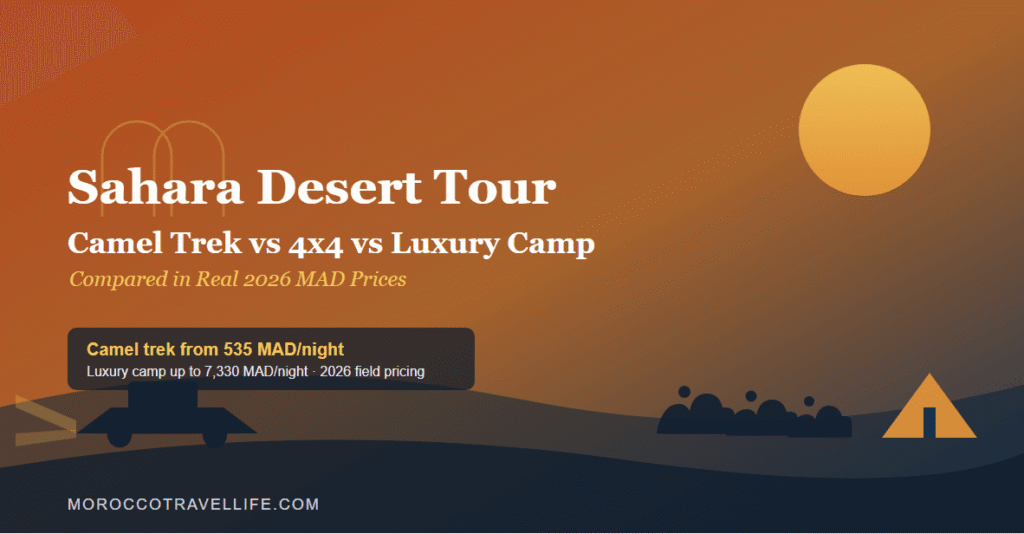
A standalone camel trek runs 50-150 EUR, roughly 535-1,605 MAD, per person. That’s a multi-day trek booked in its own right, not a one-hour add-on. The spread depends on how many nights you spend in the dunes. Figures come from a Merzouga-based operator’s 2026 pricing (Camel Trips Sahara, 2026).
The tiers break down cleanly. An overnight “Classic” trek costs 50 EUR (~535 MAD). A one-day, one-night version costs 70 EUR (~750 MAD), a two-night “Experience” runs 120 EUR (~1,285 MAD), and a three-night “Nomads” trek costs 150 EUR (~1,605 MAD). A short sunset or sunrise ride is the version bundled into most standard packages. It adds about 20 EUR (~215 MAD) on top of a base tour (Camel Trips Sahara, 2026).
The riding portion of a typical Sahara desert tour package runs closer to 6.5 hours in total including rest stops, part of which is spent walking alongside the animal whenever your legs need a break (Morocco Travel Life field notes, 2026).
Here is what the marketing photos never show. A camel trek looks romantic. For most first-timers it turns genuinely uncomfortable after about 45 minutes. The gait rocks your hips in a way nothing prepares you for, and by the second hour most guests care more about getting off than about the view.
So I tell people to treat the sunset or sunrise ride as the highlight, not the whole afternoon. For any real distance, add a 4×4 leg. Trying to camel-trek the entire approach to camp rarely ends the way the brochure suggests.
Camel trekking is the cheapest and slowest way to do a Sahara desert tour. It’s also the only format that puts you inside the landscape instead of looking at it through a window. It suits travelers who want the classic Sahara image more than speed or physical comfort, and it works best as a 20-45 minute bookend rather than as your main transport.
4×4 Desert Tours: What You’re Paying For Beyond the Camel Ride
A private 3-day/2-night 4×4 Sahara desert tour from Marrakech is the most common way to reach Merzouga or Zagora, and prices swing hard on group size and vehicle exclusivity. Budget shared minibus tours run 840-1,860 MAD per person. A standard shared tour in a smaller group runs 1,860-3,255 MAD. A private mid-range 4×4 with a comfort camp runs 4,185-7,440 MAD. The private luxury version runs 11,160-23,250 MAD. All four figures come from quotes I collected from Marrakech operators in 2026 (Morocco Travel Life field pricing, 2026).
I checked directly with a handful of Marrakech-based operators this year and found a consistent pattern. Private 4×4 quotes for foreign travelers routinely open 20-30% above what a Moroccan resident would pay. Same 3-day route, same vehicle, same driver, before any negotiation (Morocco Travel Life field pricing, 2026). The gap narrows fast when you book on a personal recommendation. It stays wide at the walk-in agencies near Jemaa el-Fna.
So what does the price difference actually buy? A private 4×4 gets you your own vehicle and driver-guide. No 15-seat minibus, no strangers, no one else’s schedule.
You also get air conditioning that holds up across a long desert drive. And you get detours. Erg Chigaga sits beyond M’Hamid and needs a further 4×4 leg that a fixed-route shared tour won’t make. This is also the format that covers the most ground, since a 4×4 reaches remote dune fields and kasbah stops a camel simply can’t get to in any reasonable time.
This format suits travelers who want the route as much as the destination: the Dades Valley, Aït Benhaddou, the Tizi n’Tichka pass. It also suits anyone short on time. Covering 500+ km in a controlled, air-conditioned way beats a slow multi-day camel approach when the clock is tight.
How Much Is a Luxury Desert Camp in Merzouga, Really?
Luxury camp pricing on a Sahara desert tour splits into two distinct tiers. Standard “luxury” camps across Merzouga and Zagora run 1,800-5,500+ MAD per night. That’s the tier bundled into most private mid-to-high-end packages, priced from direct checks with camp operators in both towns (Morocco Travel Life field pricing, 2026). It matches the field data behind my Merzouga vs Zagora gateway comparison.
Above that sits a smaller ultra-luxury segment. One Merzouga operator publishes 2026 room rates starting at 375 EUR (~4,010 MAD) for its standard “Experience” tent. Its top-tier “Serenity” and private-camp tents run 650-685 EUR (~6,955-7,330 MAD), and those are camp-only rates, quoted before any transport or guiding (Merzouga Luxury Desert Camps, 2026).
What separates a 5,000 MAD night from a 500 MAD one is a handful of concrete swaps. A private en-suite bathroom with hot water, not a shared block. A real bed, not a foam mattress on the floor. A gourmet multi-course dinner service, not a shared communal tagine.
Often there’s a private deck or lounge area too, rather than a shared central fire pit. Wi-Fi and reliable electricity for charging phones and cameras are close to universal at this tier. Below it, they’re close to nonexistent.
Luxury camps suit couples, honeymooners and comfort-focused travelers who want the dune views and the Sahara silence without giving up a proper bed or a hot shower. My Sahara desert camps compared guide breaks down budget, mid-range and top-tier camps night by night.
Sahara Tour Types Compared: Price, Duration, and Comfort Side by Side
Side by side, the three formats separate on price more than on anything else. A standalone camel trek starts around 535 MAD. A budget shared 4×4 starts around 840 MAD. A single luxury camp night starts at 1,800 MAD, before you have even reached it.
| Tour Type | Typical Price (per person) | Duration | Comfort Level | Best Suited To |
|---|---|---|---|---|
| Camel trek (standalone) | 535-1,605 MAD (1-3 nights) | 1 hour add-on to 3+ nights | Low: shared Berber tent, no shower | Purists wanting the classic image, budget travelers |
| 4×4 desert tour (3-day/2-night) | 840-23,250 MAD depending on tier | 2-5 days, most commonly 3 days | Low to high, tier-dependent | Time-limited travelers, those who want to see the route (kasbahs, valleys) |
| Luxury desert camp (per night) | 1,800-7,330 MAD | 1-2 nights within a larger trip | High: en-suite bath, real bed, gourmet meals | Couples, comfort seekers, special occasions |
Sahara desert tour prices come from operators’ own published 2026 rates (Camel Trips Sahara, Merzouga Luxury Desert Camps) for the tiers attributed to them. Conversions use approximate July 2026 rates of 1 EUR = 10.7 MAD and 1 USD = 9.3 MAD. All 4×4 and standard-tier camp figures reflect Morocco Travel Life field pricing from quotes collected in Marrakech.
Is Camel Trekking in Morocco Ethical?
This deserves a direct answer, not a dodge. Camel treks are baked into most Sahara desert tour packages. Protection for working animals runs through narrow Criminal Code provisions rather than a dedicated welfare act. A draft welfare bill produced in 2013 was never enacted, and no government body has been formally tasked with broader welfare oversight (World Animal Protection, Animal Protection Index, 2026). In practice, that leaves the standard of care almost entirely with individual operators.
A 2025 PETA Asia investigation documented real abuses at some operations. Animals were tied on short ropes with no shelter from the heat, and working camels were retired through slaughter after a few years of service rather than cared for long-term (PETA, 2025). PETA’s position is that no traveler should ride a camel anywhere, full stop.
I don’t think that’s the only responsible conclusion. I do think it’s fair pressure. Camel treks are a real source of income for desert communities where alternatives are limited. A blanket boycott can hurt exactly the families a Sahara desert tour is supposed to support. The more useful response is picking your operator carefully rather than avoiding the experience entirely.
When I vet an operator, I look at four things:
- Camels that are visibly well-fed, with no sores under the saddle pad.
- Animals resting in shade with water access through the hottest midday hours, rather than working straight through.
- Sessions capped at 2-3 hours, with breaks built in.
- A real rotation, so the same few animals aren’t working every single group, every single day.
None of that shows up in a tour listing’s price or star rating. So ask your riad or your driver directly. Which operator would they send their own family to?
If the ethics still don’t sit right with you after that, the honest alternative is simple. Skip the camel leg and do the whole Sahara desert tour by 4×4. Most operators accommodate that without fuss.
Which Tour Type Fits Which Kind of Traveler?
Fit depends less on your budget than on what you would resent losing: time, comfort, or the classic image. These are the five traveler types I get asked about most, and the pairing I would point each one toward.
| Traveler Type | Best Fit | Why |
|---|---|---|
| Backpacker or tight budget | Camel trek + budget shared 4×4 | Cheapest combination, still delivers the core experience |
| Couple or honeymoon | 4×4 transfer + luxury camp | Comfort and privacy matter more than saving on the vehicle |
| Family with kids | Private mid-range 4×4 | Own vehicle and schedule, camp tier flexible to budget |
| Photographer or purist | Longer camel trek (2-3 nights) | More time actually inside the dune landscape, away from vehicle noise |
| Time-limited (2-3 days total) | Zagora-route private 4×4 | Shorter drive from Marrakech than the Merzouga route |
Can You Combine a Camel Trek With a Luxury Camp on the Same Trip?
Yes. Most well-designed Sahara desert tour packages already do it without spelling it out. A private or shared 4×4 handles the long haul between Marrakech and the desert region. A short camel trek, usually 20-45 minutes at sunset, covers the final approach into camp, and you then spend the night at whatever comfort tier you’ve booked.
This is the combination I recommend to almost everyone who asks me directly. Private 4×4 for the drive, so you’re not stuck on a stranger’s schedule. Camel trek kept short, treated as the sunset photo moment it’s best at. Camp tier chosen on how much comfort actually matters to that particular traveler.
Splitting the decision this way beats picking one “type” of tour. Across dozens of trips, it has consistently produced the best experience-to-cost ratio I’ve seen.
The one real exception is the dedicated multi-night camel trek. It’s aimed at travelers who specifically want extended time on the animal and away from any vehicle. Niche, but real. That’s why it’s priced separately from standard Sahara desert tour packages.
Which Desert Gateway Town Should You Book Through?
Every Sahara desert tour in this guide gets booked through one of two gateway towns: Merzouga or Zagora. The town shapes your options as much as the tour type does. Merzouga sits right against Erg Chebbi’s tall dunes, with camps pitched at the edge of town. Zagora is a shorter drive from Marrakech, but its best dunes at Erg Chigaga need a further 4×4 transfer from M’Hamid.
My Merzouga vs Zagora: Choosing Your Sahara Desert Gateway guide breaks down the distance, the dune quality and the town-specific camp pricing. The two guides pair naturally. Pick your gateway town there, then come back here to decide how you get into the dunes and where you sleep. Both towns support all three tour types covered here, so nothing in this guide is exclusive to one route.
For the wider picture, my full guide to the best things to do in Morocco covers where a Sahara desert tour fits. It sits alongside hiking, cooking classes and day trips from Marrakech.
Frequently Asked Questions
How many days do I need for a Sahara desert tour?
Three days and two nights is the practical minimum for a Sahara desert tour to Merzouga’s Erg Chebbi dunes. That’s enough to drive out from Marrakech, sleep one night in the desert and return, and any less means spending more time in transit than you spend in the sand. A Zagora-route tour can work in as little as two days, thanks to its shorter drive. Most travelers still find three more comfortable.
Is a 4×4 desert tour or camel trek better for someone who gets motion sick?
Neither leg of a Sahara desert tour is entirely motion-free. A private 4×4 with a driver who knows the route tends to be smoother than a shared minibus, and you can ask for stops as needed. A camel’s gait is slow and rocking rather than jarring. Some motion-sensitive travelers find that easier to handle than a bumpy vehicle ride. It’s a different kind of discomfort, in your hips and lower back, rather than none at all.
Do luxury desert camps have Wi-Fi and electricity?
Most do at the higher-end tier of a Sahara desert tour described in this guide, including reliable outlets for charging phones and cameras. Budget and standard camps typically don’t. Confirm directly with your operator if staying connected matters for your trip.
Can I do a Sahara desert tour as a day trip from Marrakech without an overnight?
Not to Merzouga or the real Sahara dunes. The round-trip drive alone exceeds what’s realistic in a single day. The closer option is the Agafay “mini desert” near Marrakech, which works as a genuine day trip or overnight. It isn’t the same landscape as Erg Chebbi or Erg Chigaga, though. Don’t confuse it with a true Sahara desert tour.
Is it safe to book a Sahara desert tour directly with a local operator instead of a big international site?
Yes, and it’s often the better value option for a Sahara desert tour. Check reviews first, and confirm the itinerary and inclusions in writing beforehand. Booking through your riad, or on a recommendation from someone already on the ground, tends to produce fairer pricing and better-vetted camel and vehicle operators than a walk-in agency near a tourist square ever will. My Morocco tourist scams guide covers the specific tactics to watch for.
Conclusion
There’s no single “best” Sahara desert tour. There’s only the right combination of vehicle, camel time and camp comfort for your specific trip. Budget travelers do well with a shared 4×4 and a short camel add-on. Couples and comfort-focused travelers get the most out of a private 4×4 paired with a luxury camp. Purists chasing the classic image should book a longer standalone camel trek, and accept the physical trade-off that comes with it.
Whichever combination you choose, pick your gateway town first. My Merzouga vs Zagora guide settles that question. Then use the pricing and comfort breakdowns above to build the rest of the trip around it.