
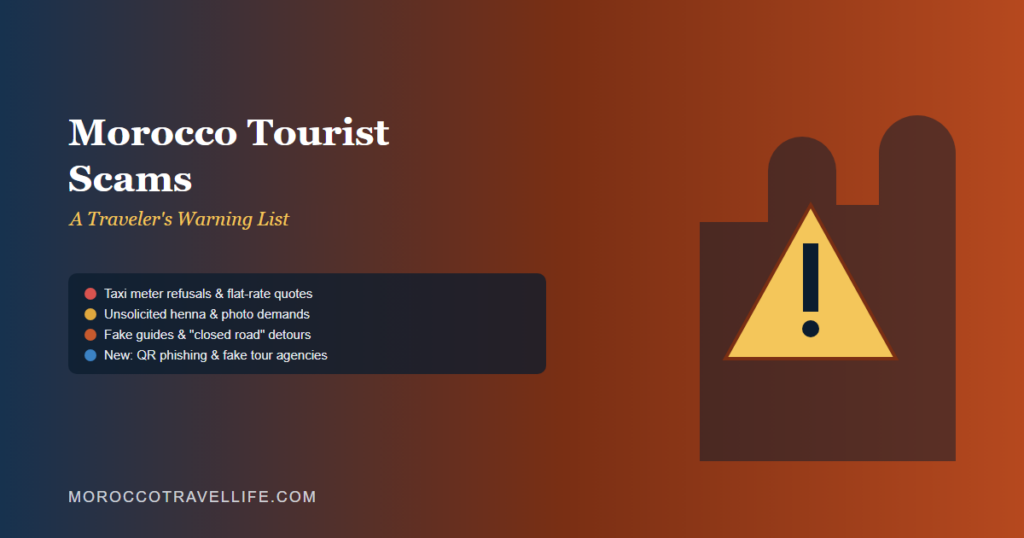
Morocco tourist scams follow a small, repeatable playbook. Learn the pattern once and almost every version of it loses its power. None of the nine below are dangerous. They can still cost you money and a good afternoon if you don’t spot them coming, and a few have gone digital since 2025.
Disclosure: Some links in this guide may earn us a commission, at no extra cost to you. It never changes what we recommend.
Morocco drew a record 19.8 million visitors in 2025, up 14% on the year before, according to figures the Ministry of Tourism released in January 2026 (Morocco World News, 2026; retrieved 8 August 2026). More arrivals mean more practice for the small number of people working these angles, and Morocco tourist scams get sharper with volume. This list isn’t secondhand. It’s the same nine warnings I give friends before they fly out, updated with the digital versions that didn’t exist a few years ago.
Key Takeaways
- The petit taxi meter refusal is the most common overcharge. A 15-20 MAD metered ride across the centre gets quoted at 100-200 MAD, on the claim that the meter is “broken” (Morocco Travel Life field observation, August 2026). Running the meter has been a legal obligation since 1963.
- Unsolicited henna demands 200-500 MAD (roughly 18-46 EUR) once a design is already on your hand. Street “black henna” often contains PPD, which the FDA says is not permitted in cosmetics applied to the skin (US FDA; retrieved 8 August 2026).
- Snake and monkey handlers in Jemaa el-Fna place animals on tourists without asking, then demand 100-300 MAD for photos nobody agreed to.
- New since 2025: QR code phishing at tourist sites and AI-generated fake tour agencies that take a deposit for a trip that doesn’t exist.
- One habit defuses nearly all of it: agree the price out loud before anything starts. The ride, the henna, the photo, the “guide’s” help.
Morocco Tourist Scams
Here’s the whole list of Morocco tourist scams at a glance, with what each one typically costs and the single sentence that shuts it down.
| Scam | Typical demand | Fair price | What shuts it down |
|---|---|---|---|
| Petit taxi meter refusal | 100-200 MAD | 15-20 MAD metered | “Compteur, s’il vous plait.” No meter, no ride. |
| Unsolicited henna | 200-500 MAD | 50-100 MAD in a shop | Pull your hand back before contact. |
| Snake or monkey photo | 100-300 MAD | Nothing. Don’t engage. | Step back the moment an animal comes near. |
| Unofficial “friendly guide” | 100-300 MAD plus shop commission | Licensed guide, booked ahead | Decline at the first offer, not the third. |
| “This way is closed” detour | Lost time plus a shop visit | Nothing | Thank them and keep walking. |
| Riad “is closed” redirect | A night at a commission hotel | Your booking | Call the riad from the taxi. |
| Counterfeit notes | Up to the full amount changed | Bank rate | Use banks and licensed bureaux only. |
| Tannery rooftop pressure | Overpriced leather | Nothing for the view | “No thank you,” then head for the stairs. |
| QR phishing and fake agencies | Deposit, or card details | Nothing | Type the official URL yourself. |
Typical demands and fair prices: Morocco Travel Life field observation across repeat visits, checked August 2026. Indicative ranges, not fixed rates; fares vary by city and time of day.
1. How does the petit taxi meter scam work?
This is the single most common Morocco tourist scam, and it’s illegal. Moroccan law has required petit taxis to run the meter on every trip since the Dahir of 12 November 1963. An Interior Ministry circular in December 2024 restated the obligation, explicitly to guarantee tariff transparency (Village de la Justice, 2025; retrieved 8 August 2026). Drivers still claim the meter is “broken” and quote a flat rate five to ten times the real fare. A short central ride that should cost 15-20 MAD on the meter gets quoted at 100-200 MAD (Morocco Travel Life field observation, August 2026).
Worth knowing: there is a real night surcharge, but it’s about 50% after roughly 8pm, not the tripling some drivers claim. Anything beyond that is invention.
The fix: say “compteur” before you sit down. If the driver refuses, get out and flag another one. There is always another petit taxi. For reference, Jemaa el-Fna to Marrakech airport should run 70-80 MAD on the meter in daylight. My full breakdown of how to get around Morocco by train, bus and taxi covers grand taxi and intercity fares too.
2. Why does a “free” henna design end in a payment demand?
Because the design goes on before you’ve agreed to anything. Women approach female tourists in Jemaa el-Fna and near major sites, offer a “free” henna sample, then apply a large pattern and demand 200-500 MAD, roughly 18-46 EUR. Some threaten a scene if you refuse. Of all the Morocco tourist scams on this list, it is the one that most specifically targets women.
There’s a health angle too. Street “black henna” is frequently darkened with a coal-tar dye containing p-phenylenediamine. The US Food and Drug Administration states plainly that PPD is not permitted in cosmetics intended to be applied to the skin. It has also received reports of skin injuries from products sold as henna and “black henna,” some resulting in scarring (US FDA; retrieved 8 August 2026). Real henna is reddish-brown, not black.
The women running this are fast. A full design goes on in under 30 seconds, before you’ve had a chance to say no twice. Pull your hand back the moment someone reaches for it, not after.
This one targets women far more often than men. My Morocco solo female travel guide covers the wider pattern of unwanted approaches and how to shut them down early.
The fix: decline any unsolicited approach and keep your hands to yourself in crowded squares. If you do want henna, agree the exact design and price with a licensed artist first, ideally inside a shop.
3. The “Free” Snake and Monkey Photo
Handlers in Jemaa el-Fna drape a snake around your neck or drop a monkey on your shoulder without asking, then demand 100-300 MAD once a camera appears. Travellers regularly report a small crowd forming to pressure payment. The transaction was never offered to you. It was performed at you, which is what separates this from the Morocco tourist scams that at least begin with a question.
This is as much an animal welfare problem as a tourist one. Captive snakes and monkeys in the square trade are frequently mistreated, kept in poor conditions between “performances,” and defanged or declawed with no regard for the animal.
The fix: keep your distance from anyone holding an animal. If one lands on you, step back and say no firmly rather than reaching for your wallet. Want a genuine wildlife photo? Several licensed sanctuaries operate near Marrakech and don’t rely on street handling.
4. How do I spot an unofficial “friendly guide”?
He approaches you, not the other way round. A local near the medina entrance claims to be “going the same way,” offers directions nobody asked for, then presents a bill. It is the defining Marrakech entry on any Morocco tourist scams list. The guide leads you deep into the souk maze, often through dead-end alleys, then into a shop run by friends or family that pays commission. By then you feel stuck without him.
Guiding without a licence is a real offence in Morocco. Law 05-12 regulates the profession. Usurping the title of tourist guide carries three months to two years in prison, plus a fine of 200 to 5,000 dirhams. That sits under article 21, which refers to article 381 of the Penal Code (Moroccan Ministry of Tourism; retrieved 8 August 2026). Enforcement against a single friendly offer is another matter. Fes has its own version, usually framed as a shortcut past a supposedly closed gate.
The fix: decline politely but firmly at the first offer, and use an offline map app instead. Licensed guides carry an official badge and can be booked through your riad or a registered operator. They cost far less than the commission-driven detour. My Marrakech travel guide covers the medina and souks in more detail.
5. The “This Way Is Closed” Detour
This is one of the quietest Morocco tourist scams, because nothing is ever demanded. A stranger tells you the street or attraction ahead is closed: a holiday, a private event, a prayer time, anything plausible. Then he redirects you toward a shop. It’s one of the three I’ve watched play out on every trip, alongside the unsolicited guide and the “free” gift. It works because the claim always sounds locally specific and is hard to verify on the spot.
The fix: thank them and keep walking toward it anyway. It’s very rarely actually closed.
6. Why would a taxi driver say my riad is closed?
Because a different riad pays him a commission for delivering you. It is among the costliest Morocco tourist scams, since it takes a whole night rather than a fare. Some drivers claim your booking is closed, full, or has moved, then offer to take you somewhere better. It targets first-timers who haven’t seen their riad yet and can’t easily check. Late at night, calling ahead feels like more hassle than it’s worth, which is exactly when the claim lands best.
The fix: save your riad’s exact address and phone number before you land, and call or message them directly if a driver says this. Most riads will happily send someone to meet you at the nearest drop-off point if he claims he can’t reach the door. If you’re not sure what to expect on arrival, here’s what a riad stay is actually like.
7. Counterfeit Notes at Street Money Changers
Unofficial street changers offer better rates than banks, then hand back counterfeit notes mixed in with real ones. Crowded exchanges make counting carefully feel awkward, which is the point. Unlike most Morocco tourist scams, this one can cost you the full amount changed. The dirham is a closed currency, regulated by the Office des Changes, and importing or exporting it is restricted (Office des Changes; retrieved 8 August 2026). That closed status is what pushes some travellers toward informal exchange in the first place.
The fix: change money only at bank branches or licensed Bureau de Change counters, and count the cash in front of the teller before you leave the window. My Morocco travel budget breakdown covers realistic daily dirham costs so you know roughly what you should be handing over.
8. Tannery Rooftop Pressure Selling
Around the Chouara Tanneries in Fes, leather shops offer a “free” rooftop view of the dye pits. Once you’re up there, the sales pressure starts, often from several staff at once. This is the gentlest of the Morocco tourist scams here, and the view genuinely is worth seeing. It’s one of Fes’s most photographed sights. The pressure afterward is the problem, not the invitation.
The fix: enjoy the view, then leave with a clear “no thank you” if you don’t want to buy. You don’t owe a purchase for a rooftop visit. If it turns aggressive, head for the stairs. Nobody will stop you. My Fes travel guide maps the rest of the medina.
9. What are the newest digital scams in Morocco?
QR code phishing and AI-generated fake tour agencies. The mechanism is not Morocco-specific. National cyber agencies now warn that criminals cover a genuine QR code with a sticker carrying a fraudulent one. The eye cannot tell the two apart (UK National Cyber Security Centre; retrieved 17 August 2026). In Morocco that shows up as codes at tourist sites redirecting to fake payment pages, alongside convincing agency websites taking deposits for trips that do not exist (Morocco Travel Life field observation, 2025-2026). Romance scams targeting solo travellers before they arrive belong to the same trend.
These are the Morocco tourist scams shifting fastest, and they scale in a way the street versions never could. A henna artist works one hand at a time. A fake agency site works on everyone who finds it.
The fix: don’t scan random QR codes at tourist sites. Type the venue’s official URL yourself. Book tours only through agencies with verifiable reviews across several independent platforms, not just their own site. Having a local data connection makes checking easy, so sort out a Morocco SIM card or eSIM on arrival.
What should I do if I get scammed in Morocco?
Report it to the Brigade Touristique, the tourist police unit that handles visitor complaints in Marrakech, Fes, Agadir and the other main destinations. Most Morocco tourist scams go unreported, which is exactly why they keep working. In Marrakech the office sits just off Jemaa el-Fna. The general emergency numbers are 19 for police in cities and 177 for the Royal Gendarmerie in rural areas, with 15 for ambulance and fire.
A few practical notes. Complaints can usually be filed in French or English. Bring your passport and any receipts, screenshots or the taxi’s plate number if you have them. If a card was involved, call your bank before you do anything else, because freezing the card matters more than recovering the dirhams.
Is it worth the trouble for 200 MAD of henna? Usually not. For a fake agency deposit or card fraud, absolutely, and a report also creates the record your travel insurance will want.
Frequently Asked Questions
What is the most common Morocco tourist scam?
The petit taxi meter refusal. Drivers claim a “broken” meter and quote flat rates five to ten times the real fare, so a 15-20 MAD ride gets priced at 100-200 MAD (Morocco Travel Life field observation, August 2026). Insisting on the meter resolves it almost every time, and the meter is legally required anyway.
Are Morocco tourist scams dangerous?
No. Nearly all of them are financial rather than physical. Morocco carries a US State Department Level 2 advisory, “Exercise Increased Caution” due to terrorism. That is the same tier as France, Spain, Germany and the UK (US Department of State, reissued 21 April 2025; retrieved 8 August 2026). The realistic risk from the scams on this page is losing money or an afternoon. For the fuller picture, read my honest guide to whether Morocco is safe.
How do I avoid the unsolicited guide scam in Marrakech?
Decline firmly at the first offer, before any directions are given. Backing out gets harder the further you walk together. Use an offline map app, and if you want a guide, book a licensed, badge-carrying one through your riad. Unlicensed guiding is an offence under Law 05-12.
Is henna safe to get in Morocco?
Only from a licensed artist who agrees the design and price with you first. Street “black henna” applied without consent often contains PPD. The FDA says PPD is not permitted in cosmetics applied to the skin, and links it to skin injuries including scarring (US FDA; retrieved 8 August 2026). Genuine henna stains reddish-brown.
Should I use ride-hailing apps instead of street taxis?
Where they operate, yes. App fares are fixed upfront, which removes the meter argument entirely. Coverage is strongest in Casablanca and Rabat, so smaller towns and the medina interior still depend on flagged petit taxis. In those places, asking for the meter is your version of the same protection.
The One Habit That Defuses Most Morocco Scams
Morocco tourist scams are common but rarely serious, and one habit handles most of them. Agree the price out loud, before it starts. Before the ride, before the henna touches your hand, before the “guide” starts walking. Recognise the pattern once and you’ll spot it every time after.
One last thing worth saying. The overwhelming majority of interactions with Moroccans involve no scam at all, from shopkeepers to strangers giving genuine directions. Healthy caution shouldn’t curdle into suspicion of everyone you meet. That would cost you far more than 200 dirhams.
Heading out soon? Start with 15 things I wish someone had told me before my first trip, or work through the complete Morocco travel guide if you’re still planning the rest.