
The first thing I got wrong about Moroccan mint tea, years ago, was thinking it was a drink. It isn’t. Or at least that’s not the part that matters. Across enough time spent in Marrakech, I’ve been handed a glass of atay to close a business deal, to reopen an argument between neighbors, and to mark a stranger becoming a guest. Once, memorably, to stall a plumber into staying long enough to finish the job. The tea was almost incidental. What was really being served, every time, was a set of social rules dressed up as a hot sweet beverage: who pours, who waits, who is allowed to refuse.
Disclosure: Some links in this guide may earn us a commission, at no extra cost to you. It never changes what we recommend.
That’s the argument I want to make here. Moroccan mint tea is a social institution that happens to be liquid. You can learn the recipe in ten minutes. Learning what the recipe does, how it runs hospitality, negotiation, family rank, and the shape of an ordinary afternoon, takes a lot longer. It’s the part no menu explains. This is the deep dive that the broader Moroccan food guide hands off to when it calls atay “the hospitality contract.”
Key Takeaways
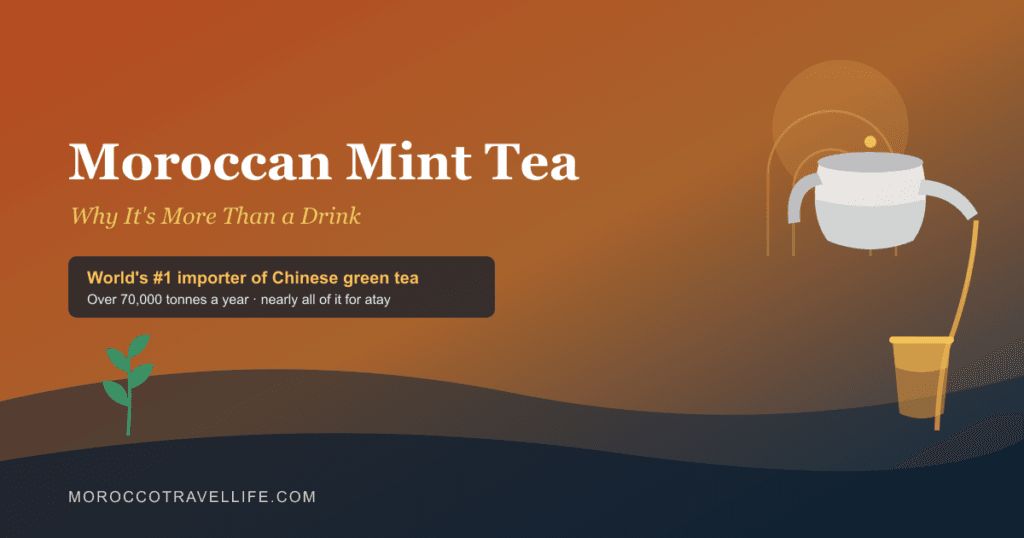
- Morocco is the single largest buyer of Chinese tea on earth, taking 91,575 tonnes in 2025, about 21.8% of China’s entire tea export volume (Firsd Tea, 2026 China Tea Report, May 2026; retrieved 2026-08-08).
- That was worth $280 million, up 14.7% year on year, putting Morocco ahead of Japan and the United States (Hespress, March 2026, citing Chinese customs data; retrieved 2026-08-08).
- The famous Crimean War origin story appears to be a myth. Historian Graham Cornwell found that none of the writers who repeat it cite any evidence for it (Cornwell, Sweetening the Pot, Georgetown University, 2018; retrieved 2026-08-08).
- What actually opened the market was tax policy: the 1856 Anglo-Moroccan treaty cut duties to 10% and abolished the royal monopolies, after which tea landing at Mogador rose twenty-five-fold by the end of the century.
- Moroccans eat about 37.3 kg of sugar per person per year, third-highest in Africa, and contrary to a widely repeated claim, the national figure is not falling: it dipped to 31.2 kg in 2021 and rebounded by 2023 (FAOSTAT Food Balance Sheets, 2010–2023 series; retrieved 2026-08-08).
Table of Contents
What Is Moroccan Mint Tea, Exactly?
Strip away the ceremony and the drink is simple. Take Chinese gunpowder green tea, leaves rolled into tight pellets that look faintly like buckshot, which is where the name comes from. Steep it hard. Add a generous fistful of fresh spearmint. Sweeten it well past what most outsiders expect. In Darija it’s atay, and the mint version is atay b naanaa. Nana is the specific spearmint Morocco grows for it: bright, clean, a little peppery, nothing like the cool menthol of packaged peppermint.
That’s the summer template. The tea shifts with season and region, which is the detail that tells you it’s a living tradition rather than a fixed recipe. In winter, especially in the Atlas and the south, the mint gives way or gets company. Wild sage (salmiya). Verbena (louiza). Wormwood (sheeba) for a bitter herbal edge. Sometimes marjoram. In the deep south you’ll meet a bracingly bitter first pour that locals treat as the point, not a mistake.
The Amazigh households I’ve drunk tea in across the High Atlas almost always keep a second jar of dried mountain herbs next to the mint. Tea there is as much foraged as bought, which fits the wider self-reliance woven through Amazigh culture in Morocco.
| Region / season | Base | Common additions | Character |
|---|---|---|---|
| Nationwide, summer | Gunpowder green + nana mint | Heavy sugar | Bright, sweet, refreshing |
| Atlas & rural, winter | Gunpowder green | Sage (salmiya), marjoram | Warming, herbal, savory-edged |
| North & cities, winter | Gunpowder green | Verbena (louiza), wormwood (sheeba) | Aromatic, faintly bitter |
| Deep south (Saharan) | Strong gunpowder green | Less mint, more steeping | Bitter-forward first glass by design |
Morocco Travel Life field observation, compiled from tea served in homes and cafés across Marrakech, the High Atlas, and the south, 2026.
How Did a Chinese Leaf Become Morocco’s National Drink?
Morocco now buys more Chinese tea than any other country: 91,575 tonnes in 2025, roughly 21.8% of China’s total tea exports, up 13.6% on the year (Firsd Tea, 2026 China Tea Report, May 2026; retrieved 2026-08-08). By value that came to $280 million, a 14.7% annual rise, ahead of both Japan and the United States (Hespress, March 2026; retrieved 2026-08-08). For a country of 38 million people, that is an extraordinary concentration of demand on one leaf.
Here’s the part that surprises people. Mint tea isn’t ancient in Morocco. Morocco has grown mint and brewed herbal infusions for centuries, but the green tea at the center of the ritual is an import, and a fairly recent one. Tea reached the Moroccan court around 1700, by tradition as a gift from Queen Anne to Sultan Moulay Ismail. Then it sat there. For roughly 150 years it stayed a luxury of wealthy urban families, priced out of ordinary reach by import duties and royal trading monopolies.
Now, the story you’ll hear next, in every guidebook and on most café walls, is that the Crimean War changed everything. British merchants, the tale goes, lost their Baltic markets to blockade in the 1850s, found themselves sitting on unsold Chinese green tea, and dumped it at Tangier and Mogador. A commercial accident, so the story goes, became a national habit.
It’s a great story. The evidence for it is thin to nonexistent. Historian Graham Cornwell, whose Georgetown doctoral history of tea and sugar in Morocco is the most thorough account of this period, went looking for the source of the Crimean thesis and found that none of the authors putting it forward offer any evidence or cite any source at all (Cornwell, Sweetening the Pot: A History of Tea and Sugar in Morocco, 1850–1960, Georgetown University, 2018; retrieved 2026-08-08). The claim propagates because it’s repeated, not because anyone checked it.
What the record does support is duller and more convincing: tax policy. Sir John Drummond Hay, Britain’s minister in Tangier, spent most of a decade pressing the Sultan for trade concessions, and the Anglo-Moroccan treaty of 1856 delivered them. Import duties dropped to 10% and the royal monopolies were swept away. The price collapsed, and the country drank. Tea landing at Mogador multiplied twenty-five times over between 1857 and the end of the century, while its value rose only eightfold, which is exactly the signature you’d expect from a luxury good becoming a staple (Cornwell, Sweetening the Pot, Georgetown University, 2018).
The Crimean War does have a real connection, just not the romantic one. Britain needed grain for its troops, Moroccan cereal exports rose, and Moroccan purchasing power rose with them. The war helped Morocco afford tea. It didn’t deliver it by accident.
What’s striking is how concentrated the resulting habit is. Morocco doesn’t just buy a lot of Chinese green tea, it buys one grade of it, and is estimated to absorb close to 46% of the world’s “gunpowder” style specifically (Firsd Tea, Global Green Tea Report, 2024; retrieved 2026-08-08). One country, one leaf, one grade, sustaining a global trade lane.
Why Does the Host Pour From So High?
Watch tea being made properly and the theater turns out to be functional. The host brews the pot, and it is the host’s job, a small honor rather than a chore handed to whoever is nearest. Then he pours the first glass and tips it straight back in. That washes and mixes the brew. Then comes the move everyone photographs: the silver pot lifted a foot or more above the glass so the tea falls in a thin ribbon.
I used to think the high pour was showmanship for tourists. It isn’t. It does two real jobs. It aerates the tea, softening the tannic bite of hard-steeped green leaf, and it builds the keskes, the little crown of foam that marks a properly poured glass. A local host will pour, inspect the foam, and if it’s thin, tip the glass back and go again. I once watched an older host in the Ourika Valley reject his own first two pours in front of guests without a flicker of embarrassment. Getting the crown right is the hospitality. A flat, foamless glass isn’t wrong so much as unfinished.
Then there’s the proverb every guide repeats. This once it’s worth repeating, because it genuinely is how the three-glass round is understood. Tea is served in at least three successive glasses from one pot, each steeping longer and tasting different. The saying runs: the first glass is as bitter as life, the second as strong as love, the third as gentle as death. Leaving before the third is, in the old etiquette, a small insult. You’ve taken the hospitality without letting it finish.
Can You Actually Refuse a Glass of Tea?
Not comfortably, no. Moroccan mint tea comes with rules nobody writes down and everybody knows. The guest is served first and served most. The host keeps the pot moving. And a refusal isn’t neutral: declining tea reads as declining the relationship, which is why a simple “no thank you” lands harder than a visitor intends.
That doesn’t mean you’re trapped into three glasses on a hot afternoon when you’ve already had four. The move locals actually use is to accept the gesture while limiting the volume. Take the glass. Hold it. Sip, and let it go slowly. Saying “shukran, baraka” (thank you, that’s plenty) with a hand lightly over the rim is understood and gracious. What reads as rude is waving the pot away before it’s poured. Accept the offer, manage the quantity. That’s the etiquette locals themselves run, and it’s the same principle I unpack in the Moroccan etiquette guide for declining anything in a hospitality-driven culture without giving offense.
There’s a gender and space dimension worth naming plainly. The pavement cafés packed with men nursing a glass for an hour are Morocco’s public tea, and historically they’ve been male-dominated, though that’s shifting fast in the big cities. The other tea, the important one, happens at home, and there it’s very often women running the pot. Same drink, opposite social jobs. One is the public living room, the other the private one. Drinking tea inside a Moroccan home, which you can arrange through experiences like a Berber family visit, shows you the version that actually anchors the culture.
“Berber Whisky”: Tea as the Engine of the Deal
You’ll hear the joke within a day of arriving. Moroccan mint tea is “Berber whisky,” the running gag being that in a country where most people don’t drink alcohol, this sweet green tea is the national intoxicant. It’s funny, and it’s also an accurate description of a function. Tea does the social work alcohol does elsewhere, and nowhere is that clearer than in a shop.
When a carpet dealer in the souk sits you down and sends a boy for tea, the negotiation has already started. You just can’t see the board yet. The tea buys time, obligates nothing on paper, and turns a transaction into a visit. I tell every visitor the same thing: accepting the tea does not commit you to buying anything, and any dealer who implies otherwise is bluffing. But do accept it, because refusing kills the rapport that actually gets you a better price. Sip slowly. Talk about something other than the carpet. Let the merchant name the first number. If you want the full choreography of buying tea, glasses, and a proper pot to take home, my Marrakech souk shopping guide covers what’s fixed-price and what’s negotiable.
Is Moroccan Tea Really That Sweet?
Yes. Moroccan mint tea is sweet by design, and the national numbers back it up. Moroccans consume about 37.3 kg of sugar per person per year as of 2023, the third-highest rate in Africa behind only Gambia and Mauritania, and well above the world average of roughly 22 kg (FAOSTAT Food Balance Sheets, 2010–2023 series; retrieved 2026-08-08). A standard pot of atay takes several tablespoons, and by weight of what’s added, sugar dwarfs the tea and mint combined.
Here’s where I have to correct something I’ve repeated myself, and that a lot of travel writing still repeats. The tidy story is that Morocco is cutting back: consumption peaked near 40 kg in 2012 and fell to about 31 kg by 2021, tracking a health-conscious younger generation. The first half of that is true. The problem is where the story stops. Pull the full FAOSTAT series instead of the two convenient endpoints and the 2021 figure turns out to be a trough, not a trend. By 2023 the number had climbed back to 37.3 kg, close to where it started.
So the honest version is this: Morocco’s sugar habit dipped for a decade and has largely bounced back. Anyone citing the 2012-to-2021 decline as evidence of lasting change is quoting a stale endpoint.
None of which contradicts what I actually see in Marrakech cafés, as long as you keep the two things separate. Ordering “atay bla sokkor” (tea without sugar) or “shwiya dyal sokkor” (a little sugar) used to earn a raised eyebrow. Among people under about 35, it now passes without comment. Diabetes awareness and a broader wellness turn have made the lighter pour a genuine option rather than an insult to the host. That’s a real shift in what’s socially askable. It just hasn’t shown up in the national supply figures, and I’d be overselling my own observation if I claimed otherwise. If you’d rather not drink a dessert, you can say so.
How to Make Moroccan Mint Tea at Home
Moroccan mint tea needs no special skill, only a metal teapot (the aluminum or steel berrad conducts heat and survives the stovetop) and a willingness to steep harder than feels right. Here’s the method I use:
- Rinse the leaves. Put about a tablespoon of gunpowder green tea in the pot, add a splash of boiling water, swirl for ten seconds, and pour that first water off. This removes the harshest tannins and the dust.
- First brew. Fill with boiling water and steep 3 to 5 minutes. Longer means stronger and more bitter, which is the southern style.
- Sweeten in the pot, not the glass. Start with a couple of teaspoons per glass and adjust down to taste. A small chunk of sugarloaf is traditional.
- Add the mint. Press a big bunch of fresh spearmint down into the hot tea and steep 2 to 3 minutes. In winter, swap in sage or add wormwood for a herbal edge.
- Mix by pouring. Pour a glass and return it to the pot two or three times to blend the sugar and aerate. Then pour from height to raise the foam.
- Serve, and pour again. The round is three glasses from one pot, and each will taste a little different as the leaves keep steeping.
How Should a Traveler Take Part Respectfully?
Accept Moroccan mint tea when it’s offered, even if you only sip it. The offer is the relationship; the drink is secondary. Take the glass with your right hand. Don’t rush off after the first glass if you can help it. If it’s too sweet, ask for bla sokkor or shwiya sokkor next time rather than leaving a full glass, which reads as rejection. And if you’re a guest in a home, let the host pour. Offering to take over the pot is like grabbing the remote in someone else’s living room. Do those few things and you’re not performing culture, you’re participating in it.
Frequently Asked Questions
What is Moroccan mint tea actually called?
In Moroccan Arabic (Darija) it’s atay, and the mint version is atay b naanaa, tea with mint. In the wider region it’s known as Maghrebi mint tea (atay maghrebi). “Nana” is the specific spearmint variety Morocco grows for it.
Is Moroccan mint tea made with black or green tea?
Green, specifically Chinese gunpowder green tea, whose tightly rolled pellets hold up to hard steeping and heavy sugar. Morocco is the world’s largest buyer of Chinese tea, taking 91,575 tonnes in 2025, about 21.8% of China’s entire export volume (Firsd Tea, May 2026), and almost all of it goes into this one preparation.
Did Moroccan mint tea really start because of the Crimean War?
Probably not. The story that British merchants dumped blockaded Baltic tea at Moroccan ports in the 1850s is repeated everywhere, but historian Graham Cornwell found that no author making the claim cites any evidence for it (Cornwell, Georgetown University, 2018). The documented driver is the 1856 Anglo-Moroccan treaty, which cut import duties to 10% and ended the royal monopolies.
Why do Moroccans pour tea from so high?
Two reasons, both practical. The height aerates the tea, taming the bitterness of strong green tea, and it builds the keskes, the foam crown that signals a properly poured glass. The showmanship is real, but it’s doing a job.
Is it rude to refuse mint tea in Morocco?
It can be, because refusing the tea reads as refusing the hospitality behind it. The graceful path is to accept the glass and sip slowly rather than wave the pot away. Saying “shukran, baraka” (thank you, that’s enough) with a hand over the glass is polite and understood, as my Moroccan etiquette guide explains.
Why is Moroccan tea so sweet, and can I ask for less sugar?
Tradition made it very sweet, and sugar outweighs the tea and mint by a wide margin in a standard pot. Morocco consumes about 37.3 kg of sugar per person per year, third-highest in Africa (FAOSTAT, 2023). Younger urban Moroccans increasingly order it light, so asking for bla sokkor (no sugar) or shwiya sokkor (a little) is no longer unusual.
Why is mint tea called “Berber whisky”?
It’s an affectionate joke. In a country where most people don’t drink alcohol, sweet Moroccan mint tea plays the social role whisky plays elsewhere: the drink that opens conversations, seals deals, and keeps a café table occupied for an hour. It also nods to tea’s deep place in Amazigh hospitality.
Putting It Together
Moroccan mint tea is the clearest single answer to a question travelers ask constantly: what is Moroccan culture actually like, day to day? It’s like being handed a glass you didn’t ask for, by someone who wants a few minutes of your time more than they want you to enjoy the tea. It’s hospitality made compulsory in the gentlest possible way.
It’s also a good reminder that the tidy stories, the Crimean War accident, the nation quitting sugar, tend to be the ones nobody checked. What’s underneath is less romantic and more interesting: a tax treaty, a price collapse, and a habit that stuck hard enough to bend a global trade route toward one grade of one leaf.
Learn to accept the glass well and you’ve learned most of what you need to move gracefully through the country. For the wider frame, the customs, the religion, the etiquette, and the traditions this ritual sits inside, my full Moroccan culture guide for travelers connects the tea to everything else, and the Moroccan food guide covers the meals it bookends. The tea is where Morocco introduces itself. Take the glass.