Moroccan culture announces itself at lunchtime, in my case through Rachid, my neighbor whenever I’m in Marrakech, who has never once let me walk past his door without trying to feed me. Not offering, trying: the door already open, a tagine already visible behind him. On my first few stays in Marrakech I treated this as politeness to be politely declined. It took me an embarrassingly long time to understand that the invitation wasn’t a courtesy. It was the culture itself, working exactly as designed, and my repeated refusals read as strange rather than modest.
Disclosure: Some links in this guide may earn us a commission, at no extra cost to you. It never changes what we recommend.
That gap, between what Moroccan culture looks like from a guidebook and how it actually functions when you’re inside it, is what this guide is for. I’ve spent enough time in Marrakech to see that most of what confuses first-time visitors isn’t exotic at all once you see the logic underneath.
Why do greetings take three minutes? Why is haggling friendly rather than hostile? Why does the whole country reorganize itself for a month every year, and why does the person pouring your tea hold the pot half a meter above the glass? This is the overview, the operating system, if you like, and each major topic below hands off to a deeper guide in this Culture & History series.
Key Takeaways
- Morocco counted 36.8 million people in its 2024 census, and the same census found 91.9% speak Darija (Moroccan Arabic) while 24.8% use an Amazigh language daily. The two identities are layered, not separate (Yabiladi, 2024; Morocco World News, 2024).
- Tamazight has been a co-official language alongside Arabic since the 2011 constitution, and in 2024 Morocco celebrated Yennayer, the Amazigh New Year, as an official paid holiday for the first time (Morocco World News, 2024).
- Roughly 99% of Moroccans are Sunni Muslim, and Islam is the state religion, so prayer times, Fridays, and Ramadan shape the daily rhythm every traveler moves through (International Center for Law and Religion Studies, 2026).
- Morocco’s craft economy is not a museum piece: in 2024 the handicraft sector generated 140 billion dirhams, about 7% of GDP, and employed over 2.7 million people (Yabiladi, 2024; The North Africa Post, 2025).
- Cultural tourism is booming around all of this: Morocco welcomed a record 19.8 million visitors in 2025, up 14% on 2024, and holds nine UNESCO World Heritage sites, every one of them listed for cultural, not natural, value (Ecofin Agency, 2026; UNESCO, 2026).
Moroccan Culture Guide
What Actually Shapes Moroccan Culture?
Start with the layers, because everything else in this Moroccan culture guide sits on them. Moroccan culture is what happens when an Indigenous North African civilization, the Amazigh, often called Berbers, absorbs thirteen centuries of Arab and Islamic influence, several centuries of Andalusi refugees bringing Iberian craft and music, and trans-Saharan trade routes carrying West African rhythm and ritual north. Then add the 44 years of French administration, 1912 to 1956, that left its language in the schools and its boulevards in the cities (Britannica, 2026). None of these layers replaced the one before it. They stacked.
That stacking is why Morocco can feel contradictory until it suddenly doesn’t. The same Marrakchi who prays five times a day queues for a French-style pastry; a wedding procession I followed through a Marrakech side street opened with Quranic recitation and closed with a Gnawa troupe whose tradition traces to West Africa. A useful traveler’s rule: when something in Morocco seems to contradict itself, you’re usually just looking at two layers at once.
Hold onto this too: Morocco is a young, fast-changing society wrapped around old institutions. Its monarchy has run continuously under the Alaouite dynasty since the 17th century, and the king carries the religious title Commander of the Faithful, yet the median Moroccan you’ll meet is under 30, glued to the same phone you are, and as likely to answer you in English as in French. Both things are true at once, and the tension between them is modern Moroccan culture.
Who Are Moroccans? Arab and Amazigh, Not Arab or Amazigh
The census answers the “who” question better than any think piece. In 2024, Morocco’s seventh general census counted 36,828,330 people (Yabiladi, 2024). Ask those people what they are, though, and you’ll rarely get a single word back. Most Moroccans carry both Arab and Amazigh heritage in some proportion, and identity here works more like a blend than a checkbox.
Amazigh means “free people,” and it’s the term to prefer over “Berber,” which stuck for searchability but comes from the same root as “barbarian.” They are North Africa’s Indigenous population, present for thousands of years before the Arab armies arrived in the 7th century.
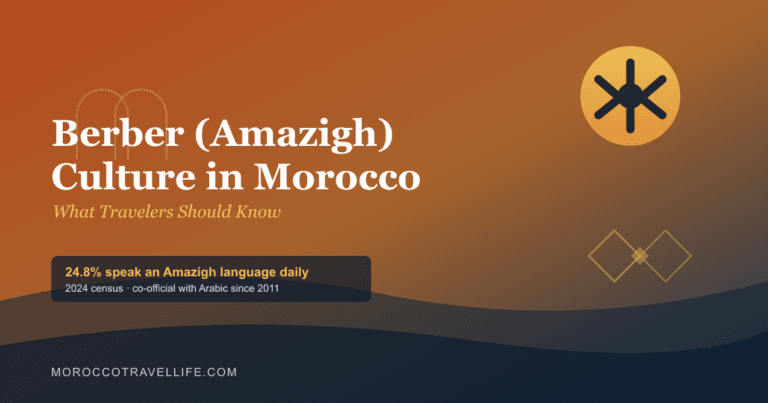
Numbers help here more than labels do. The 2024 census found 24.8% of Moroccans still use an Amazigh language daily, rising to a third of the rural population, split across three main varieties: Tachelhit in the south (14.2% of the population), Central Atlas Tamazight (7.4%), and Tarifit in the north (3.2%) (Yabiladi, 2024). Amazigh cultural associations dispute those figures as undercounts, which is itself a live cultural debate worth knowing exists.
The official recognition story matters because it’s recent and travelers see its results everywhere. The 2011 constitution made Tamazight a co-official language alongside Arabic, which is why street signs in most cities now run trilingual: Arabic, Tifinagh (the striking geometric Amazigh script), and French. In 2024, Morocco marked Yennayer, the Amazigh New Year on January 14, as an official paid national holiday for the first time (Morocco World News, 2024). Watching a decades-long cultural movement win that kind of formal recognition in real time is one of the more remarkable things to witness up close.
For the deeper story, covering Amazigh history, the Tifinagh script, tattoo and carpet symbolism, and how to engage respectfully in Amazigh regions, see my full guide to Amazigh (Berber) culture in Morocco. And if you want the lived version rather than the read version, a visit with a Berber family in the Atlas will teach you more in an afternoon than any book.
What Language Should You Expect to Hear?
Practical answer first: you’ll hear Darija (Moroccan Arabic) everywhere, French in any city, Amazigh in the mountains and the south, and enough English in tourist zones to get by without any of the above. Morocco is casually multilingual in a way that startles visitors from monolingual countries; switching languages mid-sentence isn’t showing off here, it’s Tuesday.
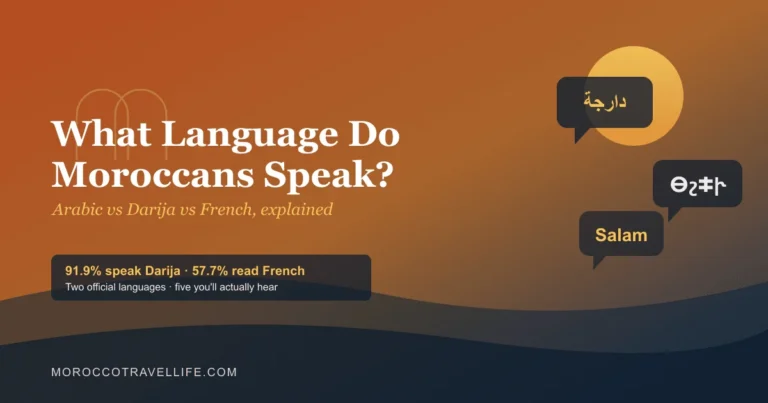
Census numbers put figures on the mix: 91.9% of Moroccans speak Darija, while 57.7% can read and write French and about a quarter use Amazigh daily (Morocco World News, 2024; Yabiladi, 2024). The catch for travelers who studied Arabic: Darija is so far from textbook Modern Standard Arabic that Middle Eastern Arabic speakers often struggle here. It compresses vowels, borrows freely from Amazigh, French, and Spanish, and moves fast.
Five phrases carry me through most Marrakech days, and I’d point any visitor to the same starter kit: salam alaykum (hello), shukran (thank you), la, shukran (no thank you, essential in the souks), bshhal? (how much?), and bslama (goodbye). The return on ten minutes of memorization is absurd. Vendors drop their tourist register, taxi negotiations soften, and simple greetings in Darija open doors that money doesn’t.
The full picture, which language to learn a little of, where French won’t help you, why Moroccans switch mid-sentence, and a proper travelers’ phrase list, is in my breakdown of what language Moroccans actually speak.
How Does Islam Shape Daily Life and Travel?
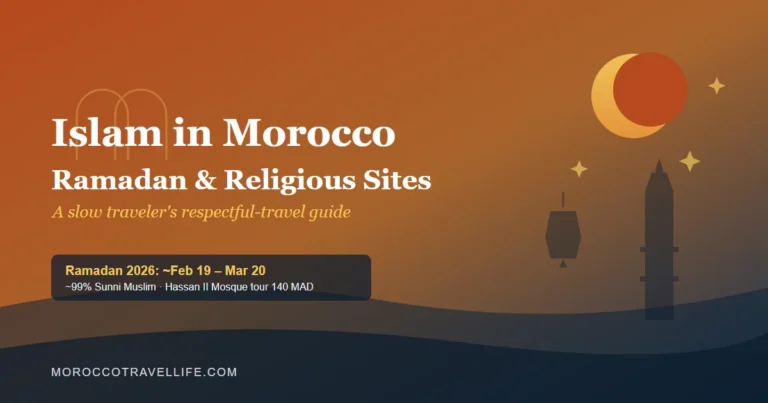
Islam here isn’t a compartment of life; it’s the clock. Roughly 99% of Moroccans are Sunni Muslim of the Maliki school, Islam is the state religion, and the king holds the title Commander of the Faithful (International Center for Law and Religion Studies, 2026). In practice, the traveler-visible version is rhythm: the call to prayer five times daily from every minaret, Friday’s long midday pause when shops shutter for the week’s main prayer and families gather over couscous, and the annual reorganization of everything during Ramadan.
You’ll hear the call to prayer before dawn wherever you sleep in a medina, my honest advice is to stop treating it as a disturbance and start treating it as the soundtrack. Within a week most visitors do. What surprises people more: Morocco is generally relaxed about visitors. Alcohol is legal and sold in licensed bars, restaurants, and supermarkets; nobody expects non-Muslims to fast during Ramadan; and Moroccan cities are used to every kind of dress. Respect is noticed and returned, but performance of piety isn’t asked of you.
Two practical rules stand above the rest. First, non-Muslims may not enter working mosques in Morocco. The grand exception is the Hassan II Mosque in Casablanca, which runs guided tours, plus the restored Almohad-era Tin Mal Mosque in the High Atlas. Admire the rest from the doorway; the doorways are spectacular anyway.
Second, plan around Ramadan if you’re traveling during it. It ran from roughly February 18 or 19 to March 19 or 20 in 2026, shifting about 11 days earlier each year (IslamicFinder, 2026). Eat and drink discreetly in public by day, then join the streets after sunset: iftar-season Morocco at night is one of the best cultural experiences the country offers.
Ramadan travel deserves its own planning, and it gets it in my guide to Islam in Morocco and traveling respectfully during Ramadan, which covers what’s open, what changes, and why some of my favorite Marrakech nights of the year happen during the fasting month.
Why Does Hospitality Matter So Much in Moroccan Culture?
Hospitality is the first Moroccan culture code most of the record 19.8 million visitors who arrived in 2025 will run into (Ecofin Agency, 2026), and it has rules worth learning fast: it’s the single highest-return cultural investment a traveler can make. The core concept: a guest is close to sacred. That’s why Rachid keeps trying to feed me, why accepting tea matters more than drinking it, and why “come for dinner” from someone you met an hour ago is usually a real invitation rather than a pleasantry.
Greetings are the visible grammar of all this. Moroccans greet at length, a handshake that lingers, a hand brought back to touch the heart, a volley of questions about your health, your family, your day, none of which expect detailed answers. Rushing a greeting to get to your actual question is the most common small rudeness visitors commit. Slow down for ninety seconds; the whole interaction after it will go better. Between men and women, let the woman offer her hand first, a hand on the heart with a smile is a perfectly warm alternative and never wrong.
A few codes to internalize early: the right hand is for eating, greeting, and passing things (the left is traditionally for hygiene); shoes come off when entering a home, watch for the pile at the door; and dress in cities is more relaxed than most blogs claim, though covered shoulders and knees remain the respectful default outside resort zones and will change how rural Morocco receives you. If someone invites you home, accept if you possibly can, bring a small gift, pastries from a good patisserie beat anything imported, and expect to be fed past the point of reason.
Here’s the reframe that unlocked Morocco for me: interactions that feel “inefficient” here aren’t failed transactions, they’re successful relationships. The three-minute greeting, the obligatory tea before business, the shopkeeper who wants to know where you’re from before quoting a price: none of this is friction in the system. It is the system. Travelers who fight it have a stressful trip; travelers who surrender to it get invited to weddings. I’ve watched both happen to friends of mine in the same week.
Public bathing culture belongs in this section too, because the neighborhood hammam is one of Morocco’s oldest social institutions, less a spa than a weekly ritual of scrubbing, gossip, and community. My Moroccan hammam guide explains the difference between the local and tourist versions and how not to embarrass yourself in either. For the complete rulebook, dress specifics by region and season, photography etiquette, tipping, mosque manners, and Ramadan-specific behavior, head to my full guide to Moroccan etiquette for travelers, and if this is your first visit, my first-time Morocco tips cover the broader practical layer.
Why Haggling Is a Social Ritual, Not a Fight
Nothing divides visitors like the souk, and almost every negative souk experience I hear about comes from one misunderstanding: treating bargaining as conflict. In Moroccan market culture, negotiation is conversation. The opening price isn’t a lie; it’s an invitation to talk. Walking in, pointing, paying the sticker price, and leaving is, from the vendor’s side, a slightly cold encounter.
This ritual has steps. You admire, you ask, you hear a price, you laugh gently, you counter low, you drink the tea if it appears, you meet somewhere in the middle, and you part with handshakes and bslama. Ten minutes, maybe fifteen. The final number typically lands between a third and two-thirds of the opening ask depending on the item and the city, but fixating on the number misses the point: you were just welcomed into a centuries-old commercial culture that runs on relationship, and the vendor will remember you tomorrow.
My honest confession: I still pay what locals would call too much for carpets, and I’ve stopped minding. The afternoon I spent in a Rahba Kedima shop three years ago, four glasses of tea, a geography lesson on Atlas weaving villages, and a carpet I use daily, was worth more than the couple hundred dirhams a harder negotiator might have saved. Bargain seriously, but keep the score in experiences, not dirhams.
Walk away politely if the price isn’t right, half the time that’s when the real price appears. And never start negotiating for something you wouldn’t actually buy. The complete playbook, souk by souk, with realistic price ranges for leather, ceramics, spices, and carpets, is in my Marrakech souk shopping guide.
Food Culture: The Table Is the Social Center
You can read Moroccan culture straight off the table. Meals are communal. The tagine lands in the center and everyone eats from their own section of the shared dish, right-handed, with bread as the utensil. Khobz, the round daily loaf, is treated with near-religious respect; you’ll see dropped bread picked up, kissed, and set aside rather than left on the ground. And Friday couscous is a national institution: families across all 36 million-plus of those census-counted Moroccans gather after Friday prayers over the steamed semolina dish that restaurants often only serve that day.
What travelers underestimate is how regional the food is. Marrakech does tanjia, a bachelor’s dish of beef or lamb slow-cooked overnight in the hammam’s furnace ashes; the coast does chermoula-marinated sardines and fish tagines; Fes claims pastilla, the sweet-savory pigeon pie inherited from Andalusia; and the south leans on dates, amlou, and argan oil, which grows nowhere else on earth but southwestern Morocco. Eating your way across regions is genuinely one of the best frameworks for a Morocco itinerary.
Street food culture deserves your trust more than most first-timers give it. The busiest snail-soup cart in Jemaa el-Fna, the hole-in-the-wall msemen griddle, the olive stalls stacked like jewelry displays. High turnover is the hygiene signal locals use, and it works. Start with my Moroccan food guide to the 20 dishes worth seeking out and where to find each one; and if you’d rather learn the cuisine from inside a kitchen, a Moroccan cooking class, usually starting with a guided market shop, is the single best half-day cultural activity I recommend to visitors.
Mint Tea: Small Glass, Entire Value System
Atay, green tea steeped with fresh spearmint and serious quantities of sugar, is Morocco’s handshake, its contract seal, its welcome mat, and its excuse to sit down: Moroccan culture in one small glass. The numbers behind the ritual are wilder than most visitors guess. Morocco now buys more Chinese tea than any other country on earth: 91,575 tonnes in 2025, roughly 21.8% of China’s total tea exports (Firsd Tea, 2026 China Tea Report, 2026). Nearly every gram of it ends up in that same minty preparation.
Know these rules going in: refusing tea outright can land as refusing the relationship, so accept the glass even if you barely sip it; the theatrical high pour isn’t showing off but aeration, building the foam crown (the “turban”) that marks a properly made glass; and the old saying about three glasses, the first gentle as life, the second strong as love, the third bitter as death, describes a real progression as the pot steeps. When a carpet seller offers tea mid-negotiation, that’s not a sales trap. It’s the older logic underneath the sale: no relationship, no transaction.
Why tea, why China, why the 19th century made it national, and how to make a proper pot yourself: the whole story is in my piece on Moroccan mint tea culture.
Why Is Morocco’s Craft Economy Still Made by Hand?
Zellige tilework, carved cedar, and hammered brass filling your camera roll aren’t heritage theater for Moroccan culture. They’re one of Morocco’s largest industries, present tense. In 2024, the handicraft sector generated about 140 billion dirhams, roughly 7% of Morocco’s GDP, across more than 170 recognized trades (Yabiladi, 2024), and by 2025 it employed over 2.7 million people, the country’s second-largest source of jobs (The North Africa Post, 2025). The mallem system, master artisans training apprentices over years, still runs the workshops you’ll walk past in any medina.
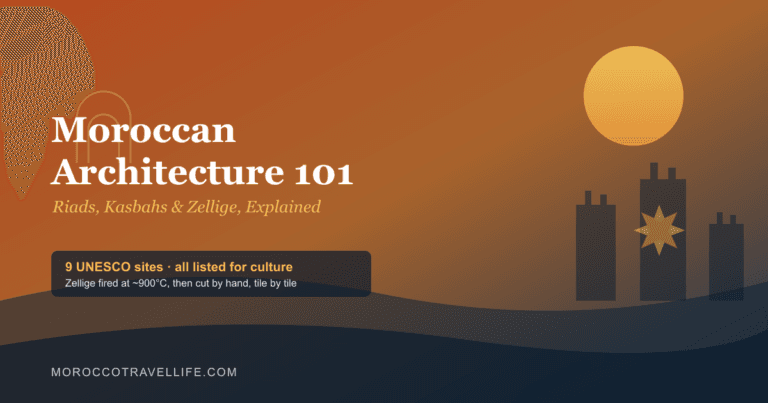
Architecture here organizes around a single idea worth learning before you arrive: inward-facing beauty. A riad presents a blank wall and a modest door to the street, then opens into a courtyard of fountains and tile: privacy outside, paradise inside, a perfect architectural expression of Moroccan social values. The same vocabulary repeats at every scale: keyhole arches, zellige geometry (Islamic art’s answer to figurative painting’s absence), carved plaster, cedar ceilings.
In the south the materials shift to rammed earth, producing the kasbahs and fortified ksour of the desert routes. Staying in a riad at least a few nights is the cheapest architecture lesson you’ll ever get. My riad vs hotel comparison covers the trade-offs in full, but the short version is: do it.
UNESCO agrees about the density of all this. In 2026, Morocco holds nine World Heritage sites, every single one listed for cultural significance (UNESCO, 2026):
| Site | Inscribed |
|---|---|
| Medina of Fez | 1981 |
| Medina of Marrakech | 1985 |
| Ksar of Aït-Ben-Haddou | 1987 |
| Historic City of Meknes | 1996 |
| Archaeological Site of Volubilis | 1997 |
| Medina of Tétouan | 1997 |
| Medina of Essaouira | 2001 |
| Portuguese City of Mazagan (El Jadida) | 2004 |
| Rabat, Modern Capital and Historic City | 2012 |
What’s a riad exactly, how does a kasbah differ from a ksar, and why does real zellige cost what it costs? All answered in Moroccan architecture 101.
Music: Gnawa, Chaabi, and a Very Loud Living Tradition
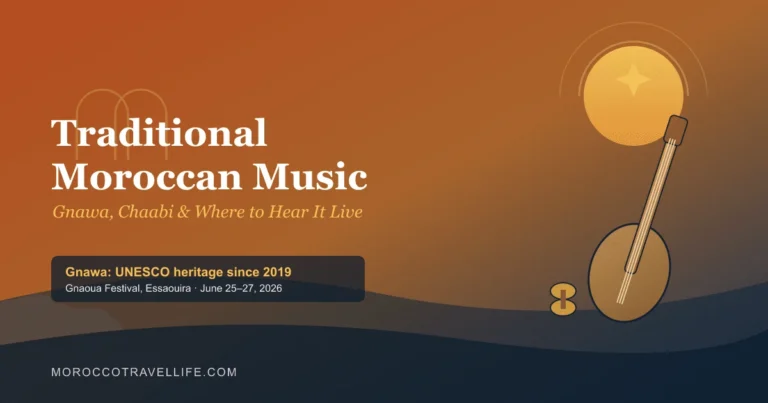
Moroccan music is participatory, spiritual, and everywhere: wedding processions drumming down residential streets, Andalusi orchestras in Fes, and the hypnotic three-stringed guembri lines of Gnawa, the tradition carried north by enslaved and displaced West Africans and forged into something uniquely Moroccan. In 2019, UNESCO inscribed Gnawa on its Representative List of the Intangible Cultural Heritage of Humanity (UNESCO, 2019). That’s recognition of a practice that runs from all-night healing rituals (lilas) to festival main stages.
Chaabi is the other sound you’ll actually hear most: Morocco’s popular party music, the soundtrack of every wedding and half the grand taxis in the country. Between them sit Andalusi classical suites, Rif and Atlas village traditions, the Sufi chanting of the zawiyas, and a fierce hip-hop scene: the layering principle that runs through all of Moroccan culture, audible this time instead of just visible.
My first live Gnawa lila in Marrakech rearranged what I thought music was for. It started near midnight, built in intensity for hours, and wasn’t a performance in any Western sense. No stage, no applause, just krakeb (iron castanets), the guembri’s bass pulse, and a room moving together somewhere between concert and ceremony. Tourist-facing shows compress and soften this, understandably. If you get a chance at something closer to the real thing, take it and stay late.
Where to hear each style live, including the Essaouira Gnaoua Festival, whose 2026 edition ran June 25-27, is mapped in my guide to Gnawa and traditional Moroccan music, and the country’s full festival landscape is in my Morocco festival calendar.
A Short History Travelers Actually Need
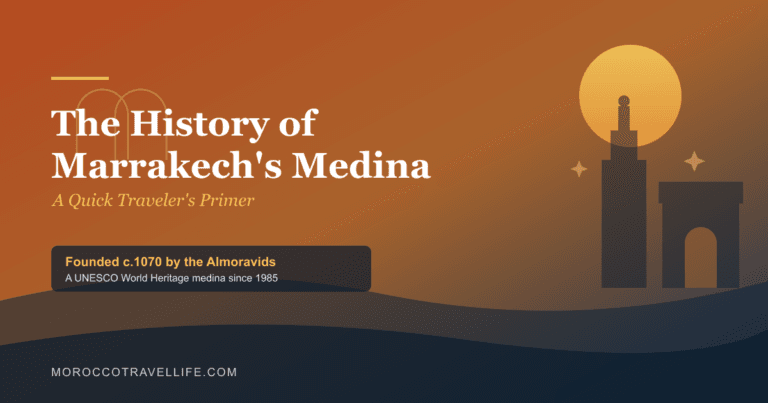
You don’t need a degree to read Morocco’s past in its streets. You need eight dates. Idris I founded Morocco’s first major Islamic dynasty in 788, and his son built Fes. The Almoravids rode out of the Sahara and founded Marrakech around 1070 as their capital (Wikipedia: Marrakesh, 2026), and the red-earth walls you see today still trace their city.
The Almohads replaced them in 1147 and raised the Koutoubia Minaret, Marrakech’s skyline-defining tower and sibling to Seville’s Giralda. The Marinids made Fes golden with madrasas in the 13th and 14th centuries; the Saadians left Marrakech its lavish tombs and the El Badi palace in the 16th; and the Alaouites, on the throne since the 17th century, still reign. King Mohammed VI is their direct descendant.
The modern rupture came late and left deep marks. France imposed its protectorate with the Treaty of Fez on March 30, 1912, and ruled until independence in March 1956 (Britannica, 2026): 44 years that explain the French you hear in banks, the ville nouvelle grid beside every old medina, and a complicated linguistic politics still playing out in schools today.
Notice what the protectorate’s own resident-general Lyautey chose to do, though. Rather than demolish the medinas, the French built their new towns alongside them. It’s why Moroccan cities today come in pairs, walled old city, gridded new one, and why you can walk from the 12th century to the 20th in about four minutes.
Marrakech’s own version of this story, covering who built which gate, why the medina is laid out the way it is, and what the Almoravid khettara irrigation channels did, is in my history of Marrakech’s medina.
Why Does Morocco’s Jewish Heritage Matter to Travelers?
Any honest Moroccan culture guide includes the mellahs, the historic Jewish quarters beside the royal kasbahs in nearly every imperial city. Jews lived in Morocco for over two thousand years, through Amazigh kingdoms and every Islamic dynasty, and by 1948 the community numbered around 270,000, then the largest in the Arab world. Waves of emigration to Israel, France, and Canada followed, and today roughly 2,100 Jews remain, most in Casablanca (World Jewish Congress, 2026).
What’s distinctive is how visibly Morocco has chosen to keep this heritage present. Restored synagogues in Fes, Marrakech, and Essaouira; the Casablanca Jewish Museum, the only one of its kind in the Arab world; Essaouira’s Bayt Dakira “House of Memory”; and cemetery restorations backed by the palace. The blue-shuttered mellah of Essaouira and Marrakech’s Lazama synagogue are open to any respectful visitor, and they reframe the whole country: Moroccan culture has never been a monoculture. Where to go and what you’ll find at each site is in my guide to Morocco’s Jewish heritage.
Why Does Moroccan Culture Change So Much by Region?
Moroccan culture shifts by region as much as it does by century, and the numbers back that up: Amazigh-language use rises from 24.8% nationally to roughly a third of the rural population, concentrated in the Atlas and the south (Yabiladi, 2024). The imperial cities, Marrakech, Fes, Meknes, Rabat, carry the urban, Arabized, historically cosmopolitan version: medina commerce, monument density, and the most tourism-adapted daily life.
The Atlas mountains run older software: Amazigh-speaking villages, agricultural rhythm, a hospitality culture that predates tourism entirely, and social codes that reward more conservative dress and slower interactions. The south, the Draa Valley, the oasis routes, the Sahara edge, mixes Amazigh, Arab, Sahrawi, and sub-Saharan heritage; Hassaniya Arabic appears, and the desert’s nomadic legacy is a living memory one generation back. And the Atlantic coast, from Tangier through Essaouira, has always faced outward: more relaxed, more Europeanized, salted with Portuguese and Spanish traces.
My field-tested advice after years of return trips: pair at least two of these Moroccos in one itinerary, because it’s the contrast that teaches. Travelers who only see Marrakech leave with a real but narrow impression. Those who add even two days in an Atlas valley or a desert town come back describing what feels like a second country. The culture shock between Moroccan regions is the best free education the country offers. A day trip from Marrakech into the mountains can do it if that’s all the time you have.
How Should a Traveler Actually Behave? The Short Version
Condensing Moroccan culture into a wallet card: greet before you ask; accept the tea; use your right hand; dress a notch more covered than you would at home, two notches in rural areas; ask before photographing people, and expect small payment requests from the water-sellers and performers whose image is their livelihood; keep public affection modest; stay out of working mosques; haggle warmly or not at all; be discreet with food and drink in public during Ramadan; and treat every invitation as the honor it is.
None of this is walking on eggshells. Moroccans are forgiving hosts who mostly find foreign fumbling endearing. It’s simply the difference between visiting a place and being welcomed by it.
Morocco in 2025 hosted a record 19.8 million visitors, up 14% in a single year (Ecofin Agency, 2026), and the country’s target of 26 million by 2030 means the culture described in this guide is absorbing more outside contact than at any point in its history. Travelers who arrive with a little cultural literacy aren’t just having better trips. They’re genuinely part of keeping the exchange worth having for the hosts’ side too.
Explore the Full Culture & History Series
Each layer of Moroccan culture above hands off to a full guide. The complete series:
- Moroccan etiquette: dress, greetings & Ramadan tips
- Moroccan food guide: 20 dishes to try
- Arabic vs Darija vs French: what Moroccans actually speak
- The history of Marrakech’s medina
- Amazigh (Berber) culture for travelers
- Mint tea culture: why it’s more than a drink
- Islam in Morocco & Ramadan travel
- Moroccan architecture 101: riads, kasbahs & zellige
- Morocco’s Jewish heritage: mellahs & synagogues
- Gnawa, chaabi & where to hear Moroccan music live
Frequently Asked Questions
What is Moroccan culture best known for?
Moroccan culture is best known for hospitality, the mint tea ritual, craft traditions, and layered identity. Morocco blends Indigenous Amazigh civilization with Arab-Islamic, Andalusi, West African, and French influences, visible in everything from trilingual street signs to Gnawa music, which UNESCO inscribed as Intangible Cultural Heritage in 2019. Its craft economy alone employs over 2.7 million people, so the culture travelers photograph is also a living industry.
Are Moroccans Arab or Berber (Amazigh)?
Both, usually in blend rather than either/or. The Amazigh are North Africa’s Indigenous people, and most Moroccans carry mixed Arab-Amazigh heritage. Morocco’s 2024 census found 24.8% of the population uses an Amazigh language daily, Tamazight has been co-official with Arabic since 2011, and the Amazigh New Year became a national holiday in 2024.
What religion is practiced in Morocco?
About 99% of Moroccans are Sunni Muslim of the Maliki school, and Islam is the state religion, with the king holding the title Commander of the Faithful. Small Christian and Jewish communities remain. Morocco’s Jewish community, now roughly 2,100 people, is the remnant of what was the Arab world’s largest at around 270,000 in 1948. Non-Muslim visitors are welcome everywhere except inside working mosques, with the Hassan II Mosque in Casablanca the notable exception.
Is Moroccan culture strict for tourists?
Less than most first-timers expect. Alcohol is legal and available in licensed venues, city dress codes are relaxed, and nobody expects visitors to observe Muslim practices. The genuinely important rules are few: dress modestly in rural areas, use your right hand for eating and greeting, ask before photographing people, stay out of working mosques, and be discreet with daytime food and drink during Ramadan.
What should I absolutely not do in Morocco?
Don’t refuse hospitality abruptly (soften any “no” with a smile and thanks), don’t photograph people without asking, don’t enter mosques as a non-Muslim, don’t eat or pass items with your left hand, don’t criticize the monarchy or Islam in conversation (both are legally and socially sensitive), and don’t treat haggling as combat. None of these require perfection; visible good intent covers almost every fumble.
When is the best time to experience Moroccan culture?
Any time, but the calendar peaks are real: Ramadan evenings (February-March in 2026, shifting earlier each year) for iftar street life, June for the Gnaoua Festival in Essaouira and the Fes Sacred Music Festival, and January 14 for the newly official Yennayer Amazigh New Year. Friday remains the weekly cultural moment year-round: couscous day, when families gather after the main prayer.
Putting It Together
Moroccan culture rewards exactly the kind of traveler curiosity you’ve just shown by reading 4,000 words about it. The layers, meaning Amazigh foundation, Islamic rhythm, hospitality codes, craft economy, and regional contrast, aren’t background to a Morocco trip; they’re the trip, whether you engage them deliberately or bump into them confused. Deliberate is better. Learn five Darija words, accept the tea, slow your greetings down, and the country opens up in ways no itinerary can schedule.
From here, go deep on whichever layer pulls you: the etiquette rulebook if you’re departing soon, the food guide if you plan trips around meals like I do, or the Amazigh culture primer if the identity story hooked you. For the trip-planning skeleton underneath it all, meaning visas, budgets, routes, and timing, my complete Morocco travel guide is the place to start, and my rundown of the best things to do in Morocco turns all this culture into an actual itinerary.