Last verified: September 18, 2026. I re-check the prices, taxi rules and holiday dates here against Bank Al-Maghrib, GOV.UK and my own field pricing, and update the date above each time. Dollar figures use my divide-by-10 rule, so treat them as approximate.
First time in Morocco tips tend to repeat the same three topics: visas, safety and packing. Those matter, but they aren’t what catches people out. Morocco logged a record 19.8 million arrivals in 2025, up 14% on the year before (ATTA, 2026), and most first-timers I meet trip over smaller things. A taxi in the wrong color. A riad door with no sign. A Friday afternoon when half the street closes for lunch.
Disclosure: Some links in this guide may earn us a commission, at no extra cost to you. It never changes what we recommend.
None of these needs a guide of its own. They’re the first time in Morocco tips I wish someone had handed me before my own first, slightly confused weeks here. I’ve come back across many seasons since, and this is still the list I give friends before they fly.
Key Takeaways
- Petit taxis are color-coded by city: ochre in Marrakech, red in Casablanca and Fes, blue in Rabat (Wikipedia, 2026).
- The dirham is a closed currency. You can carry at most 2,000 MAD in or out, so withdraw it on arrival (Office des Changes, 2024).
- A public hammam costs about 20-60 MAD, while a spa package runs about 300-700 MAD.
- Tips are expected but never required: about 5 MAD for a coffee and 20 MAD for a porter.
- Divide dirhams by 10 for a quick dollar estimate. The real rate was 9.51 MAD per dollar on 18 September 2026.
First Time in Morocco Tips
1. Why Are Petit Taxis a Different Color in Every City?
Every Moroccan city paints its petit taxis one color, so a licensed cab is easy to spot once you know the code. They’re ochre in Marrakech, red in Casablanca and Fes, blue in Rabat and light blue in Tangier (Wikipedia, 2026). Each one carries three passengers at most, and anything unpainted offering you a ride is not a petit taxi.
The color won’t stop a driver skipping the meter, though. GOV.UK advises you to agree a fare in advance or check the meter is running (GOV.UK, 2026). I say “compteur, s’il vous plaît” as I get in, and it settles the question. After 9 p.m., metered fares run about 50% higher. My guide to getting around Morocco covers grand taxis, trains and buses too.
2. Why Does Everything Slow Down on Friday?
Friday is the one day of the week that runs on a different clock. Jumu’ah, the midday congregational prayer, fills the mosques around 1 p.m. A long family lunch follows, and in many homes that means couscous. Some souk stalls close for the afternoon, and the whole country feels a notch calmer.
Don’t plan a packed shopping day for Friday afternoon. Book a garden, a museum or a slow lunch instead. Many restaurants only serve couscous on Fridays, so it’s the best day to order it. By early evening, the medina is back to full volume.
Friday is also when the difference between the old medina and the new town shows most clearly. In the Ville Nouvelle, supermarkets, chain cafés and malls keep normal hours all day, so that’s where to run errands if you need something done. Banks and government offices close at the weekend on Saturday and Sunday, not Friday, so Friday morning is still an ordinary working morning.
3. How Do You Find a Riad Behind an Unmarked Door?
Most riad entrances are plain wooden doors with no sign and often no visible number. That’s by design, because a riad turns inward to its courtyard and shows a blank wall to the street. GPS pins in the medina routinely land 30 meters off, and every alley looks alike on day one.
I’ve watched new arrivals walk past their own riad more than once. Save a photo of your exact door and the two landmarks nearest it. Ask a shopkeeper for the riad by name, not by street, because people know the name faster. Better still, ask the riad to meet you at the nearest taxi drop-off. Most will, and it’s one of the first time in Morocco tips I’d put near the top. My guide to booking a riad covers what else to ask before you arrive.
4. Why Can’t You Buy Dirhams Before You Land?
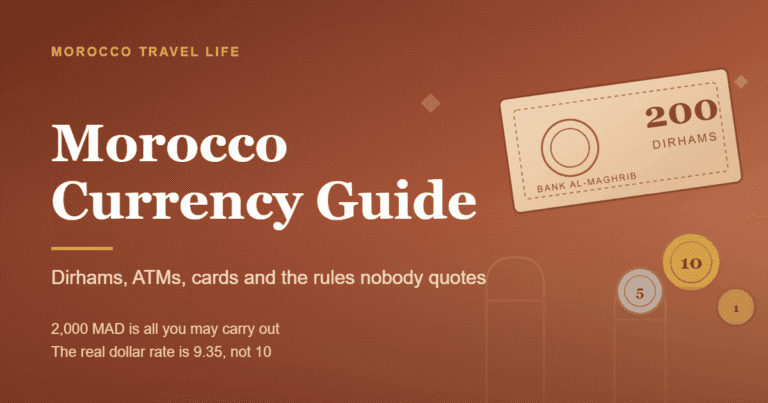
The dirham is a closed currency, so banks abroad don’t sell it. Visitors may carry at most 2,000 MAD in or out of the country (Office des Changes, 2024). The answer is simple: land with a card and withdraw as you go.
Cash still does most of the work. In 2024, 68% of all card operations in Morocco were cash withdrawals rather than payments (Bank Al-Maghrib, via Le360, 2025). Small shops, grand taxis and rural cafés rarely take cards. Use ATMs attached to a bank branch, not standalone machines in the souk. Withdraw larger sums less often to keep fees down. My Morocco currency guide covers ATM fees and changing money back.
5. Where Is Bargaining Expected, and Where Isn’t It?
Haggling is expected in the souks wherever prices aren’t marked. It isn’t expected in shops with price tags, supermarkets, pharmacies or cafés, and trying it there only confuses everyone. The skill isn’t aggression; it’s knowing which kind of shop you’re standing in before you open your mouth.
When you do haggle, decide your top price before you ask. Start well below it, stay friendly and be ready to walk away politely. A seller who lets you leave was never close to your number anyway. My Marrakech souk shopping guide goes deeper on how the back-and-forth works.
Expect the conversation to take a while, and don’t read the pace as pressure. A seller may offer mint tea, ask where you’re from and talk about the workshop before any number comes up. That’s part of how the souk works, and accepting the tea doesn’t commit you to buying anything. What does commit you is naming a price and then walking away after the seller agrees to it, which is the one move that genuinely causes offence.
6. Which Hammam Should You Try First?
A neighborhood public hammam costs about 20-60 MAD for entry. A spa or riad hammam package runs about 300-700 MAD (Morocco Travel Life field pricing, 2026). The public version is the real ritual, the one locals use every week. It’s also a lot to take in blind on your first day.
So start easy. Book a spa hammam first, where staff walk you through each stage of the scrub. Save the neighborhood hammam for later in the trip, once you know the routine. My Moroccan hammam guide explains the stages and how to pick a good one.
Bring: a swimsuit or spare underwear, flip-flops and a towel. At a public hammam, bring black soap and a kessa glove too, or buy them at the door. Lockers are rare, so leave valuables at your riad. Budget another 20-50 MAD to tip the scrubber.
7. The Right Hand Does the Work
Eating, greeting and handing over money are all done with the right hand. The left hand is associated with hygiene, and using it socially reads as impolite. It sounds like a small detail until you’re sharing a communal tagine at a family meal, and then it suddenly matters.
At that table, bread replaces the fork. Tear a piece, use it to scoop, and eat only from the part of the dish in front of you. Many Moroccans touch their right hand to their heart after a handshake, and you’re welcome to mirror it. My Morocco etiquette guide covers greetings, mosques and home invitations.
8. How Much Should You Tip in Morocco?
Tipping is one of the first time in Morocco tips people ask me about most. It isn’t legally required, but small tips are expected across nearly every service. Think 5 MAD for a café coffee, about 20 MAD for a luggage porter and 50-100 MAD for a full-day driver or guide (Morocco Travel Life field pricing, 2026). At a sit-down restaurant, 10-15% is normal (Wise, 2026).
Carry coins and small notes for this. Hand the tip over with your right hand, quietly, rather than leaving it on a café table. Nobody chases you over a missed tip, but the gesture is noticed, and it matters more than the amount.
9. The Call to Prayer Isn’t an Alarm
The adhan sounds five times a day from every mosque, and the first call comes before sunrise. It isn’t an alarm or an event; it’s the background rhythm of daily life, and by day three most visitors stop noticing it. The five calls are Fajr at dawn, Dhuhr at midday, Asr in the afternoon, Maghrib at sunset and Isha at nightfall, and their times move a few minutes every day with the sun.
Light sleepers should still pack earplugs. A riad beside a mosque hears the dawn call clearly, and the loudspeakers are close. If a quiet night matters to you, check a map before you book. Is it worth avoiding? Not for most people, and many visitors end up missing the sound when they fly home.
One practical note for sightseeing: most mosques in Morocco are closed to non-Muslims. The big exception is the Hassan II Mosque in Casablanca, which runs guided tours outside prayer times. Everywhere else, you can admire a minaret from the street, and the madrasas, the old religious schools, are open to visitors and show the same craftsmanship inside.
10. How Much Does the Dress Code Change by City?
Covering shoulders and knees is the safe default everywhere, but the local norm shifts by city. Fes and the smaller inland towns are the most conservative. Marrakech is more relaxed, and Essaouira and the surf coast are the most casual. During Ramadan, GOV.UK notes that clothing below local norms “may cause more offence” (GOV.UK, 2026).
Pack light layers you can adjust, not one outfit for the whole trip. Linen shirts and loose trousers cover most situations. What feels fine in a beach town can draw stares in a traditional medina. My Morocco packing list has the details. If you are traveling alone as a woman, my Morocco solo female travel guide goes further on which cities are easiest to start in.
Ramadan adds one more layer that first-timers often miss. GOV.UK notes that eating, drinking or smoking in public during daylight hours may cause offence while the fast is on (GOV.UK, 2026). Visitors aren’t expected to fast, and riads and tourist restaurants keep serving, but I keep my water bottle in my bag and my snacks indoors until sunset. It costs nothing, and it’s noticed.
11. Riad Wi-Fi Rarely Reaches Every Room
Most riads advertise Wi-Fi, and it usually works in the courtyard or lounge. Thick earth-and-stone walls often block it on the upper floors. That’s why a local SIM or eSIM is the better backup for maps, taxi apps and bookings, not a luxury.
Maroc Telecom has the strongest rural and mountain coverage in Opensignal’s 2025 report. That matters if your trip heads into the Atlas or toward the desert. My Morocco SIM card guide compares the three carriers and where to buy.
If your phone supports eSIM, you can set one up before you fly and land already connected, which helps when you’re trying to call your riad from the taxi rank. A physical SIM from a carrier shop is usually cheaper for a longer stay, and the airport arrivals halls in Marrakech and Casablanca have counters for all three networks. Either way, download offline maps of the medinas before you arrive, because GPS drifts in narrow alleys even when the signal is strong.
12. Is Every Friendly Approach a Scam?
No. GOV.UK warns that people posing as official guides often harass tourists in the medinas (GOV.UK, 2026). That warning is real, but after reading a scam list it’s easy to overcorrect into suspicion of everyone you meet.
Most invitations to mint tea, most strangers giving directions and most chatty shopkeepers are simply being hospitable. The tell is usually money. If a fee, a “closed road” or a detour to a cousin’s shop comes up unprompted, walk on politely. If it doesn’t, relax and enjoy the conversation. Of all these first time in Morocco tips, this one changes how the trip feels the most. My Morocco tourist scams guide covers the patterns worth recognizing.
13. How Do You Do the Exchange Rate Math in Your Head?
Divide by 10, which is the easiest of all these first time in Morocco tips to put into practice. On 18 September 2026, Bank Al-Maghrib’s reference rate put 1 US dollar at 9.51 MAD and 1 euro at 10.92 MAD (Bank Al-Maghrib, 2026). So a dirham price divided by 10 gives a fast dollar figure. It slightly understates the real cost, by about 5% at that rate. For euros, divide by 11.
That’s close enough to spot an absurd quote on the spot. I use the same rule for every dollar figure on this site, and I explain exactly how I convert dirhams in my currency guide.
14. Alcohol Exists, Just Discreetly
Alcohol is legal in Morocco, but it’s sold and drunk discreetly. GOV.UK notes that drinking in the street, or anywhere other than a licensed restaurant or bar, is illegal (GOV.UK, 2026). You’ll find it in hotel bars, licensed restaurants and some supermarket sections. You’ll rarely see it on a medina café menu.
Supply also tightens during Ramadan and the major Islamic holidays, when most outlets stop selling (Wikipedia, 2026). Ask your riad where the nearest licensed spot is rather than expecting one on every corner.
15. Which Holidays Reshape the Calendar Besides Ramadan?
Morocco keeps four Islamic public holidays on the lunar calendar: Islamic New Year, the Prophet’s Birthday, Eid al-Fitr and Eid al-Adha (Wikipedia, 2026). They sit on top of 11 fixed national holidays. Each lunar date lands about 11 days earlier every year.
In 2027, Ramadan is expected to start around 8 February, with Eid al-Fitr on 9 or 10 March (IslamicFinder, 2026). The final date depends on the moon sighting. Eid al-Adha follows about ten weeks later, and it’s the big one for travel. Families travel home, buses and trains fill, and many shops close for days. Check your dates before you book. If your trip overlaps the fasting month, read my guide to Morocco during Ramadan first.
The fixed holidays matter less, but a few still shape a trip. Throne Day on 30 July, Revolution Day on 20 August and the Youth Day and King’s Birthday holiday on 21 August cluster in high summer, and Green March Day on 6 November and Independence Day on 18 November fall in the autumn shoulder season (Wikipedia, 2026). Banks and offices close, while most shops, riads and sights stay open. If you plan to take a train on one of these long weekends, book a few days ahead.
How Should You Use These Tips in Your First 24 Hours?
Most of these first time in Morocco tips pay off in the first day, before jet lag wears off and before you’ve found your feet. I think of them as a short arrival routine. None of it takes long, and it turns the first evening from a stressful search into a relaxed dinner.
At the airport: withdraw enough dirhams for two or three days from a bank ATM in the arrivals hall, and break a large note at a café or kiosk so you have coins for tips. Buy a SIM or switch on your eSIM before you leave the building. If your riad offered a pickup, look for your name on a sign. If not, find the official taxi rank and check the car’s color matches the city.
At the riad: photograph the door and the nearest landmark before you go out, and ask the staff to mark the closest taxi drop-off on your map. Ask them which hammam they’d recommend, whether any holiday falls during your stay and where the nearest licensed restaurant is if you’d like a glass of wine with dinner.
On the first evening: walk the medina without trying to buy anything. Watch how prices are shown, listen for the Maghrib call at sunset, and let a stranger’s greeting be just a greeting. By the next morning, most of the list above will already feel familiar. Isn’t that the point of learning it in advance?
Frequently Asked Questions
What are the most useful first time in Morocco tips?
The most useful first time in Morocco tips are small and practical. Learn your city’s taxi color, save a photo of your riad door, carry coins for tips and withdraw dirhams on arrival. Those four habits prevent more first-day stress than any safety warning.
Is it rude not to tip in Morocco?
No. Tipping is appreciated but never legally required. The norm is small: about 5 MAD for a café coffee, about 20 MAD for a porter and 10-15% at a sit-down restaurant. Nobody will confront you over a missed tip, though a coin is always noticed.
Should I visit a hammam on my first trip to Morocco?
Yes. A spa hammam at about 300-700 MAD is the easier first version, with staff who explain each step. A neighborhood public hammam costs about 20-60 MAD and is the more authentic experience once you know the routine.
Do I need to know Arabic or French to get by in Morocco?
No, though a few words help. The 2024 census found 91.9% of Moroccans use Darija in daily life, and French is common on signs and in business. Riad staff in tourist cities usually speak English, and a few words of Darija always earn a smile.
Can I pay by card in Morocco?
In hotels, larger restaurants and chain stores, usually yes. Small shops, taxis and markets are mostly cash. A float of 300-500 MAD per person per day covers taxis, tips and small purchases. Withdraw it from ATMs attached to bank branches.
How different is Morocco from city to city?
Quite different. Fes is the most conservative and traditional, Marrakech the most used to visitors, and coastal towns like Essaouira the most relaxed. Don’t assume one city’s norms carry over to the next stop on your route.
Conclusion
None of these 15 things is dangerous or complicated. They’re the gaps between what guidebooks cover and what actually catches people off guard. Learn the taxi colors, save a photo of your riad door, carry coins and give Friday its slower pace. The rest of the trip tends to run itself.
Those are the first time in Morocco tips I’d hand a friend at the airport, and I still run through the same list myself each time I land. For the bigger picture, my best time to visit Morocco guide and my Morocco tourist scams guide answer the two questions first-timers ask me most. Still planning the whole trip? Start from my complete Morocco travel guide.