Is Morocco safe? Yes, more so than most people assume before they visit, and less simply than a one-word answer suggests. I’ve spent months here across repeat, extended stays. The gap between what people fear before they land and what they actually experience is one of the widest I’ve seen for any destination.
Disclosure: Some links in this guide may earn us a commission, at no extra cost to you. It never changes what we recommend.
This isn’t a reassurance piece designed to sell you a trip. It’s an honest breakdown of what the actual advisory levels say and where the real risks sit. It’s also where the conventional “is Morocco safe” fear genuinely undersells or oversells the picture, including the parts that don’t fit neatly into a marketing-friendly answer.
Key Takeaways
- Morocco holds a US State Department Level 2 travel advisory (Exercise Increased Caution, due to terrorism), the same tier the US applies to France, Spain, Germany, and the UK.
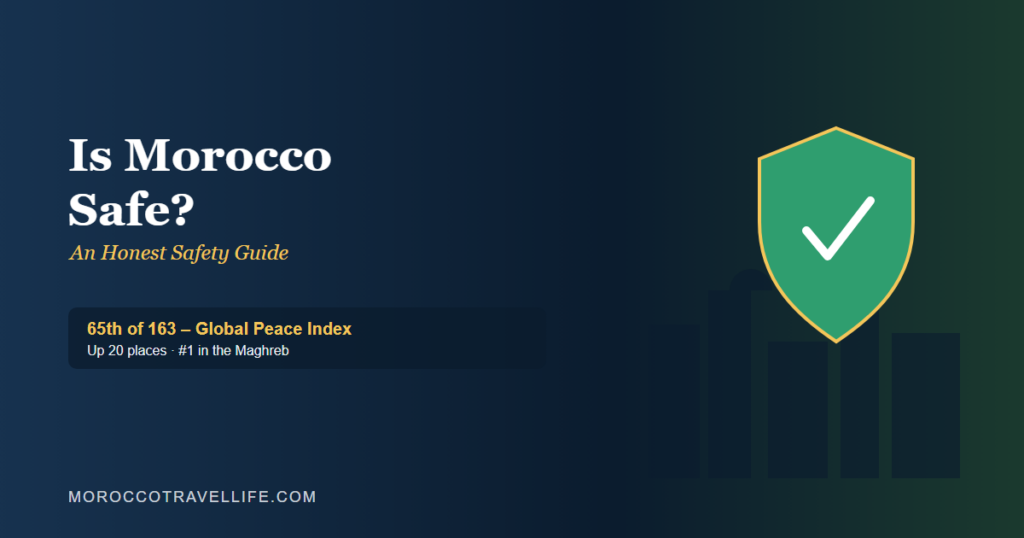
- Morocco jumped 20 places to rank 65th of 163 countries on the 2026 Global Peace Index with a score of 1.895, finishing ahead of France (99th) and every other Maghreb country (Institute for Economics and Peace, 2026).
- The UK Foreign Office warns that women may receive unwanted attention, especially when travelling alone. Harassment is the most common complaint and is overwhelmingly verbal rather than physical (GOV.UK, 2026).
- Same-sex relationships remain criminalized under Article 489 of the penal code; enforcement overwhelmingly targets Moroccan nationals, not tourists, but discretion matters.
- Youth-led protests across 11+ cities in September–October 2025 were the largest since 2011. They were serious, but not targeted at tourists or tourist areas.
Table of Contents
What Do the Actual Advisory Levels Say?
Start with the people whose job is to say so. Morocco carries a Level 2 US State Department advisory: Exercise Increased Caution, due to terrorism, reissued in April 2025 (US State Department). That reads worse than it is in context. Level 2 is the same tier the US applies to France, Spain, Germany, Italy, and the UK, and it sits two full steps below the “Do Not Travel” tier.
The UK’s Foreign, Commonwealth & Development Office rates it similarly. No advisory applies against travel to any tourist destination, including Marrakech, Fes, Agadir, Chefchaouen, Tangier, or the Sahara. Specific warnings are limited to the Algerian border area and parts of Western Sahara (GOV.UK, 2026).
Canada and Australia both advise a somewhat more cautious “exercise a high degree of caution.” Both largely cite the general possibility of terrorism common to advisories across North Africa and the Middle East, plus the same specific border-area warnings the UK flags. None of the four major English-speaking advisories recommend against visiting Morocco’s tourist circuit.
| Government | Advisory Level | Specific Warnings |
|---|---|---|
| United States | Level 2, Exercise Increased Caution (terrorism) | None specific to the standard tourist circuit |
| United Kingdom | No advisory against travel | Algerian border, parts of Western Sahara |
| Canada | Exercise a high degree of caution | Algerian border, Western Sahara, romance scams |
| Australia | Exercise a high degree of caution | Algerian border, Western Sahara |
Source: Official government travel advisory pages, cross-checked 2026.
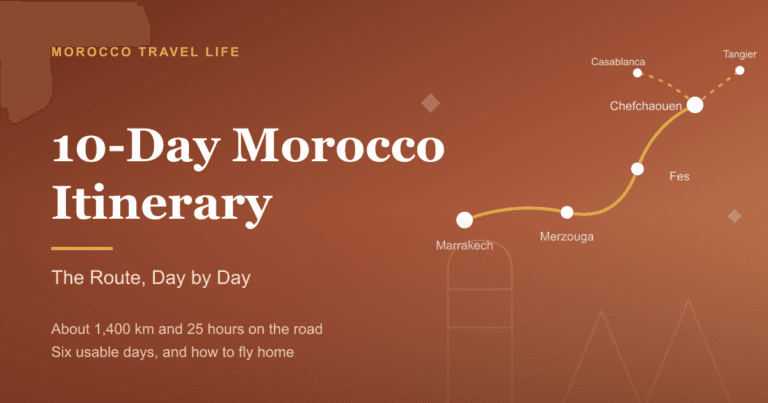
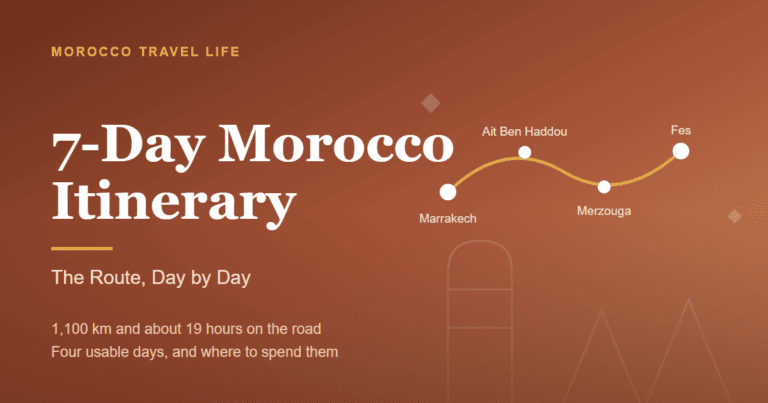
Every government warning I’ve checked converges on the same two specific areas: the Algerian land border and Western Sahara. Neither sits anywhere near Marrakech, Fes, Chefchaouen, the Sahara tourist circuit around Merzouga, or the coast. If your itinerary looks anything like the routes in my 7-day vs 10-day vs 14-day itinerary comparison, you’re nowhere near the areas any advisory actually flags.
The France comparison isn’t just a rhetorical device, either. On the 2026 Global Peace Index, Morocco ranks 34 places above France, which finished as the lowest-ranked country in Western and Central Europe (Institute for Economics and Peace, 2026).
How Does Morocco Compare on Real Safety Data?
If you want the “is Morocco safe” question answered with numbers rather than impressions, two independent indices do it. Morocco ranked 65th of 163 countries on the 2026 Global Peace Index with a score of 1.895, up 20 places from 85th the year before. That puts it ahead of every other country in the Maghreb: Tunisia sits 77th, Algeria 91st, and Libya 125th (Institute for Economics and Peace, 2026).
On the separate Global Terrorism Index, Morocco scored zero in the 2026 edition. That places it joint 100th and among roughly 25 countries with no recorded incidents in the index’s current scoring window (Morocco World News, 2026).
That window looks back a few years, not forever, and it’s worth being straight about the record underneath it. A bomb at the Argana cafe on Marrakech’s Jemaa el-Fna killed 17 people in April 2011 (Al Jazeera, 2011). Two Scandinavian hikers were murdered near Imlil in December 2018, in an attack Moroccan courts prosecuted as terrorism (France 24, 2018). The defensible claim is the narrower one: no recorded terrorist incidents in recent years, and no mass-casualty attack in well over a decade.
None of this means crime doesn’t exist, and the index scores shouldn’t be read as a promise. The UK Foreign Office is blunter than most tourist-facing writing on this point: petty crime is prevalent in tourist zones, and while violent crime is uncommon, it warns that criminals “have used knives against tourists in street attacks” (GOV.UK, 2026). Rare is not the same as never. The realistic picture is that pickpocketing, bag-snatching, and scam attempts in dense tourist areas are what you should actually plan around.
Is Morocco Safe for Solo Female Travelers?
This is the version of “is Morocco safe” I get asked most often, and it deserves a straight answer. Yes, with real caveats worth taking seriously. The UK Foreign Office puts it plainly: women may receive unwanted attention in Morocco, especially when travelling alone, and it recommends loose-fitting clothing that covers arms, legs, and chest (GOV.UK, 2026). The dominant issue is harassment: persistent and usually verbal rather than physical danger, concentrated in dense tourist zones more than in the country broadly.
There is a clear gradient between cities, and Agadir, Essaouira, and Rabat run calmer than Marrakech’s most touristed lanes. My what to pack for Morocco guide covers the modest-layers question, and Morocco etiquette explains why it changes how you are treated. For the full version, including city-by-city hassle levels, real dirham costs, the emergency numbers that work from a mobile, and what to do when harassment starts, see my Morocco solo female travel guide.
Is Morocco Safe for LGBTQ+ Travelers?
This is the one area where “is Morocco safe” doesn’t have a comfortable answer, and I’d rather be direct than soften it. Same-sex relationships remain criminalized under Article 489 of Morocco’s penal code, punishable by three to five years in prison and a fine. The UK Foreign Office states flatly that same-sex sexual relations are illegal in Morocco, advises against public displays of affection, and warns that complaints can lead to prosecution (GOV.UK, 2026).
In practice, enforcement overwhelmingly targets Moroccan nationals rather than foreign visitors, and documented prosecutions of tourists specifically for same-sex relationships are rare. That’s not the same as risk-free. Some travelers have reported harassment or scam attempts initiated through dating apps. Discretion is the realistic, honest recommendation, not an assumption that the law simply doesn’t apply to tourists. Avoid public affection, be cautious about meetups arranged online, and choose well-established hotels over locally-owned riads if that matters to you.
What Actually Happened With the 2025 Protests?
Between late September and mid-October 2025, youth-led demonstrations spread across more than a dozen Moroccan cities, including Rabat, Casablanca, Marrakech, and Tangier. It was the largest wave of protests since 2011 (Al Jazeera, 2025). The demonstrations were organized by decentralized youth collectives and driven by unemployment and frustration over public spending priorities. Clashes with security forces resulted in several deaths and injuries before the protests wound down through October.
This is worth including in a safety guide precisely because most tourist-facing content ignores it. Pretending it didn’t happen isn’t the same as being honest about risk. Two things matter for travelers. The unrest was domestic and political, not targeted at foreigners or tourist infrastructure, and it had concluded by the time the government introduced political-participation reforms afterward.
The practical takeaway isn’t different from standard travel advice anywhere. The UK Foreign Office notes that protests can occur across the country, particularly in large cities, often without warning, and that while authorized gatherings are usually peaceful, unauthorized ones have escalated into confrontations with police (GOV.UK, 2026). Avoid large public gatherings if you encounter one, and check local news for your specific dates, since the underlying grievances haven’t fully disappeared.
What Are the Real Risks?
For most visitors, “is Morocco safe” comes down to this section rather than to any advisory. Here’s what actually shows up day to day. Petty theft, pickpocketing in crowded souks, and tourist-targeted overcharging are the genuine, common risks, not violent crime and not terrorism. Taxi fare disputes, unofficial “guides” pressuring you toward specific shops, and inflated prices for goods or services are the day-to-day friction most visitors actually encounter. Every one of them is manageable with basic awareness.
In my experience fielding reader questions, roughly nine in ten “is this a scam” messages I get are about a fixed-price disagreement or a pushy shop tactic. Almost none approach an actual safety threat. I cover the specific scam patterns and how to avoid them in my dedicated Morocco tourist scams guide, since that topic deserves more depth than a safety overview can give it. If this is your first trip, 15 things I wish someone had told me covers the rest of the friction.
Frequently Asked Questions
Is Morocco safe to visit right now?
Yes. Morocco holds a Level 2 US State Department advisory (Exercise Increased Caution, due to terrorism), the same tier the US applies to France, Spain, Germany, and the UK. It also ranks 65th of 163 countries on the 2026 Global Peace Index, ahead of France at 99th, and scored zero on the 2026 Global Terrorism Index. The realistic day-to-day risks are petty theft and scams rather than violent crime.
Is Marrakech safe for tourists?
Yes, with the same caveats as any dense tourist city. Watch for pickpocketing in the souks and be firm with unofficial guides. Violent crime against tourists is uncommon and millions pass through the medina safely each year, though the UK Foreign Office does warn that street attacks involving knives have happened, so uncommon isn’t the same as impossible.
Is it safe to walk around Morocco at night?
Major tourist areas in cities like Marrakech, Fes, and Rabat are generally safe to walk at night, especially well-lit main streets and squares. As anywhere, avoid poorly lit side streets alone late at night and use a taxi if you’re unsure of the route back.
Do I need travel insurance for Morocco?
It’s strongly recommended, though not a formal entry requirement for most nationalities. Travel insurance covering medical evacuation is worth having given Morocco’s varied terrain, from desert to mountains to coast, where the nearest major hospital can be hours away.
Are the 2025 protests still a safety concern in 2026?
Not for typical tourist itineraries. The September–October 2025 demonstrations concluded by late October and were not directed at foreigners or tourist areas. The UK Foreign Office does note that protests can occur in large cities without warning, so check local news for your travel dates as routine practice, the same way you would before visiting any country.
Is Morocco safe for families with young children?
Yes, and families are common on the standard tourist circuit. Marrakech works well because the main sights sit a short taxi ride apart, and Essaouira’s calmer medina and beach suit children better than a desert overnight. The usual advice is to save a Sahara camp night for kids over about eight, since the drive is long and the temperature swing is real.
Conclusion
Is Morocco safe? The honest answer is yes, backed by real data: a Level 2 advisory that puts it in the same tier as most of Western Europe, a Global Peace Index ranking that jumped 20 places in a single year to finish 34 spots above France, and a score of zero on the 2026 Global Terrorism Index. But “safe” doesn’t mean risk-free. The specific risks (harassment, the LGBTQ+ legal reality, petty scams, and genuine if non-tourist-targeted political unrest) deserve honest treatment rather than either dismissal or exaggeration.
Plan around the real picture, not the stereotype. Start with the complete Morocco travel guide if you’re still working out the rest of your trip, or lock in your route with my 7-day vs 10-day vs 14-day itinerary comparison.