Last verified: October 16, 2026. I re-check the census, tourism and craft figures here against HCP and ministry releases, and the festival and Ramadan dates against organisers’ and calendar sources. Ramadan dates are estimates until Morocco’s moon sighting confirms them.
This Moroccan culture guide starts at a neighbor’s door. Rachid, my neighbor whenever I’m in Marrakech, has never let me walk past without trying to feed me. He isn’t offering, he’s trying: the door is already open and a tagine is already on the table behind him. On my first stays I treated this as politeness, to be politely declined. It took me far too long to see that the invitation wasn’t a courtesy. It was Moroccan culture itself, working exactly as designed, and my refusals read as strange rather than modest.
Disclosure: Some links in this guide may earn us a commission, at no extra cost to you. It never changes what we recommend.
That gap is what this guide is for: the distance between how Moroccan culture looks in a guidebook and how it works when you’re inside it. Most of what confuses first-time visitors isn’t exotic at all once you see the logic underneath.
Why do greetings take three minutes? Why is haggling friendly rather than hostile? Why does the whole country reorganize itself for a month each year? And why does the person pouring your tea hold the pot so high? This is the overview of Moroccan culture, the operating system if you like, and each major topic below hands off to a deeper guide in my Culture & History series.
Key Takeaways
- Morocco counted 36,828,330 people in its 2024 census. 91.9% use Darija and 24.8% use an Amazigh language (HCP, 2024).
- Over 99% of Moroccans are Sunni Muslim, so prayer times, Fridays and Ramadan set the daily rhythm.
- Hospitality is the core code. Accept the tea, greet slowly, use your right hand.
- All nine of Morocco’s UNESCO World Heritage sites are cultural, not natural.
- Crafts are a living industry: about 140 billion dirhams a year and 7% of GDP.
What Actually Shapes Moroccan Culture?
Moroccan culture is a stack of layers, and none of them replaced the one before. The base is Amazigh, North Africa’s Indigenous civilization. On top sit 13 centuries of Arab and Islamic influence, Andalusi refugees with Iberian craft and music, and West African rhythm carried north by Saharan trade. Then came 44 years of French rule, from 1912 to 1956 (Britannica, 2026).
That stacking is why Moroccan culture feels contradictory until, suddenly, it doesn’t. The same Marrakchi who prays five times a day queues for a French pastry. A wedding procession I followed down a Marrakech side street opened with Quranic recitation and closed with a Gnawa troupe whose roots run to West Africa. Here’s my working rule: when something in Morocco seems to contradict itself, you’re usually looking at two layers at once.
Morocco is also a young society wrapped around old institutions. The Alaouite dynasty has reigned since the 17th century, and the king holds the religious title Commander of the Faithful. Yet 26.5% of Moroccans are under 15, and only 13.8% are 60 or over (HCP, 2024). The person you meet is probably on the same phone as you, and as likely to answer in English as in French.
That ageing line matters, too. The share aged 60 and over has nearly doubled since 2004, from 8% to 13.8%. Morocco is changing fast, and the tension between the old frame and the young crowd is modern Moroccan culture.
Who Are Moroccans: Arab or Amazigh?
The honest answer is both, usually in blend. Morocco’s 2024 census counted 36,828,330 people (HCP, 2024). Ask them what they are and you’ll rarely get one word back, because most Moroccans carry Arab and Amazigh heritage in some mix. Identity in Moroccan culture works more like a blend than a checkbox.
Amazigh means “free people,” and it’s the word to prefer over “Berber,” which comes from the same root as “barbarian.” The Amazigh were here for thousands of years before Arab armies arrived in the 7th century.
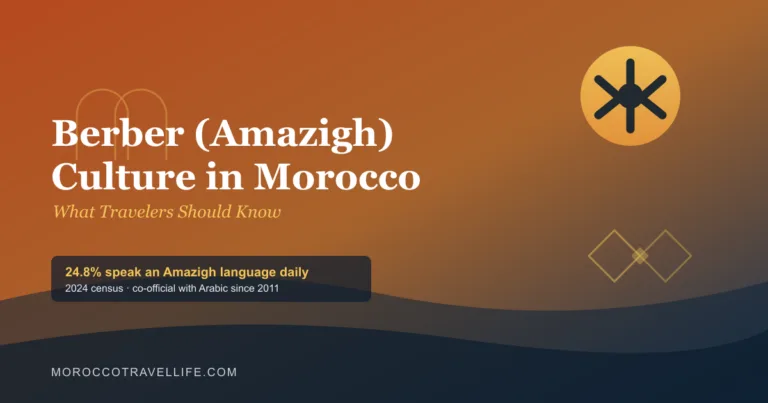
The census puts numbers on it. 24.8% of Moroccans use an Amazigh language, rising to 33.3% in rural areas and falling to 19.9% in cities (HCP, 2024). Tachelhit in the south is the largest variety at 14.2%. Central Atlas Tamazight follows at 7.4% and Tarifit in the north at 3.2% (Yabiladi, 2024). Amazigh associations call these figures undercounts. That dispute is itself a live cultural debate worth knowing about.
Official recognition is recent, and you’ll see its results everywhere. The 2011 constitution made Tamazight co-official with Arabic, which is why city street signs often run in three scripts: Arabic, Tifinagh (the geometric Amazigh script) and French. In 2024 Morocco marked Yennayer, the Amazigh New Year on January 14, as a paid national holiday for the first time (Morocco World News, 2024).
For the deeper story, from Tifinagh to tattoo and carpet symbols, see my guide to Amazigh (Berber) culture in Morocco. If you want the lived version, a visit with a Berber family in the Atlas teaches more in an afternoon than any book.
What Language Should You Expect to Hear?
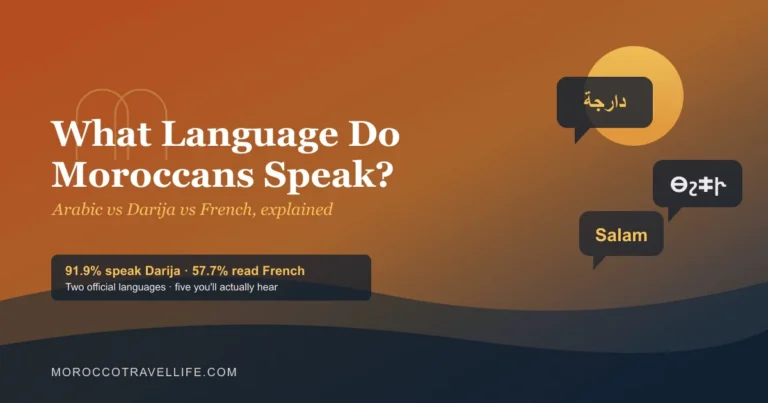
You’ll hear Darija everywhere, French in the cities, Amazigh in the mountains and the south, and enough English in tourist areas to get by. In the 2024 census, 91.9% of Moroccans used Darija. Among literate people aged 10 and over, 57.7% could read and write French and 20.5% English (HCP, 2024). In Moroccan culture, switching languages mid-sentence isn’t showing off. It’s Tuesday.
There’s a catch if you studied Arabic: Darija sits far from textbook Modern Standard Arabic, and Arabic speakers from the Middle East often struggle with it. It drops vowels, borrows from Amazigh, French and Spanish, and moves fast.
Five phrases carry me through most days, and I’d give any visitor the same kit:
- Salam alaykum: hello
- Shukran: thank you
- La, shukran: no thank you, the one you’ll use most in the souks
- Bshhal?: how much?
- Bslama: goodbye
Ten minutes of practice pays back absurdly well. Vendors drop their tourist patter, taxi talk softens, and a greeting in Darija opens doors that money doesn’t.
The full picture, including where French won’t help you and a proper phrase list, is in my breakdown of what language Moroccans actually speak.
How Does Islam Shape Daily Life and Travel?
Islam isn’t a compartment of Moroccan culture. It’s the clock. More than 99% of Moroccans are Sunni Muslim, Islam is the state religion, and the king is Commander of the Faithful (US State Department, 2024). For a traveler, that shows up as rhythm: the call to prayer five times a day, Friday’s long midday pause, and the yearly reset of Ramadan.
You’ll hear the dawn call wherever you sleep in a medina, and my advice is to stop treating it as noise and start treating it as the soundtrack. Within a week most visitors do.
What surprises people more is how relaxed Morocco is with visitors. Alcohol is legal in licensed bars, restaurants and supermarkets, nobody expects non-Muslims to fast, and cities are used to every kind of dress. Respect is noticed and returned, but nobody asks you to perform piety.
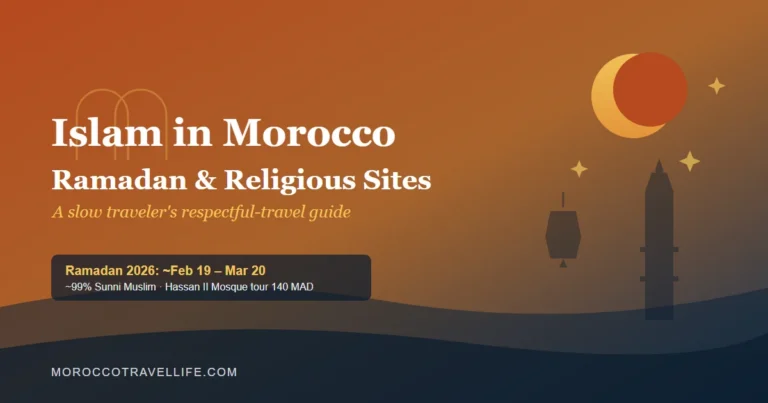
Two rules stand above the rest. First, non-Muslims may not enter working mosques. The big exception is Casablanca’s Hassan II Mosque, which runs guided tours. The other one people cite, the Almohad-era Tin Mal Mosque in the High Atlas, was badly damaged in the September 2023 earthquake. Its restoration resumed in 2025 and no reopening date has been announced (Le360, 2025). Admire the rest from the doorway. The doorways are spectacular anyway.
Second, plan around Ramadan if your dates overlap it. The month slides about 11 days earlier each year. Ramadan 2027 is expected from roughly February 8 to March 9 (IslamicFinder, 2026). Eat and drink discreetly in public by day, then join the streets after sunset. Iftar-season Morocco at night is one of the best cultural experiences the country offers.
Ramadan travel gets its own planning in my guide to Islam in Morocco and traveling during Ramadan. It covers what’s open, what changes, and why some of my favorite Marrakech nights happen in the fasting month.
Why Does Hospitality Matter So Much in Moroccan Culture?
Hospitality is the first code most visitors meet, and Morocco had a record 19.8 million of them in 2025, up 14% on 2024 (FNH, citing the Ministry of Tourism, 2026). The core idea in Moroccan culture is simple: a guest is close to sacred. That’s why Rachid keeps trying to feed me, and it’s also why “come for dinner” from someone you met an hour ago is usually a real invitation.
Greetings are the visible grammar of all this. Moroccans greet at length. A handshake lingers, a hand goes back to touch the heart, and a volley of questions follows about your health, your family and your day, none of which expect detailed answers. Rushing the greeting to get to your question is the most common small rudeness visitors commit. Slow down for 90 seconds and everything after goes better.
Between men and women, let the woman offer her hand first. A hand on the heart with a smile is a warm alternative, and it’s never wrong.
A few codes to learn early:
- The right hand is for eating, greeting and passing things. The left is traditionally for hygiene.
- Shoes come off when you enter a home. Watch for the pile at the door.
- City dress is more relaxed than most blogs claim. Covered shoulders and knees are still the respectful default outside resort areas, and they change how rural Morocco receives you.
- If someone invites you home, accept if you can. Bring pastries from a good patisserie, and expect to be fed past the point of reason.
Here’s the reframe that unlocked Morocco for me. Interactions that feel “inefficient” in Moroccan culture aren’t failed transactions. They’re successful relationships. The long greeting, the tea before business, the shopkeeper who asks where you’re from before quoting a price: none of it is friction in the system. It is the system. Travelers who fight it have a stressful trip, while travelers who go with it get invited to weddings.
The neighborhood hammam belongs here too. It’s one of Morocco’s oldest social institutions, less a spa than a weekly ritual of scrubbing, gossip and community. My Moroccan hammam guide explains the local and tourist versions. For dress by region, photography, tipping and mosque manners, see my full guide to Moroccan etiquette for travelers. First visit? My first-time Morocco tips cover the practical layer.
Why Is Haggling a Social Ritual, Not a Fight?
Almost every bad souk story I hear comes from one mistake: treating bargaining as conflict. In Moroccan market culture, negotiation is conversation, and the opening price isn’t a lie but an invitation to talk. Walking in, paying the first number and leaving is, from the vendor’s side, a slightly cold encounter.
The ritual has steps: you admire, you ask, you hear a price, you laugh gently, you counter low. You drink the tea if it appears, you meet somewhere in the middle, and you part with a handshake and a bslama. Ten minutes, maybe fifteen. The final number usually lands between a third and two-thirds of the opening ask, depending on the item and the city.
Fixating on that number misses the point, though. You’ve just been welcomed into a commercial culture that runs on relationship, and the vendor will remember you tomorrow.
My honest confession is that I still pay too much for carpets, and I’ve stopped minding. One early afternoon in a Rahba Kedima shop ran to four glasses of tea, a geography lesson on Atlas weaving villages, and a carpet I still use daily. That was worth more than the couple of hundred dirhams a harder negotiator might have saved. Bargain seriously, but keep score in experiences, not dirhams.
Walk away politely if the price isn’t right. Half the time that’s when the real price appears. And never start haggling for something you wouldn’t buy. The full playbook, with price ranges for leather, ceramics, spices and carpets, is in my Marrakech souk shopping guide.
Food Culture: Why Is the Table the Social Center?
You can read Moroccan culture straight off the table. Meals are shared: the tagine lands in the middle and everyone eats from their own side of the dish, right-handed, with bread as the spoon. Khobz, the round daily loaf, gets near-religious respect. You’ll see dropped bread picked up, kissed and set aside rather than left on the ground.
Friday couscous is one of the strongest Morocco customs and traditions: families gather over it after the main midday prayer, and many restaurants serve it only that day. UNESCO added couscous to its Intangible Cultural Heritage list in 2020, as a joint file from four Maghreb countries (UNESCO, 2020).
Travelers underestimate how regional the food is. Marrakech does tanjia, beef or lamb slow-cooked overnight in the embers of a hammam furnace. The coast does chermoula sardines and fish tagines. Fes claims pastilla, the sweet-savory pie with Andalusi roots. The south leans on dates, amlou and argan oil, from a tree that grows wild almost nowhere but southwestern Morocco. Eating your way across regions is one of the best frames for a Morocco itinerary.
Street food deserves more trust than most first-timers give it. Think the busiest snail-soup cart in Jemaa el-Fna, the hole-in-the-wall msemen griddle, the olive stalls stacked like jewelry. High turnover is the hygiene signal locals use, and it works.
Start with my Moroccan food guide to 20 dishes worth seeking out. If you’d rather learn from inside a kitchen, a Moroccan cooking class is the best cultural half-day I recommend. Most start with a guided market shop.
Mint Tea: Why Does One Small Glass Matter So Much?
Atay is green tea steeped with fresh spearmint and a lot of sugar. It’s Morocco’s handshake, its welcome mat and its excuse to sit down, which makes it Moroccan culture in one small glass. The scale behind the ritual surprises people. Morocco was the largest buyer of Chinese tea in 2025, at $280 million, up 14.7% on the year, according to Chinese customs data (Hespress, 2026). Nearly all of it ends up in that same minty glass.
Know these three rules going in:
- Refusing tea outright can read as refusing the relationship. Accept the glass, even if you barely sip it.
- The high pour isn’t showing off. It aerates the tea and builds the foam crown that marks a well-made glass.
- The old saying about three glasses, gentle as life, strong as love, bitter as death, describes a real change as the pot steeps.
So when a carpet seller offers tea mid-negotiation, is it a sales trap? Not really, because it’s the older logic under the sale: no relationship, no transaction.
Why tea, why China, and how to make a proper pot yourself: the whole story is in my piece on Moroccan mint tea culture.
Why Is Morocco’s Craft Economy Still Made by Hand?
The zellige, carved cedar and hammered brass filling your camera roll aren’t heritage theater for Moroccan culture. They’re one of Morocco’s largest industries. The handicraft sector turns over about 140 billion dirhams a year, roughly 7% of GDP, from some 275,000 craft units (Le360, 2025). It employs more than 2.6 million people, about 22% of the workforce (The North Africa Post, 2026).
The maâlem system, master artisans training apprentices over years, still runs the workshops you’ll pass in any medina. The newest proof that this is living culture came in December 2025. UNESCO inscribed the Moroccan caftan, with the skills behind it, on its Intangible Cultural Heritage list (Hespress, 2025).
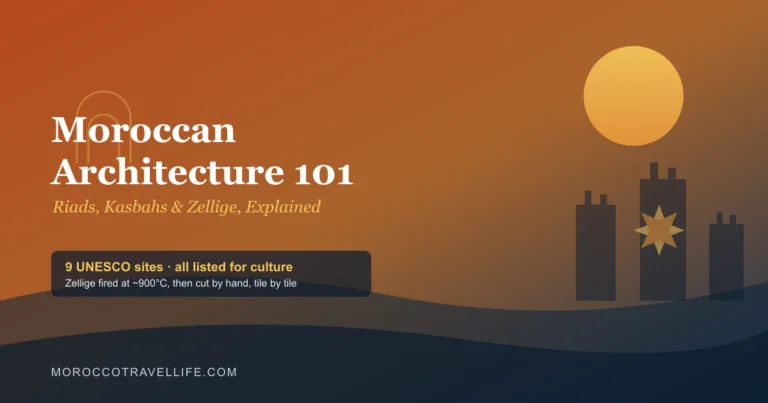
Moroccan architecture runs on one idea worth knowing before you arrive: beauty faces inward. A riad shows the street a blank wall and a modest door, then opens onto a courtyard of fountains and tile: privacy outside, paradise inside. The same vocabulary repeats at every scale: keyhole arches, zellige geometry, carved plaster, cedar ceilings.
In the south the material shifts to rammed earth, the stuff of the kasbahs and fortified ksour on the desert routes. A few nights in a riad is the cheapest architecture lesson you’ll ever get. My riad vs hotel comparison covers the trade-offs. The short version: do it.
UNESCO agrees about the density. Morocco holds nine World Heritage sites, and every one is listed as cultural (UNESCO World Heritage Centre, 2026):
| Site | Inscribed |
|---|---|
| Medina of Fez | 1981 |
| Medina of Marrakesh | 1985 |
| Ksar of Ait-Ben-Haddou | 1987 |
| Historic City of Meknes | 1996 |
| Archaeological Site of Volubilis | 1997 |
| Medina of Tétouan | 1997 |
| Medina of Essaouira | 2001 |
| Portuguese City of Mazagan (El Jadida) | 2004 |
| Rabat, Modern Capital and Historic City | 2012 |
Fourteen more sites sit on Morocco’s Tentative List, Tin Mal’s mosque among them. What exactly is a riad, how does a kasbah differ from a ksar, and why does real zellige cost what it does? All answered in Moroccan architecture 101.
Music: Gnawa, Chaabi, and a Very Loud Living Tradition
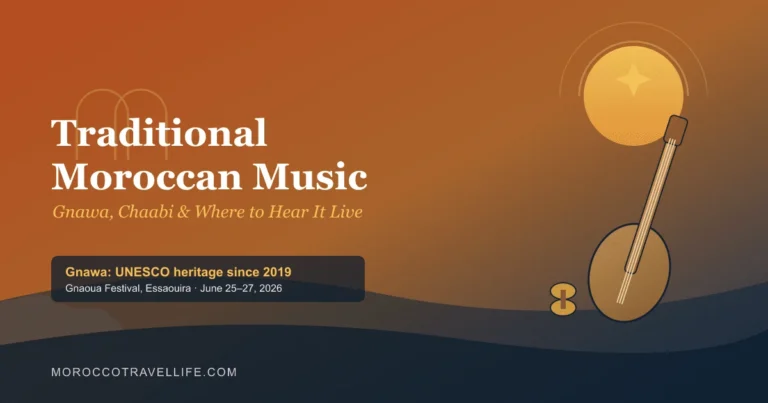
Music is the loudest part of Moroccan culture, and it’s participatory, spiritual and everywhere. Wedding drums come down residential streets and Andalusi orchestras play in Fes. And there’s the hypnotic three-string guembri of Gnawa, a tradition carried north by enslaved and displaced West Africans and made into something Moroccan. UNESCO inscribed Gnawa on its Intangible Cultural Heritage list in 2019 (UNESCO, 2019). It runs from all-night healing rituals, the lilas, to festival main stages.
Chaabi is the sound you’ll hear most. It’s Morocco’s popular party music, the soundtrack of every wedding and half the grand taxis in the country. Between the two sit Andalusi suites, Rif and Atlas village music, Sufi chant and a fierce hip-hop scene. It’s the layering principle of Moroccan culture again, audible this time.
My first Gnawa lila in Marrakech changed what I thought music was for. It started near midnight and built for hours, and it wasn’t a performance in any Western sense. There was no stage and no applause. Just krakeb, the iron castanets, the guembri’s bass pulse, and a room moving together somewhere between concert and ceremony. Tourist shows compress and soften this, understandably. If you get a chance at something closer to the real thing, take it and stay late.
The calendar has two big June dates. The Fes Festival of World Sacred Music ran June 4 to 7 in 2026 (TelQuel, 2026). Essaouira’s Gnaoua festival held its 27th edition on June 25 to 27 (Festival Gnaoua, 2026). Where to hear each style live is in my guide to Gnawa and traditional Moroccan music. The rest of the year is in my Morocco festival calendar.
What Moroccan History Do Travelers Actually Need?
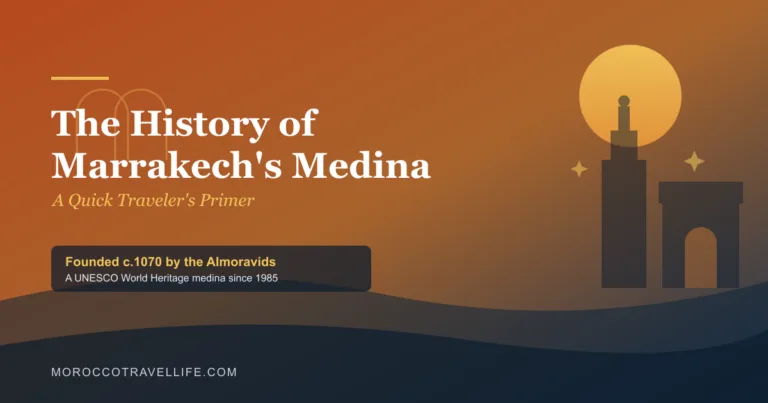
You don’t need a degree to read Morocco’s past in its streets, just eight dates. The Idrisid dynasty founded Fes between 789 and 808 (UNESCO, 2026). The Almoravids came out of the Sahara and founded Marrakech in 1070 to 1072 (UNESCO, 2026). The red earth walls you see today still trace their city.
The Almohads took over in 1147 and raised the Koutoubia, Marrakech’s 77-metre minaret and sibling of Seville’s Giralda (Britannica, 2026). The Marinids made Fes golden with madrasas in the 13th and 14th centuries. The Saadians left Marrakech its tombs and the El Badi palace in the 16th. The Alaouites, on the throne since the 17th century, still reign. King Mohammed VI is their direct descendant.
The modern break came late and left deep marks. France imposed its protectorate with the Treaty of Fez on March 30, 1912, and ruled until independence in 1956 (Britannica, 2026). Those 44 years explain the French in banks, the new-town grid beside every old medina, and language politics still playing out in schools.
Notice what the first resident-general, Lyautey, chose to do, though. Rather than knock down the medinas, the French built their new towns beside them, which is why Moroccan cities come in pairs: a walled old city and a gridded new one. You can walk from the 12th century to the 20th in about four minutes.
Marrakech’s own version, from who built which gate to how the khettara irrigation channels worked, is in my history of Marrakech’s medina.
Why Does Morocco’s Jewish Heritage Matter to Travelers?
Any honest Moroccan culture guide includes the mellahs, the historic Jewish quarters beside the royal kasbahs in nearly every imperial city. Jews lived in Morocco for over 2,000 years, and by 1948 the community numbered around 270,000, then the largest in the Arab world. Emigration to Israel, France and Canada followed. Today roughly 2,100 Jews remain, most in Casablanca (World Jewish Congress, 2026).
What stands out is how visibly Morocco keeps this heritage present. There are restored synagogues in Fes, Marrakech and Essaouira, and the Museum of Moroccan Judaism in Casablanca. Essaouira has Bayt Dakira, the “House of Memory.” Marrakech’s Lazama synagogue is open to any respectful visitor. Together they reframe the whole country, because Moroccan culture has never been a monoculture.
Where to go and what you’ll find at each site is in my guide to Morocco’s Jewish heritage.
Why Does Moroccan Culture Change So Much by Region?
Moroccan culture shifts by region as much as by century. Amazigh use runs at 33.3% in rural Morocco against 19.9% in cities, concentrated in the Atlas and the south (HCP, 2024). Hassaniya, the Arabic of the Saharan south, is spoken by 0.8% nationally. The imperial cities of Marrakech, Fes, Meknes and Rabat carry the urban, cosmopolitan version: medina trade, dense monuments, and daily life well used to visitors.
The Atlas runs older software: Amazigh-speaking villages, a farming rhythm, and a hospitality culture that predates tourism. Dress more conservatively there, and slow down.
The south, from the Draa Valley along the oasis routes to the Sahara’s edge, mixes Amazigh, Arab, Sahrawi and sub-Saharan heritage. The desert’s nomadic past is a living memory one generation back. The Atlantic coast, from Tangier to Essaouira, has always faced outward, more relaxed and more European, salted with Portuguese and Spanish traces.
My advice after many return trips is to pair at least two of these Moroccos in one itinerary, because the contrast is what teaches Moroccan culture best. Travelers who only see Marrakech leave with a real but narrow picture. Those who add even two days in an Atlas valley or a desert town describe something close to a second country.
Morocco Customs and Traditions: 10 Rules for Travelers
If you keep only one section of this Moroccan culture guide, keep this one. These ten rules are Morocco culture for travelers in its shortest form, and they cover almost every situation a visitor meets:
- Greet before you ask for anything.
- Accept the tea, even if you only sip it.
- Use your right hand to eat, greet and pass things.
- Dress a notch more covered than at home, two notches in rural areas.
- Ask before photographing people. Water-sellers and performers may expect a small payment, because their image is their living.
- Keep public affection modest.
- Stay out of working mosques unless a guided visit is offered.
- Haggle warmly or not at all.
- During Ramadan, eat and drink discreetly in public by day.
- Treat every invitation as the honor it is.
None of this is walking on eggshells, since Moroccans are forgiving hosts who mostly find foreign fumbling endearing. Is it worth the effort anyway? Yes, because it’s the difference between visiting a place and being welcomed by it.
Explore the Full Culture & History Series
Each layer of Moroccan culture above hands off to a full guide. The complete series:
- Moroccan etiquette: dress, greetings and Ramadan tips
- Moroccan food guide: 20 dishes to try
- Arabic vs Darija vs French: what Moroccans actually speak
- The history of Marrakech’s medina
- Amazigh (Berber) culture for travelers
- Mint tea culture: why it’s more than a drink
- Islam in Morocco and Ramadan travel
- Moroccan architecture 101: riads, kasbahs and zellige
- Morocco’s Jewish heritage: mellahs and synagogues
- Gnawa, chaabi and where to hear Moroccan music live
Frequently Asked Questions
What is Moroccan culture best known for?
Moroccan culture is best known for hospitality, the mint tea ritual, craft and layered identity. It blends an Amazigh base with Arab-Islamic, Andalusi, West African and French influences. UNESCO has listed Gnawa music (2019), couscous (2020) and the Moroccan caftan (2025) as intangible heritage. Crafts alone employ more than 2.6 million people.
Are Moroccans Arab or Berber (Amazigh)?
Usually both, in blend. The Amazigh are North Africa’s Indigenous people, and most Moroccans carry mixed Arab and Amazigh heritage. The 2024 census found 24.8% of Moroccans use an Amazigh language. Tamazight has been co-official with Arabic since 2011, and the Amazigh New Year became a paid national holiday in 2024.
What religion is practiced in Morocco?
More than 99% of Moroccans are Sunni Muslim, and Islam is the state religion. The king holds the title Commander of the Faithful. Small Christian and Jewish communities remain, including about 2,100 Jews. Non-Muslims can’t enter working mosques. Casablanca’s Hassan II Mosque, with its guided tours, is the main exception.
Is Moroccan culture strict for tourists?
Less than most first-timers expect. Alcohol is legal in licensed venues, city dress is relaxed, and nobody expects visitors to follow Muslim practice. The rules that matter are few. Dress modestly in rural areas, use your right hand, ask before photographing people, stay out of working mosques, and be discreet with food and drink by day in Ramadan.
What should I not do in Morocco?
Don’t refuse hospitality abruptly; soften any “no” with a smile and thanks. Don’t photograph people without asking. Don’t enter working mosques as a non-Muslim. Don’t eat or pass things with your left hand. Don’t criticize the monarchy or Islam, both legally and socially sensitive, and don’t treat haggling as combat. Good intent covers most fumbles.
When is the best time to experience Moroccan culture?
Any time, but the calendar has peaks. Ramadan 2027 is expected from about February 8 to March 9, with lively iftar evenings. June brings the Fes Festival of World Sacred Music and Essaouira’s Gnaoua festival. Yennayer, the Amazigh New Year, falls on January 14. Friday is the weekly moment year-round: couscous day after the main prayer.
Moroccan Culture Guide: The Short Version
Moroccan culture rewards exactly the curiosity you’ve just shown by reading this far. The layers are the Amazigh base, the Islamic rhythm, the hospitality codes, the craft economy and the regional contrast. They aren’t background to a Morocco trip but the trip itself, whether you meet them on purpose or bump into them confused. On purpose is better. Learn five Darija words, accept the tea and slow your greetings down, and the country opens up in ways no itinerary can schedule.
From here, go deep on whichever layer pulls you. Read the etiquette rulebook if you leave soon, or the food guide if you plan trips around meals like I do. The Amazigh culture primer is there if the identity story hooked you. For visas, budgets, routes and timing, my complete Morocco travel guide is the place to start. My rundown of the best things to do in Morocco turns all this culture into an actual itinerary.