
Last verified: 23 September 2026. I re-check the dish prices here against my own field notes on every trip, and the heritage and trade figures against UNESCO and Moroccan ministry releases. The date above changes each time. Dollar figures divide dirhams by 10 for simplicity. The real rate was 9.55 at Bank Al-Maghrib’s 22 September 2026 fixing.
The best thing I ate on my last trip cost twelve dirhams. It was a bowl of babbouche, snail broth, from a cart at the edge of Jemaa el-Fna. The man ladling it has stood behind that pot longer than I have been coming to Marrakech. The worst thing I ate cost 180 dirhams. That one came from a restaurant with the tagine listed in four languages and a photographer’s lightbox in the window. The gap between those two meals is what this Moroccan food guide exists to close.
Disclosure: Some links in this guide may earn us a commission, at no extra cost to you. It never changes what we recommend.
Every friend planning a trip asks me some version of the same question. What should I actually order, and where? So here are the 20 dishes I would put in front of a first-time visitor, in the order I would feed them to you. Each entry says where the dish really lives, whether that is a street cart, a family kitchen or a restaurant that bothers. Each one also carries what it should cost in 2026 dirhams, and how to ask for it. Food is the fastest door into how this country works. For the table manners, the tea and the Friday rhythm, my complete guide to understanding Moroccan culture is the umbrella this post hangs from.
Key Takeaways
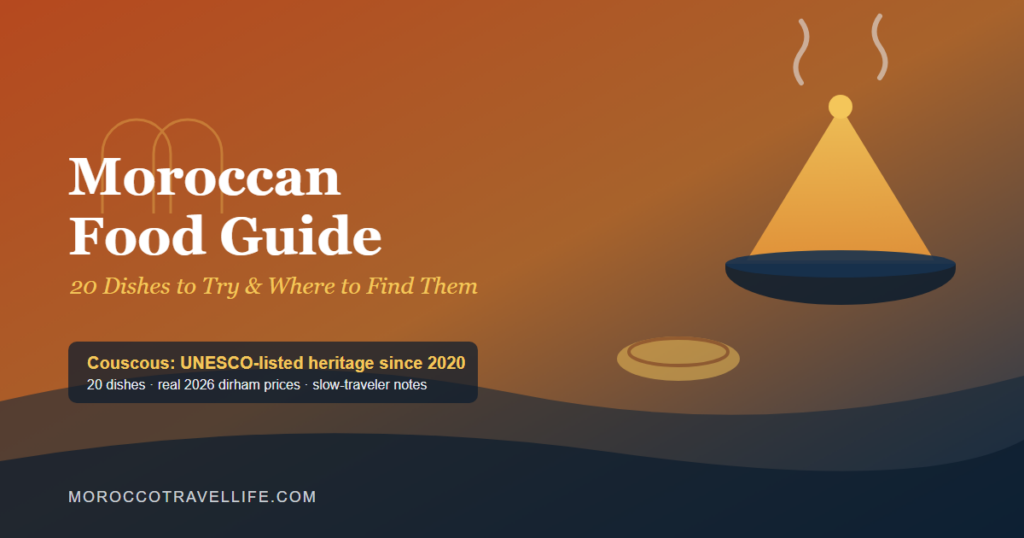
- Couscous is more than Morocco’s most famous dish. UNESCO inscribed the knowledge and practices of couscous on its Intangible Cultural Heritage list in 2020, on a rare joint nomination by Morocco, Algeria, Tunisia and Mauritania (UNESCO Intangible Cultural Heritage, 2026).
- In the 2025–26 TasteAtlas Awards, Moroccan cuisine ranked 30th among world cuisines. Its single best-rated dish was rfissa, at 4.7 out of 5 (Morocco World News, 2026).
- Morocco is the world’s leading exporter of canned sardines, shipping 152,137 tonnes in 2022. That scale is why a 20-dirham grilled-sardine plate is one of the country’s great food bargains (Morocco World News, 2026).
- A full tagine or couscous meal at a local restaurant runs 50–100 MAD, bread and tea included. Street snacks start around 5 MAD (Morocco Travel Life field pricing, 2026).
- Moroccan cooking sits inside the UNESCO-listed Mediterranean diet, inscribed in 2013 with Morocco one of seven states on the nomination (UNESCO Intangible Cultural Heritage, 2026).
Table of Contents
How This Moroccan Food Guide Works: Where Locals Actually Eat
Start with one reframe and the whole list makes sense: the best Moroccan food is not in restaurants. The canon splits three ways. Some dishes live on the street. Others live in home kitchens and reach menus only reluctantly. The rest are what restaurants genuinely do well. Knowing which category you are ordering from matters more than knowing any single dish name. It tells you what a fair price looks like, and whether the version in front of you is real. A few words of Darija help too. I put the ones worth memorizing in my guide to the languages Moroccans actually speak.
Price is the second compass. In 2026 a full tagine or couscous meal at a local restaurant costs 50–100 MAD, bread and mint tea included. Street snacks run 5–20 MAD. Tourist-district restaurants charge 120–250 MAD per main for food that is often no better (Morocco Travel Life field pricing, 2026). Dollar figures here divide dirhams by 10, and my Morocco currency guide carries the real rate. My full Morocco travel budget breakdown itemizes the rest. The chart below is its food slice.
One ordering habit beats memorizing all twenty entries below. Eat where the line is, at the hour the line forms. Moroccan street food runs on turnover. The busiest msemen griddle sells out and remakes its batter several times a morning. The quiet stall next door holds the same tray all day. Locals choose by queue, not by signage, and the rule has never once failed me across repeat trips. The corollary matters as much. If you are hungry at 4 pm, snack rather than commit. The good street-food windows are morning and post-sunset, and a harira cart at odd hours is selling you the bottom of the pot.
The Slow-Cooked Canon: Six Dishes That Define Moroccan Cuisine
The list starts where Moroccan cooking is slowest and most serious. The six dishes below anchor the whole cuisine. Learn to judge them and you can judge everything else here.
1. Tagine: the pot, the method, and a hundred dishes at once
Tagine is the conical clay pot, the slow-braise method and the finished dish, all sharing one name. The classics are chicken with preserved lemon and green olives, lamb with prunes and almonds, and kefta with eggs poached in tomato. A proper one simmers 45 minutes to an hour over coals and arrives still bubbling. A tourist-trap one comes out in ten minutes from a warming oven. Expect 50–100 MAD with bread at a local place (Morocco Travel Life field pricing, 2026). Order it at lunch, when the pots have been going since morning. Eat it the Moroccan way, scooping with bread from your own section of the dish.
2. Couscous: Friday’s national institution
Couscous is Morocco’s Friday ritual. Families gather after the midday prayer over a mountain of hand-rolled, triple-steamed semolina. It comes under seven vegetables, or crowned with tfaya, the sweet caramelized onions and raisins. UNESCO inscribed the knowledge and practice of couscous on its Intangible Cultural Heritage list in 2020, on a joint nomination by Morocco, Algeria, Tunisia and Mauritania (UNESCO Intangible Cultural Heritage, 2026).
Here is the catch nobody warns visitors about. Couscous is a home dish, so many local restaurants serve it on Fridays only. The good ones sell out by 2 pm. On an early trip I promised visiting friends couscous on a Tuesday, then struck out at four restaurants in a row. If your trip includes a Friday, plan lunch around it. Expect 60–120 MAD where it is made properly (Morocco Travel Life field pricing, 2026). If not, a home-cooking class is honestly your best route to a real one.
3. Tanjia: Marrakech’s bachelor dish
Tanjia is the dish Marrakech guards most jealously. Beef or lamb is sealed in an urn-shaped clay amphora with preserved lemon, smen (aged butter), garlic and saffron. It then slow-cooks overnight in the ashes of a hammam furnace. It began as workingmen’s food, prepared by men and carried to the farnatchi, the furnace keeper, then collected after work. It remains gloriously rich, and falls apart at a touch. TasteAtlas rates it 4.5, among Morocco’s best-scored dishes (Morocco World News, 2026). Find it in Marrakech specifically, where medina restaurants do it for roughly 80–150 MAD a portion (Morocco Travel Life field pricing, 2026). My Marrakech travel guide covers the neighborhoods where the real versions live.
4. Mechoui: pit-roasted lamb, sold by weight
Mechoui is whole lamb, slow-roasted in a sealed clay pit until you can pull it apart with two fingers. It is seasoned with nothing but cumin and salt, served on the side. In Marrakech, Mechoui Alley is a short row of storefronts off Jemaa el-Fna. It sells by weight from late morning until the lambs run out, usually mid-afternoon. A generous half-kilo for two with bread runs roughly 140–200 MAD (Morocco Travel Life field pricing, 2026). Go before 1 pm, point at the shoulder, and take the cumin seriously.
5. Rfissa: the celebration dish TasteAtlas rates highest
Rfissa is shredded msemen or trid pastry, buried under chicken stewed with lentils, fenugreek and ras el hanout. It is traditionally cooked for new mothers and family gatherings. It was also the single best-rated Moroccan dish in the 2025–26 TasteAtlas Awards, at 4.7 (Morocco World News, 2026). It is overwhelmingly a home dish. Restaurants that serve it charge 60–100 MAD where you find it, often on set weekdays only (Morocco Travel Life field pricing, 2026). If a Moroccan household invites you to anything involving rfissa, cancel whatever else you had planned.
6. Pastilla: Fes’s sweet-savory showpiece
Pastilla layers shredded pigeon, or chicken in most modern kitchens, with spiced eggs and fried almonds inside tissue-thin warqa pastry. Cinnamon and powdered sugar finish it. Fes claims it by way of Andalusia, and Fassi restaurants remain the benchmark. Expect 60–120 MAD for a starter-size round in a good restaurant, more for the seafood version on the coast (Morocco Travel Life field pricing, 2026). Order it as a shared starter rather than a main. It is rich enough that a whole one defeats most first-timers. My Fes travel guide covers where to eat well inside the world’s largest car-free medina.
Soups, Salads, and the Bread That Holds It All Together
This next stretch covers what holds a Moroccan table together before and beneath the main dish. That means soup, salad and bread.
7. Harira: the soup that sets the national clock
Harira is Morocco’s tomato, lentil and chickpea soup. A flour-and-water swirl thickens it, and celery and coriander sharpen it. During Ramadan it breaks the fast in nearly every household, paired with dates and chebakia. Ramadan 2027 is expected to run from roughly 8 February to 9 March (IslamicFinder, 2026). The rest of the year it is a 5–10 MAD bowl at street carts and cheap cafés, usually with a boiled egg on offer (Morocco Travel Life field pricing, 2026). Evening is its hour. My guide to traveling Morocco during Ramadan explains why iftar season is secretly a great time to eat here.
8. Bissara: the 5-dirham breakfast of champions
Bissara is dried fava beans puréed into a thick, silky soup, flooded with olive oil and dusted with cumin and paprika. It is a northern and Fes specialty, a winter-morning workers’ breakfast. It is also one of the cheapest hot meals in the country at 5–10 MAD with bread (Morocco Travel Life field pricing, 2026). Look for the steamed-up hole-in-the-wall places near markets between about 7 and 11 am. Order “bissara, zit bezzaf” for extra oil, then eat it like a local, dragging bread through it.
9. Zaalouk: the eggplant salad you’ll try to recreate at home
Zaalouk is a warm cooked salad of smoky eggplant and tomato, collapsed together with garlic, paprika and cumin. It arrives as part of the salad course that opens most proper Moroccan meals. Expect 15–30 MAD as a starter, or find it included in a set menu (Morocco Travel Life field pricing, 2026). It is the dish most people I have traveled with attempt first when they get home. It is also the one that convinces vegetarians this cuisine has room for them.
10. Taktouka: zaalouk’s pepper-and-tomato sibling
Taktouka swaps the eggplant for flame-roasted green peppers, stewed down with tomatoes into something between a salad and a dip. The two usually appear together, with khobz doing the work of cutlery. Same price band as zaalouk, and the same rule applies. A restaurant that makes its own taktouka from scratch is almost always worth the rest of the menu.
11. Khobz: the bread that runs the country
Khobz is the round, crusty daily loaf that anchors every Moroccan table. It is baked at home, or carried on wooden boards to the neighborhood ferran, the communal oven. It sells everywhere for roughly 1.5–3 MAD (Morocco Travel Life field pricing, 2026). Watch how it is treated. Dropped bread gets picked up, kissed and set aside, never left on the ground. You will rarely get a fork with the salads and tagines above. A wedge of khobz, held right-handed, is the correct tool, and using it well is the fastest way to look like you have been here before.
Street Food Worth Crossing a City For
Before the individual entries, here is the honest pricing picture. I keep a running note on my phone of what I actually pay for street food in Marrakech. On each trip I spot-check it against Fes, Essaouira and Casablanca. The chart below is that field data as of mid-2026. These are typical prices paid, not the tourist quote, which can start at double.
12. Msemen: the laminated flatbread you’ll smell before you see
Msemen is a square, layered flatbread, folded and refolded with oil and semolina, then griddled. The outside crisps and the inside stays chewy. Plain with honey and melted butter it is breakfast, around 5 MAD. Stuffed with spiced onions and fat, or with khlii (preserved meat), it is lunch at 10–15 MAD (Morocco Travel Life field pricing, 2026). Morning griddle stalls near any market are the move. Point, hold up fingers for quantity, done.
13. Baghrir: the thousand-hole pancake
Baghrir is a spongy semolina pancake, cooked on one side only. Its surface opens into hundreds of tiny holes that exist solely to trap honey-butter. You will find it at the same morning stalls as msemen, for a similar price, and on every riad breakfast table. It is mild and comforting. It is also the single best vehicle for amlou, the southern almond-argan-honey spread, if you spot the two together.
14. Sfenj: doughnuts on a palm cord
Sfenj are ragged rings of unsweetened dough, fried in deep oil and handed over threaded on a strip of palm fiber. They run roughly 2.5 MAD apiece (Morocco Travel Life field pricing, 2026). TasteAtlas rates them 4.5, which is remarkable for what is essentially workers’ breakfast (Morocco World News, 2026). The sfenj maker, the sfenaj, works dawn to mid-morning and again at dusk. Between those windows the oil rests, and so should you. Eat them hot, dusted with sugar if you like, with mint tea.
15. Maakouda: the potato fritter that built Casablanca lunch
Maakouda are crisp-edged potato fritters. Eat them solo, or better, stuffed into half a khobz with harissa and olives for a 10–15 MAD sandwich (Morocco Travel Life field pricing, 2026). TasteAtlas scores them 4.5. Their Casablanca street-food cousin caliente, a chickpea-flour flan of Spanish ancestry, rates 4.6 (Morocco World News, 2026). Any city’s medina has a maakouda man. Follow the smell of frying at lunchtime.
16. Babbouche: snail broth, and trust me on this one
Babbouche is small snails, simmered in a dark broth of what vendors will tell you is anywhere from twelve to thirty spices. Thyme, aniseed, licorice root and green tea leaves are among them. A small bowl runs 5–15 MAD at the carts on Jemaa el-Fna, and at market edges countrywide (Morocco Travel Life field pricing, 2026). You pick the snails out with a toothpick, then drink the broth after. Locals treat that broth as a tonic for colds.
Babbouche was my own personal wall. It took me three trips of walking past the carts before I ordered a bowl. What finally got me there was watching who else was eating it. Grandmothers, taxi drivers, teenagers on dates: the whole demographic spread of the city, at one cart. It tastes like a savory herbal tea with a chewy payoff, nothing like the French garlic-butter cliché. I go back to the same vendor every trip now. Start with the small bowl. You will order the second one yourself.
17. Kefta: spiced meat, three ways
Kefta is ground beef or lamb, worked with cumin, paprika, parsley and onion. It shows up three ways. Grilled as brochettes it runs 30–60 MAD a skewer plate. It also simmers in a tagine with tomato and eggs, and packs into a street sandwich for 20–35 MAD (Morocco Travel Life field pricing, 2026). The stalls that grill to order over real charcoal beat any food-court version, and you will hear and smell the difference. Ask for “khobz, kefta, kul shi” (everything), then accept the grilled-tomato-and-onion smash that comes with it.
From the Coast and the Sweet End of the Table
This last stretch moves from the Atlantic grill to the pastry stall, where the list closes on its sweetest notes.
18. Grilled sardines and fish chermoula: the Atlantic’s daily gift
Morocco is the world’s leading exporter of canned sardines, shipping 152,137 tonnes in 2022 (Morocco World News, 2026). The version that matters to you is fresh. Butterflied pairs are stuffed with chermoula, a marinade of coriander, garlic, cumin, paprika and lemon, then grilled or fried at port-side stalls. A generous plate with bread and salad runs about 20–40 MAD in Essaouira’s fish grills, or any Atlantic port town (Morocco Travel Life field pricing, 2026). My Essaouira travel guide covers the port and the grill etiquette. The short version: go at lunch, and choose the stall the fishermen eat at.
19. Chebakia: Ramadan’s sesame-honey flower
Chebakia is a rose-shaped pastry of sesame-studded dough, deep-fried, then bathed in honey and orange-blossom water. It is harira’s inseparable Ramadan partner, made in industrial family quantities before the month starts. Souk pastry stalls sell it year-round by weight, roughly 40–80 MAD per kilo depending on the almond content (Morocco Travel Life field pricing, 2026). Its cousin sellou, a roasted flour, almond and sesame powder pressed into bowls, shares the same stalls. Buying either by the quarter-kilo is a perfect souk errand. My Marrakech souk shopping guide covers how to buy food in the souks without the haggling anxiety, since food prices are mostly fixed. I always end a souk trip with a bag of these.
20. Seffa: the sweet couscous finale
Seffa is fine couscous or broken vermicelli, steamed soft, mounded high and dressed with cinnamon, powdered sugar and fried almonds. Sometimes a whole chicken hides inside, which makes it seffa medfouna, “buried” seffa. It closes celebration meals in home kitchens, and appears in traditional restaurants as a main or a dessert. It is the gentlest landing on this list. It is also the dish I would serve anyone who thinks nineteen entries have already taught them Moroccan food: sweet, savory, celebratory and communal at once.
All 20 Dishes in This Moroccan Food Guide, at a Glance
Here is every dish in one scannable table, price included.
| # | Dish | What it is | Where it lives | Typical 2026 price (MAD) |
|---|---|---|---|---|
| 1 | Tagine | Slow-braised stew in a conical clay pot | Restaurants, homes | 50–100 with bread |
| 2 | Couscous | Steamed semolina, seven vegetables or tfaya | Homes; restaurants on Fridays | 60–120 |
| 3 | Tanjia | Urn-cooked beef/lamb in hammam-furnace ashes | Marrakech restaurants | 80–150 |
| 4 | Mechoui | Pit-roasted lamb, sold by weight | Mechoui Alley, Marrakech | 140–200 per half-kilo |
| 5 | Rfissa | Shredded pastry, chicken, lentils, fenugreek | Home celebrations | 60–100 where served |
| 6 | Pastilla | Sweet-savory pigeon/chicken pie in warqa | Fes restaurants | 60–120 |
| 7 | Harira | Tomato-lentil-chickpea soup | Street carts, cafés, iftar tables | 5–10 |
| 8 | Bissara | Fava-bean purée with olive oil | Market stalls, mornings, north | 5–10 |
| 9 | Zaalouk | Smoky eggplant-tomato cooked salad | Restaurant salad course | 15–30 |
| 10 | Taktouka | Roasted pepper-tomato cooked salad | Restaurant salad course | 15–30 |
| 11 | Khobz | Round daily bread from the communal oven | Everywhere | 1.5–3 |
| 12 | Msemen | Layered griddled flatbread | Morning street stalls | 5 plain, 10–15 stuffed |
| 13 | Baghrir | Thousand-hole semolina pancake | Morning stalls, riad breakfasts | ~5 |
| 14 | Sfenj | Fried doughnut rings on a palm cord | Dawn and dusk street stalls | ~2.5 each |
| 15 | Maakouda | Potato fritter, usually in a sandwich | Medina lunch stalls | 10–15 sandwich |
| 16 | Babbouche | Snail broth with a deep spice mix | Night carts, Jemaa el-Fna | 5–15 |
| 17 | Kefta | Spiced ground meat: skewers, tagine, sandwich | Charcoal grills everywhere | 20–60 |
| 18 | Sardines/chermoula | Stuffed, grilled or fried Atlantic sardines | Port-town grills | 20–40 plate |
| 19 | Chebakia | Sesame-honey pastry, Ramadan staple | Souk pastry stalls | 40–80 per kilo |
| 20 | Seffa | Sweet cinnamon-almond couscous | Home celebrations | Mostly home-cooked |
Classify those twenty by where you will most likely meet each one first, and the shape of Moroccan eating becomes obvious. It is not restaurant-shaped. This split is my own editorial read, built from eating all twenty in their natural habitats across repeat trips.
Is Moroccan Street Food Safe to Eat?
Broadly yes, if you follow the same signals locals do. Skipping street food means skipping nearly half the dishes on this list. Morocco welcomed a record 19.8 million visitors in 2025 (Morocco World News, 2026). The overwhelming majority eat from the same grills and carts I do, without incident.
The rules that matter are short. Choose high-turnover stalls, because the queue is the hygiene certificate. Eat cooked food hot off the fire, not items sitting in ambient heat. Be cautious with pre-cut fruit and unwashed salads early in your trip. Drink bottled or filtered water while your gut adjusts. Fried and grilled items are the lowest-risk entry points, because nothing survives the oil. That means sfenj, maakouda, kefta and sardines.
Give your stomach a two-day ramp. Do not eat the entire top half of this list on arrival night. The full safety picture covers food, water, scams and everything else first-timers worry about. It is in my honest take on whether Morocco is safe to visit.
Can Vegetarians Eat Well in Morocco?
Vegetarians eat better here than the menu suggests, but worse than the vegetable-heavy cuisine implies. You need to know the traps. The salad course, bissara, msemen, baghrir, khobz with amlou and vegetable tagines will carry you happily for days. Here is the catch. “Vegetable” couscous and tagines are frequently built on meat broth, and harira often is too. Ask directly. “Bla lham” (without meat) is understood everywhere, and “ghir khodra” (only vegetables) closes the loophole.
Cities are easy mode. Rural roadside stops narrow to omelettes and salads fast. Fish, if you eat it, reopens the entire coast. Several cooking schools now run dedicated vegetarian sessions, which double as the best lesson in what to order for the rest of your trip.
How Does Moroccan Food Change by Region?
Eating your way across regions is one of the best itinerary frameworks there is, because the map genuinely changes the menu. Marrakech means tanjia and mechoui. Fes claims pastilla and the refined old-city kitchen tradition. Bissara rules the northern mornings. The Atlantic coast, from Essaouira down to Safi and Dakhla, is sardine and chermoula country.
The south runs on dates, amlou and argan oil, which grows only in southwestern Morocco. UNESCO inscribed the argan practices and know-how on its Intangible Cultural Heritage list in 2014 (UNESCO Intangible Cultural Heritage, 2026). That sits alongside couscous in 2020, and Morocco’s place in the seven-country Mediterranean diet listing of 2013. Three UNESCO food inscriptions is a serious cultural résumé for one cuisine. The 2025–26 TasteAtlas Awards placing Moroccan cuisine 30th worldwide suggests international eaters are catching up to what the inscriptions already recognized (Morocco World News, 2026).
What Do Moroccans Drink With Meals?
Mint tea, first and always. Atay is the meal’s bookend, the hospitality contract, and a ritual with more rules than most visitors realize. Morocco is the single largest buyer of Chinese tea on earth, taking 91,575 tonnes in 2025, about 21.8% of China’s entire tea export volume (Firsd Tea, 2026 China Tea Report, May 2026). Nearly all of it ends up in that one minty preparation. The full story of how a Chinese leaf became Morocco’s national ritual is in my piece on Moroccan mint tea culture. Treat tea as dish zero.
Beyond tea, nous-nous (half espresso, half steamed milk) powers café mornings. Fresh-squeezed orange juice runs 5–10 MAD from carts and stands (Morocco Travel Life field pricing, 2026). Seasonal juices reward curiosity, like avocado with almond milk in winter, or sugarcane in the north. Alcohol exists in licensed restaurants and bars, but almost never at the street-food and local-restaurant addresses on this list. Plan your wine around dinner, not lunch.
Frequently Asked Questions
A few quick answers to the questions I get asked most.
What is Morocco’s national dish?
Couscous is the strongest claim. It is hand-rolled steamed semolina, served under vegetables and meat, and eaten by families across the country after Friday midday prayers. UNESCO inscribed the knowledge and practices of couscous on its Intangible Cultural Heritage list in 2020, on a joint nomination by Morocco, Algeria, Tunisia and Mauritania. Tagine is the international icon, but Friday couscous is the national institution.
What food is Marrakech famous for?
Tanjia is Marrakech’s signature dish, rated 4.5 by TasteAtlas. It is beef or lamb, slow-cooked overnight in an urn-shaped clay pot buried in hammam-furnace ashes. The city is also home to Mechoui Alley’s pit-roasted lamb. On Jemaa el-Fna, babbouche (snail broth) carts anchor the square’s night food scene.
Is street food in Morocco safe for tourists?
Generally yes, with local logic applied. Eat at busy, high-turnover stalls, and take cooked food hot off the fire. Be careful with pre-cut fruit and salads early in the trip, and drink bottled or filtered water. Fried and grilled items like sfenj, maakouda and kefta are the safest entry points. Millions of visitors eat Moroccan street food annually without trouble. Treat that record as reassurance, not a guarantee.
How much does a meal cost in Morocco in 2026?
Street snacks run 5–20 MAD. A full tagine or couscous meal at a local restaurant costs 50–100 MAD, bread and mint tea included. Tourist-district restaurants charge 120–250 MAD per main course. Bank Al-Maghrib fixed the dirham at 9.55 to the US dollar on 22 September 2026, so eating extremely well on 150–250 MAD a day is realistic outside tourist districts.
Can vegetarians eat well in Morocco?
Yes, with one critical habit: asking. Cooked salads (zaalouk, taktouka), bissara, breads and vegetable tagines are everywhere. But “vegetable” couscous, tagines and harira are often built on meat broth. Say “bla lham” (without meat) when ordering. Cities offer plenty of options, while rural stops narrow quickly to omelettes and salads.
What do Moroccans eat for breakfast?
Bread-centered spreads. Expect khobz or msemen with olive oil, honey, amlou or soft cheese, plus baghrir pancakes with honey-butter and sfenj doughnuts from the corner fryer. In the north especially, add a hot bowl of bissara. Mint tea or nous-nous coffee completes it. Most riads serve exactly this spread, which makes breakfast the easiest authentic meal of a Morocco trip.
Putting This Moroccan Food Guide Together
Twenty dishes is a lot of homework, so here is the compressed strategy I give friends. One Friday couscous. One proper tagine at a locals’ lunch spot. One morning of msemen and bissara. One night of Jemaa el-Fna courage, babbouche included. Sardines the day you hit the coast, and chebakia from a souk stall for the ride home. Hit those six and the other fourteen will find you on their own.
Two ways to go deeper. If you want to cook rather than just eat, a Moroccan cooking class turns this list from a menu into a skill. Most start with a guided market shop, and they run 300–700 MAD at the schools I have used. And there is a wider frame these dishes sit inside: the hospitality codes, the Friday rhythm, the tea ceremony, the regional identities. My full Moroccan culture guide for travelers connects the food to all of it. The table is where Morocco explains itself. Twenty dishes in, you will be fluent enough to ask good questions.