The first Tifinagh sign most visitors photograph is the one at the airport, usually without knowing it. Those angular characters running under the Arabic and French on the road signs aren’t decoration. They’re Tifinagh, the alphabet of the Imazighen, and they’re your first glimpse of Amazigh culture in Morocco. The people who wrote it farmed these valleys and traded across the Sahara a thousand years before the Arab armies arrived. Most Moroccans will tell you they’re the foundation everything else got built on.
Disclosure: Some links in this guide may earn us a commission, at no extra cost to you. It never changes what we recommend.
An Amazigh dynasty founded Marrakech around 1070. I’ve spent enough time in that city to hear the same misconception from visiting friends, over and over. They assume “Berbers” are a minority tribe you visit in the mountains, the way you’d visit a monument. That framing gets it backwards. This guide covers who the Imazighen actually are and why the name matters. It also covers what Tifinagh on a wall is telling you, and how to engage with Amazigh culture as something that runs through the whole country.
Key Takeaways
- “Amazigh” means roughly “free people,” and it’s the term to prefer over “Berber,” which reached European languages from the same Latin root as “barbarian” (Minority Rights Group International, 2026). The plural is Imazighen. The language is Tamazight.
- Morocco’s 2024 census found 24.8% of Moroccans use an Amazigh language daily, split across three varieties: Tachelhit (14.2%), Central Atlas Tamazight (7.4%), and Tarifit (3.2%). Broader heritage self-identification runs closer to 40% (Yabiladi, 2024; Minority Rights Group International, 2026). Amazigh associations dispute the census figures as undercounts.
- Tamazight has been co-official with Arabic since the 2011 constitution. The 2019 Organic Law 26-16 set a 15-year phased rollout into schools and public life (Nationalia, 2026).
- In 2026, Morocco celebrates Yennayer, Amazigh New Year 2976, on January 14. It became a paid national holiday in 2024, a year after the royal decree (Morocco World News, 2026).
- Amazigh craft is a living economy, not a museum. UNESCO inscribed argan know-how, carried by rural Amazigh women, on its Intangible Cultural Heritage list in 2014 (UNESCO, 2026). The surrounding argan forest has been a UNESCO Biosphere Reserve of about 2.56 million hectares since 1998.
Table of Contents
Who Are the Imazighen? The Indigenous Layer Under Everything
The Imazighen aren’t a minority group inside Moroccan culture. They’re the base layer of it. The Imazighen (singular Amazigh) are the Indigenous population of North Africa, present from the Atlantic to the western edge of Egypt for at least three thousand years (Minority Rights Group International, 2026). That’s long before Phoenician traders, Roman legions, or the 7th-century Arab conquests that brought Islam and Arabic.
What happened next is the key to reading Morocco. The Arab arrival didn’t replace Amazigh society. It layered onto it. Amazigh dynasties, the Almoravids and Almohads, went on to build the medieval Moroccan empire. They founded Marrakech and raised monuments you’ll walk past in Fes and Rabat today.
Most Moroccans now carry both Arab and Amazigh heritage in some blend. Which is why the question travelers most want answered has an awkward shape.
So here’s the single most useful thing I can tell a visitor: stop asking whether a given Moroccan is “Arab or Berber.” For most of the country that’s a false binary. The honest answer you’ll get from a Marrakchi is usually some version of “both, and I’ve stopped counting.” Identity here works like ancestry that’s been stirred for thirteen centuries, not like a checkbox on a form. Plenty of people do identify strongly and specifically as Amazigh, by daily language, by region, by a deliberate reclaiming of the label. That’s a real and growing movement. It sits alongside millions who carry the heritage without foregrounding it.
Why Say “Amazigh” Instead of “Berber”?
The name is the first act of respect. “Amazigh” is what the people call themselves, and it translates as something close to “free people” or “noble people.” “Berber” came into English and French from the Latin barbarus, the same root that gives us “barbarian.” It was originally an outsider’s word for anyone who didn’t speak Greek or Latin (Minority Rights Group International, 2026).
So why does “Berber” still appear everywhere, including in this article’s title? Search behavior. Most English-speaking travelers still type “Berber culture Morocco” into a search bar, and a guide that refuses the word entirely never reaches the people it’s trying to inform.
My rule, and the one I’d suggest for any visitor: use “Berber” if you must to be understood, then switch to “Amazigh” the moment you’re actually talking to someone. This matters most in the Atlas and the Souss. It lands the way using someone’s real name lands, instead of a nickname a stranger gave them.
Morocco’s 2024 census puts numbers on the community. It found that 24.8% of Moroccans use an Amazigh language every day, rising to about a third of the rural population (Yabiladi, 2024). Amazigh cultural associations argue those figures undercount the reality. The census measures daily language use, not heritage, and broader self-identification estimates run closer to 40% of the population (Minority Rights Group International, 2026).
The Three Language Groups: Tachelhit, Tamazight, Tarifit
Tamazight gets spoken of as one language. For a traveler moving across Morocco it’s really three regional varieties, geographically sorted, mutually intelligible only in patches. Knowing which one you’re in tells you a lot about where you are.
| Variety | Where you’ll hear it | Rough share (2024 census) |
|---|---|---|
| Tachelhit (also spelled Tashelhit; speakers are Chleuh) | The Souss plain, Agadir, the Anti-Atlas and western High Atlas, the southern oases | 14.2% |
| Central Atlas Tamazight | The Middle and central High Atlas: Azilal, Beni Mellal, Khenifra, Imilchil | 7.4% |
| Tarifit (Riffian) | The northern Rif mountains: Al Hoceima, Nador | 3.2% |
My own Tachelhit is embarrassing. But the handful of words I’ve picked up buy an outsized welcome in the mountains. Azul (hello), tanmirt (thank you), and manza (how are you / where is) have opened more doors in Atlas villages than any amount of French.
Greet someone in their actual mountain language, rather than Arabic or French, and the reaction is genuinely different. It signals you noticed there was a distinction to make. If you’re only going to learn Amazigh words for one region, learn Tachelhit. It’s the variety you’re statistically most likely to meet.
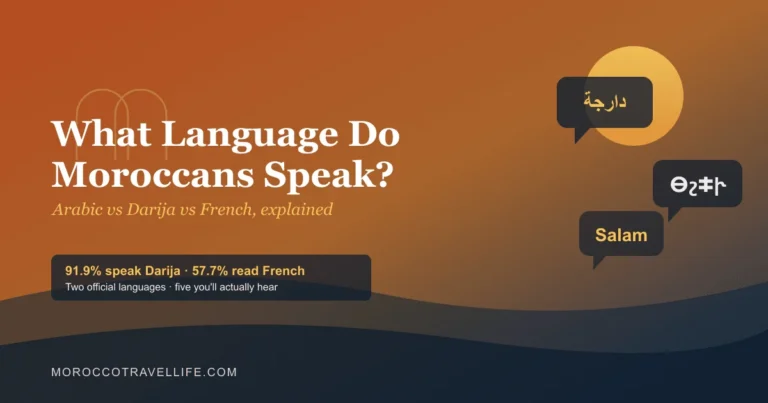
For how these languages sit alongside Darija and French in daily Moroccan life, and which to learn a little of, see my breakdown of what language Moroccans actually speak.
What Is Tifinagh, the Script on Every Road Sign?
Tifinagh is the writing system that makes Amazigh culture visible to a passing traveler. Its story is more recent than the ancient-looking characters suggest. The script itself is old, descended from a Libyco-Berber alphabet used across North Africa in antiquity. Its modern standardized form was formalized only in this century.
King Mohammed VI created the Royal Institute of Amazigh Culture (IRCAM) in October 2001 to safeguard and promote the language. IRCAM went on to standardize a 33-character “Neo-Tifinagh” alphabet (Morocco World News, 2019). The institute adopted it as the official script for writing Tamazight in Morocco in 2003 (Morocco World News, 2016).
That decision is why you now see Tifinagh on government buildings, ministry logos, university signs, and the trilingual road signage that confuses first-timers. The character travelers notice most is ⵣ (yaz). It represents a “z” sound and doubles as the emblem of Amazigh identity. It’s the red figure at the center of the Amazigh flag, meant to evoke a free person with arms raised.
It took me about a year of visiting before I stopped treating Tifinagh as ornament and started actually reading the station and street signs. I’d recommend any curious visitor spend ten minutes learning to spot four or five characters. It changes how you see the country. Suddenly the script is everywhere, and you realize the state has been quietly stitching Amazigh identity back into public life in a way that was politically unthinkable a generation ago. Recognizing ⵣ, ⵎ (m), and ⵏ (n) is enough to start sounding out place names on the mountain roads.
How Did Tamazight Go From Suppressed to Official?
Tifinagh on a road sign feels significant to Moroccans because it represents a genuine reversal. For decades after independence the state pursued Arabization, and Amazigh culture and language were pushed to the margins of public life. The turnaround has been fast, and it’s still unfolding.
In 2011 the new constitution made Tamazight a co-official language of the state alongside Arabic. That was the landmark change. Organic Law 26-16, passed in 2019, then laid out how that status would actually be implemented, with a phased rollout of up to 15 years across education, justice, media, and administration (Nationalia, 2026).
Implementation is real but uneven, and it’s fair to say so. Tamazight teaching has expanded significantly in primary schools, reaching more than 600,000 pupils. That’s roughly 13% of Morocco’s 4.5 million primary students. Full generalization is still a target for 2030, hampered by a shortage of trained teachers (Nationalia, 2026). The gap between constitutional status and classroom reality is one of the live cultural debates worth knowing exists.
Where Do Travelers Encounter Living Amazigh Culture?
You don’t have to seek out Amazigh culture. In much of Morocco you’re already inside it. But four regions are where it’s most concentrated and most visible to visitors:
- The High Atlas. The mountains south of Marrakech are Amazigh heartland: terraced villages, Central Atlas Tamazight and Tachelhit, and a hospitality culture that predates tourism. My Atlas Mountains guide covers Imlil, Toubkal, and which villages are realistic bases.
- The Souss and Anti-Atlas. Around Agadir, Taroudant, and Tafraoute, this is Tachelhit country and the home of the argan tree. It’s the most economically distinct Amazigh region.
- The southern oases and desert routes. The Draa and Dades valleys, Ouarzazate, and the pre-Sahara mix Amazigh heritage with Arab, Saharan, and sub-Saharan influences. My Ouarzazate travel guide and my comparison of Merzouga vs Zagora both run through this terrain.
- The Rif. The northern mountains around Al Hoceima and Nador are Tarifit-speaking. This is the most linguistically distinct and least tourism-adapted of the four.
Here’s the distinction I wish more visitors arrived with. There’s a real difference between encountering Amazigh culture as the actual texture of a place and consuming it as a staged “Berber experience” sold as a bus-tour stop. The first happens naturally when you spend a night in an Atlas village or shop in a Souss market. The second is a performance built for a schedule.
Want the real version? The highest-return move is an overnight in someone’s home rather than a twenty-minute tea demonstration. I go deep on that distinction in my guide to visiting a Berber family the right way.
Cultural Markers: Carpets, Tattoos, Silver, and Argan
Objects are where most travelers actually engage with Amazigh culture, usually through a purchase. So it’s worth knowing what you’re looking at.
Carpets are the clearest window in. Amazigh rugs are woven by women, and their motifs work like regional dialects in wool. Diamonds, chevrons, and zigzags carry meanings tied to fertility, protection, and tribal identity rather than being purely decorative. A Beni Ourain rug from the Middle Atlas, cream wool with sparse dark lines, looks nothing like a boldly colored Taznakht carpet from the Souss. The region often tells you more about a rug than any label does. If you’re buying, my Marrakech souk shopping guide covers realistic prices and how to read quality.
Silver jewelry traditionally functioned as portable wealth and protection. Heavy fibula brooches pinned a woman’s garment, and chunky amber and coral necklaces and engraved bangles often carried the same protective symbols as the tattoos.
Facial tattoos are the tradition most visibly fading. Older Amazigh women in rural areas still carry indigo facial tattoos. The siyala, a line from lip to chin, was often applied at puberty, and it was historically believed to mark identity, beauty, and protection against harm. The practice has all but ended. In most communities, the elderly tattooed women you may meet are the last generation to have received them (Morocco World News, 2019). Look, appreciate, and never photograph these women without asking and expecting to be told no.
Argan is Amazigh culture as a modern rural economy. UNESCO inscribed the practices and know-how around the argan tree on its Representative List of Intangible Cultural Heritage in 2014, explicitly identifying rural Amazigh women as the bearers who transmit the knowledge. The surrounding Arganeraie has been a UNESCO Biosphere Reserve of about 2.56 million hectares since 1998 (UNESCO, 2026). The women’s cooperatives you’ll pass on the road to Agadir are the visible, contemporary form of that heritage.
A field note on those cooperatives, since they’re a common stop. Quality and fairness vary enormously between a genuine women’s cooperative and a roadside operation using the label for tour-bus footfall.
The tells I use are simple. A real cooperative will let you watch women hand-cracking argan nuts, which is slow, unglamorous work. It prices its culinary oil in the rough range of 150 to 250 MAD for a half-liter rather than at tourist-inflated numbers. And it won’t pressure you. Buying there does real economic work. Buying at a slick highway showroom often doesn’t reach the women at all (Morocco Travel Life field observation, 2026).
What Is Yennayer, the Amazigh New Year?
Nothing captures Amazigh culture’s shift from margin to mainstream better than Yennayer. It’s the Amazigh agricultural new year, and it runs on a calendar that counts from 950 BCE. That’s the year the Amazigh king Shoshenq I is said to have taken the throne of Egypt, which makes the year beginning in January 2026 2976 (Morocco World News, 2026).
For most of modern Moroccan history, Yennayer was celebrated privately, in homes and villages, without official status. That changed when King Mohammed VI decreed in 2023 that it would become a paid national holiday, first observed on January 14, 2024 (Morocco World News, 2026). Now the whole country gets the day off, Arab and Amazigh alike. Families gather over dishes like tagoula, a wheat porridge, and couscous. In some households a symbolic item is hidden in the food to divine who’ll have a lucky year.
The first Yennayer after it became official, in January 2024, was genuinely moving to watch. I was in Marrakech for it. It stopped being a thing that happened quietly in the Atlas and became a public, national event: banks shut, greetings of Asgas Amegaz (“happy new year” in Tamazight) traded in the street, restaurants running tagoula specials. If your trip lands in mid-January, it’s one of the more meaningful cultural moments to catch, and it’s spreading well beyond traditionally Amazigh regions.
Music: Ahidous, Ahwach, and a Dance on UNESCO’s Urgent List
Music is where Amazigh culture is most participatory. It’s communal rather than performance-for-an-audience, and it splits along the same regional lines as the language. In the Middle and eastern High Atlas, Ahidous is the signature form. Villagers, men and women, form lines or a circle and move in a shoulder-to-shoulder sway to frame drums (bendir) and call-and-response sung poetry (izlan). Further south and west, in the High Atlas, Anti-Atlas, and Souss, the related Ahwach fills the same social role at weddings and festivals.
Not all of it is safe. UNESCO inscribed Taskiwin, a martial dance of the western High Atlas, on its List of Intangible Cultural Heritage in Need of Urgent Safeguarding in 2017 (UNESCO, 2017). Dancers carry a decorated horn called the tiskt and shake their shoulders to tambourines and flutes. UNESCO’s assessment is blunt about the risk: the dance has vanished from several communities, and the remaining bearers can’t find young people to teach.
That listing is worth carrying with you. It’s the difference between “traditional music” as a vague backdrop and a specific practice with a countdown on it. You’re most likely to encounter these forms at a village celebration or a festival like Timitar in Agadir, which curates Amazigh music specifically. For where to hear Morocco’s traditional music live across all its forms, including Gnawa and chaabi, see my guide to Gnawa and traditional Moroccan music.
How Do You Engage Respectfully Without Exoticizing?
The respectful version of engaging with Amazigh culture comes down to one reframe: you’re meeting a living, modern people, not visiting a preserved past. The Amazigh farmer whose village you walk through has a smartphone, an opinion about the football, and a job. The traditional dress and the ancient language sit alongside all of that, not instead of it.
A short set of practical rules covers most of it. Use “Amazigh” once you’re in conversation. Learn a couple of words in the local variety. Always ask before photographing people, especially older women, and accept no gracefully. Buy directly from cooperatives and weavers rather than middlemen when you can. And if you’re invited into a home, treat it as the honor it is rather than a photo opportunity.
Home-visit etiquette runs deeper than that: what to wear, what to bring, how compensation actually works. It’s its own subject. I’ve handed the whole thing off to my guide on visiting a Berber family home respectfully.
One more piece of honesty worth carrying. Much of the tourism framing of “Berber culture,” including some of what’s written in English, flattens a diverse, internally debated identity into a single romantic image. The Rif and the Souss don’t see themselves as interchangeable. The language-rights movement is genuinely political. And not every Amazigh person wants to be a cultural exhibit. Arriving with that awareness is itself a form of respect.
Frequently Asked Questions
Are “Berber” and “Amazigh” the same thing?
Yes. They refer to the same Indigenous people of North Africa. “Amazigh” (plural Imazighen) is the name the people use for themselves, and it means roughly “free people.” “Berber” is an exonym that entered European languages from the Latin root for “barbarian,” so many communities prefer “Amazigh.” “Berber” remains common in English travel writing, largely because that’s what most travelers search for.
What language do Amazigh people in Morocco speak?
Tamazight, which exists in three main regional varieties. Tachelhit covers the south and Souss and is the largest at 14.2% of Moroccans per the 2024 census. Central Atlas Tamazight covers the Middle and High Atlas at 7.4%. Tarifit covers the northern Rif at 3.2%. In total, 24.8% of Moroccans use an Amazigh language daily. Tamazight has been co-official with Arabic since the 2011 constitution.
What is the Tifinagh script travelers see on road signs?
Tifinagh is the alphabet used to write Tamazight. The Royal Institute of Amazigh Culture (IRCAM), created in October 2001, standardized a 33-character modern form and adopted it as the official script in 2003. It now appears on trilingual road signs, government buildings, and schools alongside Arabic and French. The character ⵣ (yaz), the emblem on the Amazigh flag, symbolizes a free person.
Where can travelers experience Amazigh culture in Morocco?
Four main regions. The High Atlas, in the villages south of Marrakech. The Souss and Anti-Atlas around Agadir, home of argan and Tachelhit. The southern oases and desert routes around Ouarzazate and the Draa Valley. And the Rif in the north. The most genuine encounters come from overnight village stays and cooperative visits rather than staged bus-tour stops.
When is Amazigh New Year (Yennayer) in 2026?
Yennayer falls on January 14, 2026, marking the start of Amazigh year 2976. It became a paid national holiday in Morocco in 2024, following a royal decree the previous year, so the entire country now observes it. Families celebrate with dishes like tagoula, a wheat porridge, and couscous.
Is it okay to photograph Amazigh people and their tattoos?
Only with permission, every time, and be ready to accept no. Older women with traditional indigo facial tattoos in particular should never be photographed without asking. The tattoos are personal and the tradition is a fading one, not a tourist attraction. Buying a craft directly is a warmer form of engagement than taking a picture.
Putting It Together
The mistake is to think of Amazigh culture as one stop on a Morocco itinerary: a village visit, a rug, a photo. It’s actually the substrate the whole country grew from. You see it the moment you learn to read the script on the road signs and hear the language shift as you climb into the mountains.
Twenty-five years of change runs from IRCAM to an official script, a co-official language, and now a national holiday counting the year 2976. That’s Amazigh culture moving from the margins back to the center, in real time, while you visit.
Engage with it as a living, modern, internally varied people rather than a preserved past, and Morocco reads completely differently. Amazigh identity also sits alongside the country’s Arab, Islamic, Andalusi, and Jewish layers. The Judeo-Berber communities of the Atlas and the south were part of that fabric for two millennia. To see how the layers fit together, start with my complete guide to Moroccan culture. For the lived version, nothing beats an afternoon in an Atlas village home.