
The first Gnawa lila I sat through changed what I thought music was for. It was past midnight, in a house off Marrakech’s Bab Doukkala, and nobody had bought a ticket. No stage. No applause. Just the bass pulse of a three-string guembri and the clatter of iron castanets. This was the Gnawa that Morocco keeps for itself, not the polished set that ends up on a festival stage. I’d been visiting for a couple of years by then. I thought I understood Moroccan music. I understood almost none of it.
Disclosure: Some links in this guide may earn us a commission, at no extra cost to you. It never changes what we recommend.
Here’s what most guides get wrong. Traditional Moroccan music isn’t one sound. The Gnawa music Morocco is famous for is only one of at least seven overlapping traditions, each with its own instruments, its own crowd, and its own place to hear it done right. Some you’ll stumble into for free in a public square. One of them, Gnawa, has an all-night ritual form that isn’t really meant for tourists at all. This guide maps what you’re actually hearing, genre by genre. It also tells you where to hear each one live, rather than in a watered-down hotel-lobby version.
Key Takeaways
- Gnawa is the flagship, a trance tradition carried north by enslaved and displaced West Africans. UNESCO inscribed it as Intangible Cultural Heritage in 2019 (UNESCO, 2019).
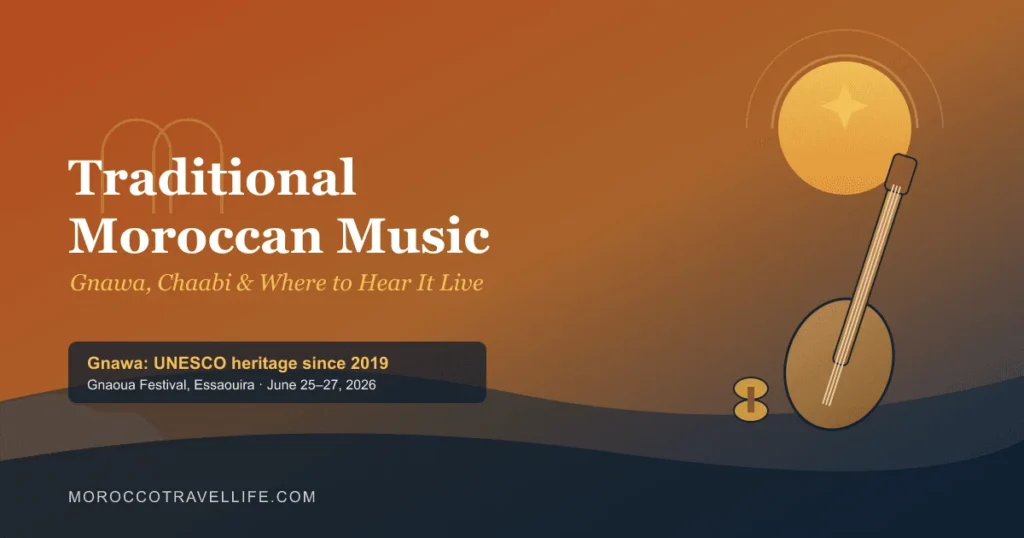
- The Gnaoua World Music Festival held its 27th edition in Essaouira on June 25-27, 2026. Dates for the next edition are not yet published, and the coastal town is Gnawa’s home year-round (Festival Gnaoua official site, 2026).
- Chaabi is the music you’ll hear most, Morocco’s popular wedding-and-street sound. The band Nass El Ghiwane, founded in 1969, was dubbed the “Rolling Stones of Africa” by Martin Scorsese (AramcoWorld, 2024).
- Andalusian classical music (al-Ala) traces to Muslim Iberia and reached Fes with refugees after the fall of Granada in 1492. 11 of its nuba suites survive in Morocco, out of a repertoire tradition once reckoned at twenty-four.
- Malhun, Morocco’s sung poetry, joined the UNESCO list in 2023, the country’s most recent musical inscription (UNESCO, 2023).
Table of Contents
What Counts as “Traditional Moroccan Music”?
Traditional Moroccan music is not a single style, and Gnawa is only its best-known strand. It’s a stack of distinct traditions layered over centuries. Sub-Saharan Gnawa, popular chaabi and its rural parent aita, courtly Andalusian al-Ala, Indigenous Amazigh village music, the sung poetry of malhun, and the eastern-desert influence of rai. Each one answers a different social need. A wedding, a healing ritual, a saint’s festival, a café evening. That’s why you can’t hear all of Morocco in one place, or in one night.
The quickest way to get your bearings, whether you came for Gnawa or something else, is to know which sound belongs to which setting. Here’s the whole roundup at a glance, before we go genre by genre.
| Genre | What it is | Signature instrument | Where you’ll hear it |
|---|---|---|---|
| Gnawa | Sub-Saharan trance and healing music | Guembri (3-string bass lute) + qraqeb | Essaouira, lila ceremonies, Gnaoua Festival |
| Chaabi | Popular street and wedding music | Oud, banjo, darbuka | Weddings, cafés, grand taxis, everywhere |
| Aita | Rural precursor to chaabi | Fiddle (kamanja) + hand drums | Countryside festivals, sheikhat performances |
| Andalusian (al-Ala) | Classical Arab-Andalusian suites | Oud, rebab, violin | Fes, Tetouan, Sacred Music Festival |
| Amazigh | Communal village music | Bendir frame drum | Atlas villages, Timitar in Agadir |
| Malhun | Sung poetry, semi-classical | Oud, violin, rebab | Fes, Meknes, cultural festivals |
| Rai | Popular protest-pop from the east | Keyboards, modern band | Oujda, radio, fusion stages |
Everything below expands one row of this table. If you only have time for one, make it Gnawa. It’s the most distinctly Moroccan of the lot, and it has the richest live scene.
The Gnawa Music Morocco Is Famous For
Gnawa, also spelled Gnaoua, is where any honest guide has to start. It’s the trance tradition that defines the genre abroad, and it’s both the most internationally famous of these traditions and the least understood. It grew out of the communities of enslaved and displaced West Africans brought north across the Sahara. Over centuries, their spiritual practices fused with Moroccan Sufi Islam and Amazigh custom. In 2019, UNESCO inscribed Gnawa on its Representative List of the Intangible Cultural Heritage of Humanity. The listing recognizes a living practice that runs from all-night healing rituals to festival main stages (UNESCO, 2019).
The sound is built on two instruments. The first is the guembri, also called the sintir or hajhouj. It’s a three-string bass lute with a body carved from a single log and covered in camel skin, and its low, looping line is the spine of every Gnawa piece. The second is the qraqeb, heavy iron castanets whose metallic clatter drives the rhythm into a hypnotic gallop. A Gnawa ensemble is led by a maâlem, or master musician. The good ones spend decades learning the repertoire, and UNESCO’s inscription explicitly recognises that transmission chain (UNESCO, 2019).
What travelers rarely grasp is that the Gnawa practised at home isn’t entertainment at all. It’s therapy. The full ceremony, called a lila or derdeba, is an all-night ritual. It calls on seven families of spirits, the mluk, and each family carries its own color, its own incense, and its own section of the musical repertoire. Participants in trance are draped in cloth matching the spirit being summoned. The festival version you’ll see on a stage in Essaouira is real music played by real masters. But it’s a concert excerpt of something that, in ceremonial form, is closer to a spiritual house-call than a show.
The seven-color structure of a lila is the single most useful thing to understand before you hear Gnawa live. It explains why the music moves through distinct movements over hours, instead of playing discrete songs. I’ve laid out the seven spirit families below, in the order a maâlem works through them across a night.
Where to hear it: start in Essaouira. It’s Gnawa’s home city, and its medina squares fill with the sound year-round, not just during the festival. My Essaouira travel guide covers the town beyond festival week. For the flagship live event, see the live-music section below.
Chaabi: The Sound You’ll Actually Hear Most
If Gnawa is the tradition foreigners come looking for, chaabi is the one that will actually follow you around Morocco. The word means “popular” or “of the people.” It’s the music of weddings, of café radios, of the grand taxi driver’s playlist on the road to Essaouira. Modern chaabi blends older rural forms with electric instruments: oud, banjo, keyboards, and the darbuka drum. The result is an irresistibly danceable party sound.
The single most important name here is Nass El Ghiwane. The group formed in Casablanca in 1969, in the working-class Hay Mohammadi neighborhood. They took chaabi’s roots, laced them with Gnawa rhythm and Sufi poetry, and turned the whole thing into a vehicle for coded social protest during a tense political era. Filmmaker Martin Scorsese famously called them the “Rolling Stones of Africa,” and their influence rippled outward as far as Algeria’s rai scene (AramcoWorld, 2024).
I’ve been invited to a handful of Moroccan weddings over the years, and chaabi was the engine of every one. Around midnight, when the formal dinner winds down, a live band or a very loud sound system kicks into a chaabi set. Then the whole room is on its feet, grandmothers included, doing the shoulder-and-hip shimmy that no visitor ever quite masters. You don’t seek chaabi out in Morocco. It finds you.
Aita: Chaabi’s Rural, Rebellious Parent
Before chaabi went electric and urban, there was aita. The word means “call” or “cry” in Arabic, and the sound lives up to it. This is Bedouin folk music from Morocco’s rural plains, built on piercing vocals, a scratchy fiddle called the kamanja, and rollicking hand drums. It’s widely considered one of the main precursors to modern chaabi.
Aita is older than the Gnawa now exported abroad, and it is inseparable from the sheikhat, the women singers who perform it. Historically these performers occupied a complicated and often marginalized place in society, and their songs carried real defiance. The legendary aita singer Kharboucha is remembered as a voice of rebellion against a repressive local ruler. Today aita has distinct regional styles across the Chaouia, Doukkala, and Abda plains, and a wave of younger artists has been reclaiming it with pride rather than embarrassment.
Andalusian Music (Al-Ala): Morocco’s Classical Inheritance
At the opposite end of the spectrum from a dusty countryside aita is Andalusian classical music, known in Morocco as al-Ala. This is the refined, orchestral tradition of the old Muslim courts of Iberia. When Granada fell in 1492, Muslim and Jewish communities were expelled from Spain and carried their music with them to North Africa. Fes and Tetouan became its Moroccan strongholds.
The music is organized into long suites called nuba. Each is tied to a particular melodic mode, and traditionally matched to a time of day or an emotional register. Of the original Andalusian repertoire, 11 nuba survive in the Moroccan tradition. An al-Ala orchestra is a genteel affair of oud, rebab (a bowed spike fiddle), violin, and light percussion, with vocal passages sung in classical Arabic. It’s the least street-level of Morocco’s traditions, and the one most likely to be performed in a formal concert hall or a historic riad courtyard.
Here’s a connection most visitors miss: Morocco’s Andalusian tradition is shared heritage, not just Muslim heritage. The Jewish communities expelled alongside Muslims from Spain kept the same repertoire alive. To this day, some of the finest custodians of certain Andalusian and malhun pieces have been Moroccan Jewish musicians. If you want the fuller story of that community, my guide to Morocco’s Jewish heritage traces it through the country’s medinas in ways the music makes audible.
Amazigh Music: The Indigenous Village Sound
Morocco’s oldest musical layer is Amazigh (Berber) music, the communal sound of the Indigenous people who predate the Arab arrival. It’s participatory rather than performed for an audience, and it splits along the same regional lines as the Amazigh languages. Ahidous belongs to the Middle and High Atlas, where villagers form swaying lines to frame drums and call-and-response poetry. Ahwach comes from the southern High Atlas, Anti-Atlas, and Souss. The Rwais are the professional Tachelhit troubadours, who set sung poetry to the ribab fiddle and lotar lute.
Amazigh identity is its own deep subject, covering language, history, and a cultural revival that runs well beyond music, so I hand the full context to my Amazigh (Berber) culture guide. For music specifically, the place to hear it curated and live is the Timitar festival in Agadir, which programs Amazigh artists deliberately.
Malhun and Rai: Poetry and the Eastern Influence
Two more traditions round out the picture. Malhun is Morocco’s sung poetry, a semi-classical form where verses in Moroccan Arabic (and sometimes Hebrew) are set to oud, violin, and rebab. Its themes run from love and wine to religious devotion and social commentary. It originated centuries ago in the Tafilalet region of the southeast, then spread to the craft guilds of Fes and Meknes. In 2023, UNESCO added malhun to its Representative List of the Intangible Cultural Heritage of Humanity, Morocco’s most recent musical inscription (UNESCO, 2023).
Rai is the odd one out. It’s really an eastern Moroccan and western Algerian phenomenon, born in the border city of Oran and heard in Morocco most strongly around Oujda. It’s popular, often rebellious dance-pop with roots in Bedouin folk. It’s more Algerian than Moroccan by origin, but it’s part of the soundscape in the country’s east, and a reminder that Morocco’s musical map doesn’t stop at any tidy national border.
It helps to see these traditions on a timeline, because the word “traditional” flattens a spread of more than a thousand years. Andalusian court music and malhun are medieval. Gnawa took shape over the centuries of the trans-Saharan slave trade. Aita is a rural folk form of similar depth. Chaabi as you hear it today is essentially a 20th-century invention. I’ve plotted the rough era each tradition took root below, drawn from the origin dates in the sources cited throughout this guide.
Where Can You Hear Live Music in Morocco?
Knowing the genres is half the job. The other half is knowing where each one is actually played well. Here are the venues and events worth planning around, from a headline festival to a free nightly square.
The Gnaoua World Music Festival, Essaouira
This is the one to build a trip around, and it is the biggest Gnawa showcase Morocco stages all year. The Gnaoua World Music Festival held its 27th edition on June 25-27, 2026, filling the coastal medina’s squares with Gnawa maâlems trading sets with jazz, blues, and world musicians (Festival Gnaoua official site, 2026). Dates for the next edition had not been published as of August 2026, though the festival has consistently landed in late June.
It’s grown into one of Morocco’s largest cultural events, with attendance widely reported in the hundreds of thousands across its run, though the organisers publish no audited figure (Festival Gnaoua official site, 2026). Most main-stage concerts are free. Book accommodation months ahead, because the town swells far beyond its normal size. My Morocco festival calendar handles the full logistics and dates.
The Fes Festival of World Sacred Music
The spiritual and Andalusian end of the spectrum has its own event. The Fes Festival of World Sacred Music ran its 29th edition on June 4-7, 2026, gathering artists worldwide for Sufi chant, sacred song, and world-music fusion in venues like Bab Makina (Telquel, 2026). It’s the calmest and most contemplative of Morocco’s big music festivals, and its usual early-June slot makes it easy to pair with a spring trip.
Jemaa el-Fnaa, Marrakech: Free, Nightly, Year-Round
You don’t need a festival at all. Every night, Marrakech’s great square, Jemaa el-Fnaa, becomes an open-air stage. Gnawa troupes, Amazigh musicians, and halqa storytellers perform in circles of onlookers. UNESCO first proclaimed the square’s cultural space a Masterpiece of the Oral and Intangible Heritage of Humanity in 2001, precisely for this living tradition (UNESCO, 2001). It’s the single easiest place in the country to hear traditional music for free, and my Marrakech travel guide covers the square and the medina around it.
Timitar (Agadir) and Tanjazz (Tangier)
For Amazigh music specifically, Timitar in Agadir ran its 21st edition on July 23-25, 2026, curating Amazigh artists alongside global acts (Telquel, 2026). It has usually landed in July. Up north, Tanjazz brings jazz to Tangier each September, if your taste runs more toward fusion than tradition. Both, along with the rest of the year’s calendar, are mapped in my festival guide.
Riads, Cafés, and the Honest Truth About Lila Ceremonies
Beyond the festivals, many riads and dinner restaurants in Marrakech, Fes, and Essaouira stage nightly music. It’s usually a softened, tourist-friendly chaabi or Gnawa set over dinner, not the Gnawa Morocco reserves for its own ceremonies. It’s pleasant, and there’s nothing wrong with it. Just understand it for what it is: a performance, not a ceremony.
Which brings me to the one thing I’d ask every visitor to take seriously. A real Gnawa lila is a private spiritual and healing ritual, not a show put on for outsiders. These do happen, and travelers are occasionally invited. But a lila is not something to buy a ticket to, or to crash with a camera. If you’re ever genuinely invited to one, go: quietly, respectfully, and prepared to stay until dawn. If you’re being sold a “traditional lila experience” as a packaged tour, know that you’re getting the concert version. Treat the real thing, if you ever meet it, as the privilege it is.
Frequently Asked Questions
What is Gnawa music?
Gnawa is the spiritual trance tradition rooted in the practices of enslaved and displaced West Africans, and it’s what Morocco is internationally known for. It’s built around the three-string guembri bass lute and iron qraqeb castanets, and led by a master musician called a maâlem. In its full form it’s an all-night healing ceremony, a lila, that summons seven families of spirits. It’s also performed as concert music. UNESCO inscribed it as Intangible Cultural Heritage in 2019.
What’s the difference between Gnawa and chaabi?
Gnawa, inherited from West Africa, is spiritual, trance-based, and ceremonial in function. Chaabi, meaning “popular,” is Morocco’s everyday party and wedding music. It’s secular, danceable, and built on oud, banjo, and darbuka. You’ll hear chaabi constantly in daily life. Gnawa is more of a destination sound, heard at its best in Essaouira or at a lila.
Where can I hear traditional Moroccan music live for free?
Jemaa el-Fnaa square in Marrakech is the easiest free option, nightly and year-round. It’s the best place to hear Gnawa without a ticket, and Amazigh musicians perform in the same circles of onlookers after dark. Most main-stage concerts at the Gnaoua World Music Festival in Essaouira are free as well, during its run each June.
When is the Gnaoua Festival in Essaouira?
The 27th edition ran June 25-27, 2026, in Essaouira. Dates for the next edition had not been published as of August 2026, but the festival has consistently landed in late June, so plan around that window and book accommodation months ahead. Full logistics are in my Morocco festival calendar.
Is it disrespectful to attend a Gnawa lila as a tourist?
Not if you’re genuinely invited and behave respectfully. A lila is a private healing ceremony, not a tourist show, so you shouldn’t try to buy your way into one or treat it as a photo opportunity. Festival and riad performances are the appropriate places to experience Gnawa music as a paying visitor. A real lila is something you attend only as a welcomed guest.
Putting It Together
Traditional Moroccan music isn’t one sound to check off a list. It’s a stack of living traditions, each tied to a place and a purpose. Gnawa belongs to trance and to Essaouira. Chaabi for every wedding you’ll ever attend. Andalusian al-Ala for Fes and formal courtyards. Amazigh music for the Atlas villages. Malhun and aita for the poetry and the plains. The best approach isn’t to hunt for all of it in one trip. Let the setting hand you the right sound: a free night in Jemaa el-Fnaa, a festival weekend in June, a wedding you happen to be invited to.
For the wider cultural context that all this music sits inside, from language and faith to food and identity, start with my guide to understanding Moroccan culture. When you’re ready to time a trip around a specific festival, the Morocco festival calendar has every date I could verify. And my roundup of the best things to do in Morocco folds a music night into a wider itinerary.