
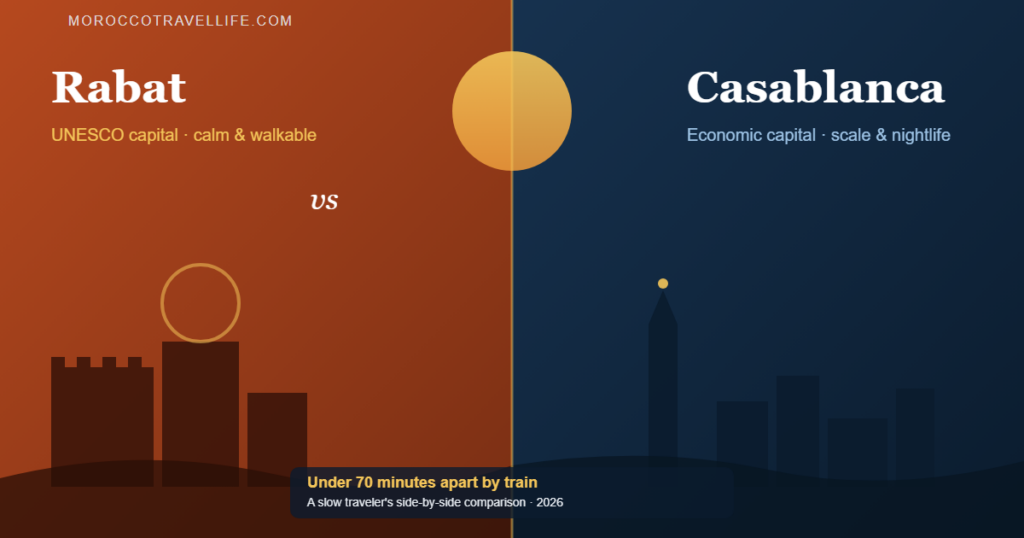
“Rabat vs Casablanca” sounds like a simple either-or question, but most travelers get the framing wrong from the start. Rabat is Morocco’s political and diplomatic capital, home to more than 120 foreign embassies (List of diplomatic missions in Morocco, Wikipedia, 2026) and a UNESCO World Heritage listing earned in 2012 (UNESCO World Heritage Centre, 2026). Casablanca is the country’s economic engine, a city of roughly 3.2 million people built around business, not sightseeing (HCP 2024 census, via Wikipedia, 2026).
Disclosure: Some links in this guide may earn us a commission, at no extra cost to you. It never changes what we recommend.
I’ve spent enough time within an hour’s train ride of both cities, and this Rabat vs Casablanca question is the one readers ask every month: which one is actually worth the day?
Key Takeaways
- Rabat holds UNESCO World Heritage status (inscribed 2012) for its kasbah, Hassan Tower, and Chellah necropolis. Casablanca isn’t inscribed, it only sits on Morocco’s UNESCO Tentative List for its 20th-century architecture, added in 2013 as “Casablanca, a Twentieth-Century City, Crossroads of Influences” (UNESCO World Heritage Centre, 2026).
- Casablanca is roughly six times the size of Rabat, with a city population near 3.2 million against Rabat’s roughly 516,000, per Morocco’s 2024 national census (HCP 2024 census, via Wikipedia: Rabat, Casablanca, 2026).
- Trains connect the two cities in under an hour to about 70 minutes, running roughly every 30 to 60 minutes throughout the day (ONCF timetables; Rail transport in Morocco, Wikipedia, 2026).
- Casablanca Finance City ranked Africa’s top financial center in GFCI 39 (March 2026), climbing to 49th globally out of 120 centers evaluated and earning a spot among the index’s “Global Leaders” (Global Financial Centres Index 39; Wikipedia, 2026).
- Rabat suits travelers who want calm history and walkable streets. Casablanca suits travelers who want scale, modern architecture, and a working city rather than a postcard one.
Rabat vs Casablanca
Rabat vs Casablanca: What’s the Quick Answer?
In 2026, Rabat wins on history, walkability, and calm, while Casablanca wins on scale, business energy, and coastal nightlife, based on the UNESCO and census data cited throughout this guide (UNESCO; HCP 2024 census, via Wikipedia: Rabat and Casablanca, 2026). Neither city replaces Marrakech or Fes as Morocco’s top draw, but each earns at least a day on most routes.
Here’s the Rabat vs Casablanca comparison at a glance, before the rest of the guide takes it row by row.
| Category | Rabat | Casablanca |
|---|---|---|
| Why visit | UNESCO history, calm capital, government architecture | Business hub, Hassan II Mosque, modern skyline, nightlife |
| Things to do | Kasbah des Oudayas, Hassan Tower, Chellah, Andalusian Gardens | Hassan II Mosque, Corniche/Ain Diab, Habous Quarter, Morocco Mall |
| Walkability | High: compact medina and riverside corniche | Moderate: spread out, taxi or tram needed for most routes |
| Typical stay | 1 to 2 days | 1 to 2 days, or a stopover en route elsewhere |
| Cost of stay, mid-range | Roughly 700-900 MAD/night | Roughly 800-1,100 MAD/night |
| Best for | First-timers wanting an easy, uncrowded imperial city | Modern-city travelers, business trips, coastal nightlife |
Source: my own on-the-ground pricing and observations, 2026, cross-referenced with the UNESCO and HCP data cited throughout this guide.
The rest of this guide covers each row, starting with what actually justifies a Rabat detour.
What Makes Rabat Worth Visiting?
On history, Rabat’s trump card is clear: it earned UNESCO World Heritage status in 2012 as “Rabat, Modern Capital and Historic City: a Shared Heritage,” covering the Kasbah of the Oudayas, the unfinished Hassan Tower, and the Chellah necropolis in one inscription (UNESCO World Heritage Centre, 2026). That’s a level of formal recognition Casablanca doesn’t share.
The Kasbah des Oudayas sits where the Bou Regreg river meets the Atlantic: a whitewashed 12th-century fortress with narrow blue-and-white lanes and a garden that stays quiet even in high season. The Hassan Tower, an unfinished 12th-century minaret meant to be one of the tallest of its era, stands beside the guarded Mausoleum of Mohammed V. Chellah, a walled Roman-then-Merinid necropolis a short walk from the center, draws a fraction of the visitors Volubilis does despite similarly striking ruins.
What surprises most first-time visitors is how calm Rabat feels. There’s no medina hustle, no persistent guide offers at every corner, just a capital city quietly going about its business. It’s the version of an imperial city I recommend to readers who found Marrakech’s souks overwhelming.
What Makes Casablanca Worth Visiting?
Casablanca’s answer is the Hassan II Mosque, which has the world’s second-tallest minaret at 210 meters, and its prayer hall holds up to 25,000 worshippers, making it the city’s single non-negotiable stop (Hassan II Mosque, Wikipedia, 2026). Beyond the mosque, Casablanca’s appeal is less about monuments and more about experiencing Morocco’s largest working city firsthand. My Casablanca travel guide covers the city on its own terms, from the airport train to the mosque tour.
Casablanca is Morocco’s economic capital, and Casablanca Finance City ranked as Africa’s top financial center in GFCI 39 (March 2026), placing 49th globally out of 120 centers evaluated and among the index’s “Global Leaders,” a status visible in the glass towers along Boulevard Anfa (Global Financial Centres Index 39, 2026). The Corniche at Ain Diab strings beach clubs and late-night restaurants along the Atlantic, a scene Rabat simply doesn’t have.
The Habous Quarter, built in the 1930s in a deliberately old-world Mauresque style, is Casablanca’s most photogenic neighborhood. It’s also part of why the city sits on Morocco’s UNESCO Tentative List for its 20th-century architecture, added in 2013 as “Casablanca, a Twentieth-Century City, Crossroads of Influences,” one step behind Rabat’s full inscription (UNESCO World Heritage Centre, 2026).
Which City Is More Walkable?
Rabat wins this one by a wide margin. Its historic core, government quarter, and riverside corniche all sit within a compact, flat area you can cover on foot in a day. Casablanca sprawls across a much larger footprint, and its main sights sit far enough apart that a taxi or tram becomes necessary.
I’ve walked Rabat’s entire old town and government district in a single unhurried afternoon. Doing the same in Casablanca means picking one neighborhood and accepting you won’t see the rest without wheels. Casablanca’s tram helps, connecting the port area to newer business districts, but it doesn’t reach the Corniche or Habous Quarter directly.
How Much Does It Cost to Stay in Each City?
Rabat vs Casablanca hotel costs follow the same pattern as everything else. In 2026, a mid-range room runs roughly 700-900 MAD a night in Rabat versus 800-1,100 MAD in Casablanca, based on my own recent bookings in both cities. Budget guesthouses start around 250-350 MAD in Rabat and 300-400 MAD in Casablanca, with Casablanca’s business-travel demand keeping its upper tiers consistently pricier.
Food and transport track closely between the two: a sit-down dinner runs 80-150 MAD in either city, and petit taxi rides across town rarely exceed 30-40 MAD. The real cost gap shows up at the top end, where Casablanca’s international hotel chains and business-district restaurants charge a premium Rabat’s smaller hospitality scene doesn’t try to match. For a full country-wide breakdown, see my real dirham budget breakdown, which covers daily costs by travel style across Morocco.
How Do You Get Between Rabat and Casablanca?
ONCF trains connect Rabat and Casablanca roughly every 30 to 60 minutes throughout the day, covering the roughly 90 km route in under an hour to about 70 minutes depending on the service (ONCF timetables; Rail transport in Morocco, Wikipedia, 2026). It’s the easiest intercity hop in the country, easy enough that many residents commute it daily.
As of my last few rides in 2026, a one-way second-class ticket runs roughly 35-90 MAD depending on the train type and how close to departure you book, with first class costing somewhat more. Both cities’ main stations, Rabat Ville and Casa Voyageurs, sit close to their respective centers, so neither end requires a long taxi transfer. If you’re weighing trains against buses, grand taxis, or renting a car for the rest of your trip, my trains, buses, and grand taxis compared guide covers every option.
Where Do Rabat and Casablanca Fit in a Morocco Itinerary?
Fitting a Rabat vs Casablanca stop into a bigger trip is straightforward: most travelers slot them in as one combined stop rather than two separate destinations, often as a stopover between the north (Tangier, Chefchaouen) and Marrakech or Fes further south. Given how short the train ride is, doing both in a single long day, or splitting one overnight between them, works for almost any itinerary length.
If you’re still deciding how many days to give the whole trip, my 7-day vs 10-day vs 14-day itinerary comparison breaks down what each route can realistically include, and where a Rabat-Casablanca stop tends to fit best. On a classic 7-day loop, most travelers skip both in favor of the Sahara circuit. On a 10-day or 14-day trip, there’s usually room for a one-night stopover in one of the two, most often Rabat for the calmer arrival.
For a full breakdown of where this pairing fits into a bigger trip, start with my guide to the Moroccan cities worth building a trip around.
First time in Morocco? Start with my complete first-trip planning guide for visas, budgeting, safety, and a full 7-day route before you build the rest of your itinerary.
Rabat vs Casablanca: Which One Should You Choose?
If it comes down to just one, choose Rabat. It delivers Morocco’s imperial-city history and UNESCO-listed sights in a calmer, more walkable package than Marrakech or Fes, without Casablanca’s sprawl. Casablanca earns its slot only if you specifically want the Hassan II Mosque, a business-city contrast, or a coastal night out.
Most guidebooks frame Casablanca as the “must-see” simply because it’s Morocco’s biggest city, but size and worth-your-time aren’t the same thing. Judged purely on what a traveler with one spare day actually gets to see and do on foot, Rabat outperforms Casablanca more often than its lower profile suggests.
Here’s how the Rabat vs Casablanca choice usually breaks down by traveler type:
| Traveler Type | Recommended City | Why |
|---|---|---|
| First-timer with one spare day | Rabat | Compact, walkable, UNESCO history, low hassle |
| Business or conference traveler | Casablanca | Airport hub, financial district, international hotels |
| Architecture or history enthusiast | Rabat | UNESCO-listed kasbah, Hassan Tower, Chellah |
| Nightlife and modern-city traveler | Casablanca | Corniche nightlife, Hassan II Mosque, dining scene |
| Tight on time, just passing through | Either, as a train stopover | Under 70 minutes apart, easy same-day hop |
Not sure which side fits your full route? The itinerary comparison linked above covers exactly that.
Frequently Asked Questions
Is Rabat or Casablanca better for a day trip?
Rabat wins for most travelers. Its UNESCO-listed sights sit within walking distance of each other, while Casablanca’s main draw, the Hassan II Mosque, sits apart from the rest of the city (UNESCO, 2026).
How far is Casablanca from Rabat?
About 90 km. ONCF trains cover the distance in under an hour to roughly 70 minutes, running every 30 to 60 minutes for most of the day (ONCF timetables; Rail transport in Morocco, Wikipedia, 2026).
Is Rabat Morocco’s capital, or is it Casablanca?
Rabat is Morocco’s political and administrative capital, home to more than 120 foreign embassies. Casablanca is the country’s largest city and economic capital, but not the seat of government (List of diplomatic missions in Morocco, Wikipedia, 2026).
Which city has the Hassan II Mosque?
Casablanca. Its 210-meter minaret is the world’s second-tallest minaret, and the mosque is one of the few in Morocco open to non-Muslim visitors on guided tours (Hassan II Mosque, Wikipedia, 2026).
Can I visit both Rabat and Casablanca in one day?
Yes, easily. The combo works because the train ride is under 70 minutes each way, so a single long day covering the Kasbah des Oudayas in Rabat and the Hassan II Mosque in Casablanca is realistic for most travelers (ONCF timetables; Rail transport in Morocco, Wikipedia, 2026).
Conclusion
Rabat vs Casablanca ultimately comes down to different questions. Rabat gives you Morocco’s imperial history in a UNESCO-listed, walkable package. Casablanca gives you the country’s economic pulse, its most famous mosque, and a coastal nightlife scene Rabat can’t match. Most itineraries have room for at least a stopover in one, and the short train ride between them means you rarely have to choose only one over the other.
The decision comes down to matching the city to what you actually want from the day: calm history or modern scale. Whichever you pick, check how it fits your overall route with my 7-day vs 10-day vs 14-day itinerary comparison, and start from my Moroccan cities guide if you’re still mapping out the rest of the trip.