The first time I bought a phone charger in Marrakech, the shopkeeper used four languages in about ninety seconds. He opened in Darija. He saw my blank face and tried French. He clocked my worse French and switched to English for the price. Then he took a call in what I later learned was Tachelhit. He never seemed to notice he’d done it. The language spoken in Morocco is not one language, and that shop taught me so in under two minutes.
Disclosure: Some links in this guide may earn us a commission, at no extra cost to you. It never changes what we recommend.
Back home, one conversation means one language. Here, a single transaction can pass through three or four, and nobody keeps score. That juggling act is the honest answer to the question travelers ask me most: what do people actually speak here?
The short version is “more than one, always, at once.” But the useful version takes a few minutes. Darija, Modern Standard Arabic, three Amazigh varieties, French, Spanish in the north, and fast-rising English each sit in a different part of daily life. Knowing which one lives where is what turns a confusing trip into an easy one. I’ve made enough trips through Marrakech to have needed this map myself, so here’s the one I wish someone had handed me on day one.
Key Takeaways
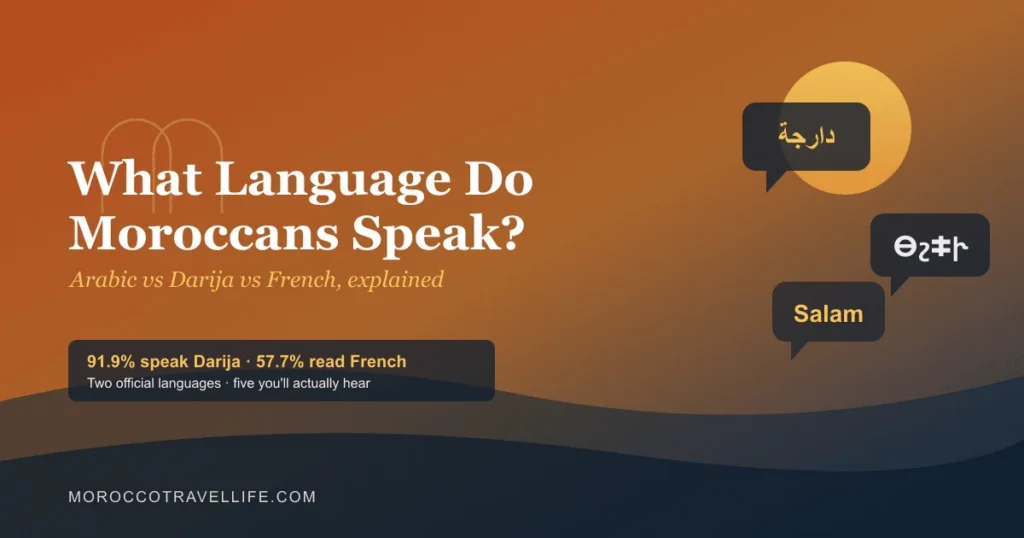
- 91.9% of Moroccans use Darija (Moroccan Arabic) in daily life, per the 2024 national census (HCP, 2024). It is a mother tongue with no single standard written form, and Gulf Arabic speakers often struggle to follow it.
- Morocco’s two official languages are Arabic and Amazigh (Tamazight), named in Article 5 of the 2011 constitution (Constitute Project, 2011). Darija, the one you’ll actually hear, is neither.
- French is a reading skill more than a speaking one. 57.7% of literate Moroccans can read and write it, but a 2024 survey found only about 19% speak it fluently (Yabiladi, 2024; Hespress, 2025).
- English is climbing fast among the young: 9% of Moroccans speak it fluently overall, but 17% of under-34s do. An earlier survey found 40% of young Moroccans call English the most important language to learn (Hespress, 2025; Morocco World News, 2021).
- You do not need Arabic to travel here. English and French cover the tourist trail comfortably, and ten memorized Darija words earn a warmth that’s wildly out of proportion to the effort.
- Six languages of Morocco matter to a visitor: Darija, Modern Standard Arabic, Amazigh, French, Spanish, and English. This guide maps where each one lives, then hands you 28 phrases worth memorizing.
Table of Contents
What Is the Main Language Spoken in Morocco?
Here’s the practical answer before the detail. On the street you’ll hear Darija (Moroccan Arabic) everywhere. French turns up in every city, on signage and in business. Amazigh (Berber) languages hold the mountains and the south. Spanish lingers in the far north. And there’s enough English in tourist zones to get by without any of the above.
Morocco is casually multilingual in a way that startles visitors from single-language countries. The languages of Morocco don’t queue politely. Switching between them mid-sentence isn’t showing off here. It’s Tuesday.
The layering has a logic. Darija (Moroccan Arabic) is the mother tongue almost everyone shares, and the 2024 census counted 91.9% of the population using it in daily life (HCP, 2024). Modern Standard Arabic (MSA) sits above it as the formal written language. It’s the Arabic of the news, the Quran, newspapers, and government forms. Nobody actually converses in MSA, any more than an English speaker chats in the language of legal contracts.
French layers on top from the colonial era. It still runs much of business, higher education, and street signage. Amazigh runs underneath all of it as the Indigenous foundation. And English is the new arrival, climbing fast among anyone under 35.
The mistake I see travelers make is treating this as a ranking, with one “real” language on top. It isn’t. A Marrakchi university student thinks in Darija with friends. She writes her thesis in French, prays in classical Arabic, texts her cousin in the Rif in Tarifit, and watches American shows in English. None of that feels like a contradiction to her. Once you stop hunting for the single answer, the whole system makes sense.
Is Darija the Same as Arabic?
Yes and no. The “no” is the part that trips up travelers who studied Arabic before their trip, and it’s the single most confusing thing about the language spoken in Morocco.
Darija, Moroccan Arabic, is a form of Arabic. It descends from it, shares most of its bones, and is written in Arabic script when it’s written at all. One open-source study of Moroccan vocabulary found that 77.6% of Darija words are borrowed from Modern Standard Arabic (Outchakoucht & Es-Samaali, Darija Open Dataset, 2021). But it has drifted far enough that the two aren’t smoothly interchangeable. Darija compresses vowels, drops syllables, and moves fast. Shared roots don’t guarantee comprehension.
What makes Darija its own creature is what got layered on afterwards. The same study put French at 11.7% of the vocabulary, the single largest non-Arabic source. Moroccans say tomobil for car, from the French automobile. Simana for week comes from the Spanish semana. Amazigh leaves a lighter lexical mark than most travel guides suggest, under 1% by that count, but its fingerprints are all over the sound and rhythm of the language, plus the names of places, plants, and dishes.
The result travels badly. A Gulf Arabic speaker dropped into a Marrakech café often catches maybe half of a fast conversation. That’s why Moroccan films and shows are frequently subtitled when they air elsewhere in the Arab world.
I watched this happen over dinner on a rooftop in Fes. A friend visiting from Jordan, a native Arabic speaker, spent the week half-lost. He followed the gist but kept asking people to slow down or repeat. He gave up entirely on the rapid-fire back-and-forth of the souk. His verdict: “It’s Arabic the way Portuguese is Spanish.” That’s about right. If you learned textbook Arabic, you’ll read the signs and follow formal announcements. The living street language is a different skill.
Do Moroccans Speak French? (And Why “Literacy” Isn’t “Fluency”)
Yes, many do, but far fewer than you’d guess from the street signs. French is everywhere in writing and much rarer in fluent speech than travelers assume. That gap is the most misunderstood part of the whole language spoken in Morocco question.
Start with the reading figure. The 2024 census found that 57.7% of literate Moroccans aged 10 and over can read and write French (Yabiladi, 2024). Note the base. National literacy runs about 75%, so that headline share works out closer to 43% of the population overall. It’s a legacy of the 1912–1956 French protectorate, and it still runs through banks, science and business faculties, menus, product labels, and the street signs of every city.
But “can read and write” is not “speaks comfortably.” A 2024 survey by the research group Sunergia found only about 19% of Moroccans speak French fluently (Hespress, 2025). It rises to 24% among under-34s and 43% among higher-income groups. It drops to 6% among lower-income Moroccans.
So French is best understood as the language of the educated urban middle class and of officialdom. Dominant on paper, patchier in a taxi. In a riad, at a bank, or in a nice restaurant, French works beautifully. In a rural grand taxi or a village market, it may get you nowhere.
What About Spanish, English, and Amazigh?
Three more languages of Morocco round out the map, each with its own territory.
Spanish survives in the north: Tangier, Tetouan, and the Rif. It’s a leftover of the Spanish protectorate and of Spain’s sheer closeness across the Strait of Gibraltar. Nationally it’s tiny, about 1.2% of literate Moroccans, but it climbs sharply above Rabat and fades to near zero south of Casablanca (Yabiladi, 2024). If you speak Spanish and you’re heading to Chefchaouen or Tangier, it’s genuinely more useful there than in Marrakech.
English is the language on the rise, and the trend is unmistakable. Beyond the 9%-overall, 17%-among-under-34s fluency split, an earlier survey found 40% of young Moroccans consider English the single most important language to learn, versus just 10% for French (Morocco World News, 2021). The government is following the demand. In 2023 the Ministry of Education began rolling English into middle schools from the first year, aiming for full coverage by the 2025–2026 school year (Morocco World News, 2023). For travelers, the old “learn French first” rule of thumb has flipped. The younger the person, the likelier English works.
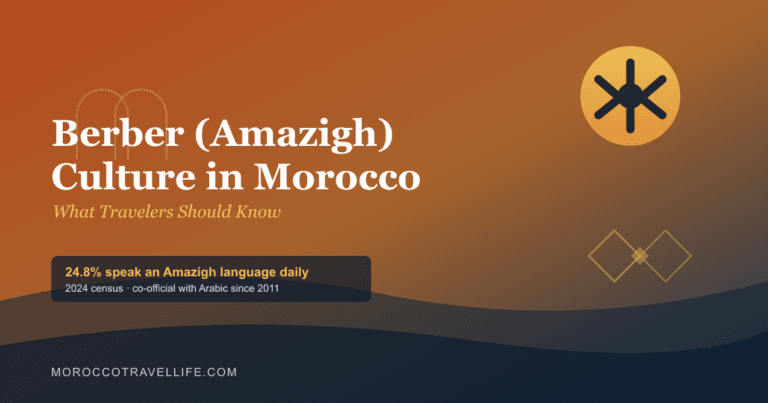
Amazigh (Berber) languages are the Indigenous foundation of the language spoken in Morocco. The 2024 census recorded 24.8% of Moroccans using one daily, rising to 33.3% in rural areas (HCP, 2024). They split into three regional varieties: Tachelhit in the south (14.2%), Central Atlas Tamazight (7.4%), and Tarifit in the Rif (3.2%).
Amazigh became co-official with Arabic under Article 5 of the 2011 constitution (Constitute Project, 2011). That’s why road signs now run trilingual: Arabic, the geometric Tifinagh script, and French. The full story of the Imazighen, the Tifinagh alphabet, and how to engage respectfully in Amazigh regions has its own deep dive in my guide to Amazigh (Berber) culture in Morocco. This post keeps the focus on the practical, spoken side.
Do I Need to Speak Arabic to Travel in Morocco?
No. I want to be clear about this, because worry over the language spoken in Morocco stops some people from booking at all.
You can travel Morocco end to end on English and French alone, without speaking a word of any other language spoken in Morocco. In the main tourist areas, English alone is usually enough. Hotel and riad staff, tour guides, most restaurant servers, taxi drivers in tourist zones, and souk shopkeepers deal with international visitors daily and have the language to match. The classic city circuit is well covered: Marrakech, Fes, Chefchaouen, the Sahara tours, Essaouira.
Where you’ll feel the gap is off the trail. Rural bus stations, small-town cafés, mountain villages, the interior where tourism is thin. There, French helps more than English, and a few words of Darija or the local Amazigh variety help most of all.
But “feel the gap” means slower, more gestural, more patient conversations. It doesn’t mean being stranded. Point, smile, open a translation app, and you’ll be fine. For the wider practical layer, my first-time-in-Morocco tips cover the non-language logistics, and my guide to getting around Morocco gets into the transport situations where a little language goes furthest.
Language Spoken in Morocco, Setting by Setting
The clearest way to hold the language spoken in Morocco in your head is by setting. Which one wins in which situation? This is the map I run.
| Setting | Language you’ll mostly meet |
|---|---|
| Government offices, official documents, news | Modern Standard Arabic (written/formal) |
| The street, home, casual conversation | Darija (Moroccan Arabic) |
| Banks, business, higher education, science | French |
| City road signs & storefronts | Arabic + French (+ Tifinagh) |
| Souks & markets (tourist areas) | Darija first, then French/English as needed |
| Riads, hotels, guides, tour operators | English and/or French |
| High Atlas & Souss villages | Tachelhit / Central Atlas Tamazight (+ some Darija) |
| The Rif & far north | Tarifit + Spanish in towns |
| Youth, tech, tourism-facing jobs | Rising English |
A Traveler’s Darija Phrasebook (With Pronunciation)
This is the part worth actually memorizing. You don’t need to learn the language spoken in Morocco to travel well, but 28 words will change how people treat you. My sibling Moroccan etiquette guide has a short greetings table for the essentials. The three tables below are the fuller kit, the one I’d load onto a traveler’s phone.
Darija has no single standard spelling in Latin script, so these are practical phonetic transliterations. Say them out loud and you’ll be understood. Two sounds to know: gh is a throaty French “r,” and kh is the raspy sound in the Scottish “loch.”
Greetings & politeness
| Darija | Meaning | Say it like |
|---|---|---|
| Salam / Salam alaykum | Hello / peace be upon you | sa-LAAM (a-lay-koom) |
| La bas? | How are you? / all good? | la-BAASS |
| La bas, hamdullah | I’m fine, thank God | la-bass, ham-doo-LAH |
| Shukran | Thank you | SHOOK-ran |
| La, shukran | No, thank you (souk gold) | la SHOOK-ran |
| Afak / Aafak | Please | a-FAAK |
| Smeh liya | Excuse me / sorry | smeh LEE-ya |
| Iyeh / La | Yes / No | EE-yeh / la |
| Bslama | Goodbye | b-sla-MA |
| Inshallah | God willing (i.e. “hopefully”) | in-sha-LAH |
Numbers & money
| Darija | Meaning | Say it like |
|---|---|---|
| Wahed, jouj, tlata | One, two, three | WA-hed, zhoozh, TLA-ta |
| Rbaa, khamsa | Four, five | r-BAA, KHAM-sa |
| Aachra | Ten | AASH-ra |
| Meya | One hundred | MEH-ya |
| Bshhal? | How much? | b-sh-HAAL |
| Ghali bezzaf | Too expensive | gha-LEE be-ZZAAF |
| Naqes shwiya | Lower it a little | NA-qes shwee-ya |
| Flous | Money | floos |
Haggling, directions & the useful rest
| Darija | Meaning | Say it like |
|---|---|---|
| Kayn / Makaynsh | There is / there isn’t | KINE / ma-KINE-sh |
| Fin…? | Where is…? | feen |
| Yemna / Lisar | Right / left | YEM-na / lee-SAR |
| Nishan | Straight ahead | nee-SHAAN |
| Lmohim… | The main thing / anyway | l-mo-HEEM |
| Bghit had shi | I want this one | b-GHEET had shee |
| Ma/bla sukkar | With / without sugar | ma / bla soo-KAR |
| Ldeed / Bnin | Delicious | l-DEED / b-NEEN |
| Safi | Enough / that’s it / done | SAA-fee |
| Yallah | Let’s go / come on | ya-LAH |
If you only bank five of these, make them salam, shukran, la shukran, bshhal, and bslama. The return on ten minutes of memorizing is genuinely absurd. Vendors drop their tourist register. Taxi negotiations soften. On every trip, someone asks me where I picked it up, delighted, on the strength of a greeting and nothing else. La, shukran alone will save you more hassle in the souk than any other phrase. It’s the polite, confident deflection that a simple English “no” never quite manages.
Which Translation Apps Actually Handle Darija?
Badly, is the short answer. This is where technology hasn’t caught up to the language spoken in Morocco, and it’s worth knowing before you lean on your phone.
Here’s the irony. In June 2024, Google Translate added 110 new languages, and Tamazight (Amazigh) was among them. Moroccan Darija was not (Google, 2024), and as of 2026 it still isn’t. So the mainstream app now translates the Indigenous script on the road signs, yet can’t handle the spoken language 92% of the country uses every day. Google Translate does support “Arabic,” but that means Modern Standard Arabic. Set it to Arabic and you’ll get stiff, formal phrasing that a Marrakech vendor finds oddly bookish. They’ll understand it. They’ll also know exactly what happened.
For real Darija, the workarounds are specialized. Several dedicated apps and sites target Moroccan Arabic specifically, including GoDarija and TalkDarija, and they handle it far better than general-purpose tools. My honest field advice: use Google Translate in Arabic or French mode for anything written, like menus, signs, and pharmacy labels. Keep expectations low for spoken Darija. Lean on a dedicated Darija app only if you’re going somewhere genuinely off-trail. And download your language packs for offline use before you go, because connectivity in the mountains is patchy. That’s one more reason to sort out a Morocco SIM card and data plan on arrival.
Why Do Moroccans Switch Languages Mid-Sentence?
Because they can, and because each language carries a slightly different flavor the speaker is reaching for. Linguists call it code-switching. In Morocco it’s just talking, and it’s the reason the language spoken in Morocco resists a one-word answer.
A single sentence might start in Darija (Moroccan Arabic), drop a French noun for something technical, add an Arabic religious expression, and finish with an English word borrowed from a show. It isn’t confusion or incomplete knowledge. It’s a rich, deliberate blend, the spoken equivalent of the layered culture itself.
The thing that took me longest to appreciate is that the choice of language is itself a message. A shopkeeper who greets you in French is reading you as European. One who tries English has clocked you as likely American, British, or “international.” When a Moroccan switches to Darija with you after you’ve offered a couple of words, that’s not just practicality. It’s a small acceptance, a signal that you’ve moved half a step from “tourist” toward “guest.” That’s the real reward of learning ten words. Not the words. The door they open.
Frequently Asked Questions
What language do most Moroccans speak day to day?
Darija (Moroccan Arabic). It’s the main language spoken in Morocco day to day, recorded by the 2024 census as used by 91.9% of the population. It’s the mother tongue of the street, the home, and casual conversation. Morocco’s two official languages, used for writing and institutions, are Arabic and Amazigh. French remains a widely used second language in business, education, and signage.
Is Moroccan Darija the same as standard Arabic?
Not quite. Darija descends from Arabic, and one open-source study found 77.6% of its vocabulary is borrowed from Modern Standard Arabic. But it compresses vowels, moves fast, and takes another 11.7% of its words from French. The result is different enough that Middle Eastern and Gulf Arabic speakers often struggle to follow rapid Moroccan speech, and Moroccan films are sometimes subtitled elsewhere in the Arab world.
Do Moroccans speak French?
Many read and write it. The 2024 census put it at 57.7% of literate Moroccans, thanks to the 1912–1956 French protectorate, and French still dominates banking, higher education, and street signage. Spoken fluency is much lower. A 2024 survey found only about 19% speak French fluently, concentrated among the educated urban middle class. French works well in cities, riads, and business settings, less so in rural areas.
Can I travel Morocco speaking only English?
Yes, on the main tourist circuit, and you don’t need any of the languages of Morocco to manage it. Riad and hotel staff, guides, tour operators, and most souk vendors in tourist areas speak enough English to help you. English is also rising fast among young Moroccans, with 17% of under-34s fluent. Off the beaten path, French helps more, and a few words of Darija (Moroccan Arabic) help most. You won’t be genuinely stranded anywhere tourists commonly go.
What language is spoken in northern Morocco?
The language spoken in northern Morocco is the same Darija-first mix as the rest of the country, plus a notable amount of Spanish in Tangier, Tetouan, and the Rif. That’s a legacy of the Spanish protectorate and of Morocco’s closeness to Spain. Nationally Spanish is small, about 1.2% of literate Moroccans, but it’s meaningfully more useful in the north. The Rif is also Tarifit-speaking, one of Morocco’s three Amazigh varieties.
Does Google Translate work for Moroccan Arabic?
Only partially, and it’s the weakest link in translating the language spoken in Morocco. Google Translate supports Modern Standard Arabic, which reads as formal and a bit bookish on the street, and it added Tamazight in June 2024. It still doesn’t support spoken Darija (Moroccan Arabic). For real Darija, dedicated apps like GoDarija or TalkDarija do a better job. For written text like menus and signs, Google Translate in Arabic or French mode is usually good enough.
Putting It Together
The language spoken in Morocco isn’t one language. It’s a working system of six, sorted by setting rather than stacked in a ranking. Darija, Moroccan Arabic, is the shared spoken heart. Modern Standard Arabic is the formal skeleton. French is the language of the office and the road sign. Amazigh is the Indigenous foundation, Spanish the northern accent, English the fast-rising future.
So when someone asks what the main language spoken in Morocco is, the honest reply is a question back: in which room? You don’t need to master any of the languages of Morocco to have a smooth trip. You need the map, ten words of Darija, and a willingness to let people meet you where you are. Being Moroccan, they almost always will.
For how language fits alongside everything else that shapes a visit, from Islam and hospitality to food, craft, and history, start with my complete guide to Moroccan culture, the pillar this piece belongs to. And if the identity side of the story pulled you in, my Amazigh (Berber) culture guide goes deep on the Indigenous language, the Tifinagh script, and how to travel respectfully through Amazigh Morocco.