
The first place I ever slept in Morocco was a riad off a Marrakech derb. The lane was so narrow I had to turn my suitcase sideways to reach the door. From the alley it looked like nothing: a scuffed wall, a low studded door, no sign. Inside was a tiled courtyard open to the sky, a lemon tree, and a fountain ticking over.
The silence was something the medina outside had no business allowing. I’ve been back for weeks at a time since. I still think that first thirty-second walk, from grubby lane to hidden courtyard, makes the case on its own. Morocco does accommodation differently from almost anywhere else.

Disclosure: Some links in this guide may earn us a commission, at no extra cost to you. It never changes what we recommend.
That difference is exactly what trips people up when they try to work out where to stay in Morocco. “Hotel” barely covers it here. You can sleep in a 300-year-old courtyard house, a mud-brick fortress on a desert caravan route, or a canvas tent under the Milky Way. You can also pick a family guesthouse in a Berber village, or a glass-walled resort with a rooftop pool. Every one of those is a normal, bookable Morocco stay.
This guide is the map to all of it, written from repeat, extended stays rather than a single pass through. Each type below hands off to a deeper guide in my Accommodation series. Go as far down the rabbit hole as your trip deserves.
Key Takeaways
- Morocco drew a record 19.8 million visitors in 2025, up 14% on 2024. It logged over 43.4 million overnight stays in classified establishments. Beds are in demand, and the best riads book out months ahead (ATTA, 2026; Morocco World News, 2025).
- A riad is a traditional courtyard house in the medina, and it is the signature Moroccan stay. Expect roughly 500–1,000 MAD (about $50–100) a night for a comfortable mid-range room (Morocco Travel Life field pricing, July 2026).
- Marrakech-Safi alone took about 38% of all Moroccan tourist nights in 2025, some 16.5 million. The country’s accommodation market is heavily concentrated in and around Marrakech (Morocco World News, 2025).
- Nightly rates span an enormous range, from ~100 MAD hostel dorms to 4,000+ MAD luxury riads and desert camps. A Sahara camp is usually priced per person with dinner and breakfast, not per room (Morocco Travel Life field pricing, July 2026).
- Short-term rentals sit in the middle. The average Airbnb night in Morocco runs about 850–1,050 MAD, with Marrakech listings near 799 MAD ($79) (AirROI, 2026).
Where to Stay in Morocco?
Where to Stay in Morocco: What Are Your Options?
Morocco gives you roughly eight distinct ways to sleep. Knowing the vocabulary before you open a booking site saves hours of confusion, and it is where any honest answer to where to stay in Morocco starts. The main types are riads (courtyard houses in the medina) and dars and guesthouses (simpler family-run homes).
Then hotels and modern resorts, plus kasbah stays, the fortified earthen buildings of the south and mountains. Then come Sahara desert camps, eco-lodges, family-friendly riads and resorts with pools, and apartments or Airbnb rentals. Almost every trip I help plan mixes at least three, which is the real answer to where to stay in Morocco.
The reason to mix is that Morocco is really several countries stacked into one. Each rewards a different kind of stay, so where to stay in Morocco changes as you move. In the imperial cities of Marrakech, Fes and Meknes, the medina riad is the whole point. It puts you inside the maze rather than a taxi ride from it.
In the desert, a camp is not a gimmick: it is genuinely the only way to wake up in the dunes. In the Atlas and the Dades, a kasbah or mountain guesthouse plugs you into village life and terrace views no city hotel can touch. The art of a good Morocco itinerary is matching the stay to the place. The sections below walk through each type with honest trade-offs and current prices.
One structural note surprises first-timers. Where to stay in Morocco is shaped by supply, and Morocco’s beds are not evenly spread. Marrakech-Safi took roughly 38% of all national tourist nights in 2025 and Souss-Massa (Agadir) another 20% (Morocco World News, 2025). That concentration means Marrakech has the deepest, most competitive accommodation market in the country: great for choice, hard on availability at the top end. If you want a specific well-reviewed riad in high season, treat “book early” as a rule, not a suggestion.
What Is a Riad, and Why Is It the Signature Moroccan Stay?
A riad is a traditional Moroccan house built inward around a central courtyard or garden. It usually runs two or three stories, with rooms facing the quiet interior rather than the street. The name comes from the Arabic riyad, meaning garden. Strictly, a house with a planted courtyard is a riad, and one with a plain tiled patio is a dar. Hospitality marketing now calls almost all of them riads. When people ask where to stay in Morocco and picture something distinctly Moroccan, this is the answer.
The thing no listing photo conveys is the acoustic shift. A riad turns its back on the medina by design: blank walls out, beauty in. Stepping through the door drops the noise of the souk to almost nothing. That inward-facing architecture repeats across Moroccan buildings. It is why a mid-medina riad can feel like a monastery two meters from a motorbike-clogged lane. I explain the courtyard-and-keyhole vocabulary in my guide to Moroccan architecture. You will understand it faster by sleeping in one for a night.
The honest trade-offs matter. In a riad’s favor: character no chain can fake, and home-cooked breakfast on the roof terrace. Add owners who actually help you plan your day, and a location deep in the old city. Against it: most riads sit down pedestrian-only alleys, so a taxi drops you at the edge and someone walks you in. Arrange that in advance. Rooms can be dim because windows face inward, there is rarely an elevator, and the smallest riads have thin walls.
For a full side-by-side on comfort, cost, and who each suits, see my comparison of riads versus hotels in Morocco. For a plain-language walkthrough of what a first night actually feels like, read what a riad stay is really like.
Pricing runs in fairly predictable tiers. Dollar figures in this guide use a deliberately round 10 MAD ≈ $1 for quick mental maths. The real rate sits nearer 9.3, so treat the dollar column as a floor. Check Bank Al-Maghrib before budgeting tightly. A simple guesthouse-style riad room runs about 250–500 MAD ($25–50) a night as of July 2026.
A comfortable mid-range riad with a plunge pool and a decent breakfast lands around 500–1,000 MAD ($50–100). A genuinely luxurious riad (hammam, staff, suite-sized rooms) starts near 1,500 MAD and climbs past 4,000 MAD ($150–400+) (Morocco Travel Life field pricing, July 2026). The chart below sets those riad tiers against every other stay type so you can see where your money goes.
When Do Hotels Beat Riads in Morocco?
Hotels absolutely have their place in the where to stay in Morocco decision. Pretending every traveler should force themselves into a riad does nobody any favors. A modern hotel wins when you want an elevator, reliable air-conditioning, or a car that pulls up to the door. It also wins if you want a proper gym, a big pool, or simply a predictable international standard after a long flight.
The newer districts (Gueliz in Marrakech, the ville nouvelle in Fes, the beachfront strips in Agadir and Essaouira) are where the hotels and resorts cluster.
Friends traveling with elderly parents or a mountain of luggage get the same advice. A Gueliz hotel for the first two nights, then a medina riad for the next two. It defuses almost every complaint I used to hear. The riad delivers the romance; the hotel delivers the elevator, the taxi rank, and the 24-hour reception when a flight lands at 2 a.m. Nobody has to choose between character and a good night’s sleep if the itinerary buys both.
Rates are broad. A solid three- to four-star hotel typically runs 700–1,500 MAD ($70–150) a night as of July 2026. Five-star city hotels and Atlantic beach resorts climb well beyond that. The Agadir belt runs highest, pulling a fifth of the country’s tourist nights (Morocco Travel Life field pricing, July 2026; Morocco World News, 2025). If you are torn between the two worlds, my riad versus hotel breakdown is built exactly for that decision, city by city.
What Is a Kasbah Stay Like in the Atlas and Dades?
A kasbah is a fortified earthen building (historically a fortress or a walled family compound) built from rammed earth and mud-brick. In the south of Morocco many have been restored into some of the country’s most atmospheric guesthouses. Where the riad is the signature city stay, the kasbah is the signature mountain and desert-route stay. Expect thick cool walls, crenellated towers, and terraces looking straight onto the High Atlas, the Dades gorge, or the palm groves of the Skoura oasis.
Staying in one changes the tempo of a trip, and it is the part of where to stay in Morocco that first-timers most often skip. You reach these on the long, spectacular drive between Marrakech and the Sahara. Look around Aït Ben Haddou, Ouarzazate, the Dades and Todra gorges, or the Skoura palmeraie. They turn a transit day into a highlight. Expect fewer amenities than a city hotel, and more soul. Shared dinners, a pool fed by mountain water, wildly good stargazing, and owners who know every trail.
Prices are gentler than the equivalent riad. Expect roughly 800–2,000 MAD ($80–200) a night for a boutique kasbah room with half-board (Morocco Travel Life field pricing, July 2026).
My favorite Dades nights have all followed the same shape. Arrive dusty at golden hour, tea on a terrace facing rock walls going pink, a tagine cooked by the family. Then a sky so full of stars it feels rented. If that sounds like your kind of stop, the properties and their trade-offs are in my guide to boutique kasbahs in the Atlas Mountains and Dades. The region itself gets the full treatment in my Atlas Mountains travel guide.
Are Sahara Desert Camps Worth It?
Yes, unequivocally, if you get to the real dunes and pick the right tier. For one night it is the best answer to where to stay in Morocco there is. A night in the Sahara is the highlight of most people’s Morocco trip, and the only way to actually wake up in the sand.
Desert camps sit out among the big ergs, most famously Erg Chebbi near Merzouga and Erg Chigaga, which lies beyond M’Hamid on the Zagora route. You reach them by 4×4 or camel for the last stretch. The catch is that “desert camp” covers everything from a bare mattress under canvas to a suite with a chandelier. The tier you book matters more here than anywhere else in the where to stay in Morocco question.
The market splits into three honest bands. Standard camps give you a private tent, simple or shared bathrooms, dinner, breakfast, music around the fire, and a camel ride. That runs typically 400–800 MAD ($40–80) per person for the night. Luxury camps add proper beds, private hot-water bathrooms, rugs and real furniture at roughly 1,500–2,500 MAD ($150–250) per person.
Ultra-luxury camps with full service run 2,500–5,000+ MAD ($250–500+) per person (Morocco Travel Life field pricing, July 2026, consistent with the tiers published in this cluster’s Sahara camps guide). Remember that these are per-person, half-board rates, not per-room: a couple pays roughly double the headline number.
The mistake I see most is people paying luxury-camp money for a camp nowhere near the tall dunes. The other is booking a “Sahara” night at Zagora when they pictured Merzouga’s towering Erg Chebbi. The two are very different desert experiences, and I compare them head to head in Merzouga versus Zagora. For the camps themselves, tier by tier with what you give up at each price point, see Sahara desert camps compared. If you would rather have the whole multi-day route organized, my Sahara desert tour guide covers how the trips are structured.
Guesthouses, Dars, and Eco-Lodges: The Friendly Middle
Below the polished riads sits a huge, friendly layer that budget travelers love. It covers the family-run dar, the village guesthouse, the auberge on a mountain road, and the growing crop of eco-lodges. This tier is the cheapest honest answer to where to stay in Morocco.
These are typically simpler: fewer rooms, plainer furnishings, home cooking, and a host family very much present. They are where you meet Morocco rather than just photograph it. Rates commonly run 250–500 MAD ($25–50) a night. In rural areas half-board, meaning dinner and breakfast included, is both normal and a bargain (Morocco Travel Life field pricing, July 2026).
Eco-lodges deserve their own mention because Morocco has quietly become good at them. Off-grid solar camps in the Agafay, permaculture farm-stays in the Atlas foothills, and rammed-earth lodges that run on the desert sun are no longer rare. They are often the most memorable beds in the country, precisely because they are so tied to their landscape.
I gather the best of them in my guide to eco-lodges and sustainable stays in Morocco, with a clear-eyed look at which “eco” claims are real. Building a first trip and want the broader budget picture? My Morocco travel budget guide puts nightly rates in context with food, transport, and activities.
Families, Apartments, and Airbnb Rentals in Morocco
For families, the where to stay in Morocco answer is usually a riad or hotel with a pool. There are far more of them than parents expect. A private riad with a plunge pool, booked whole, can be cheaper than two hotel rooms. It gives kids a courtyard to safely run wild in, and gives you walls between the bedrooms.
Pools are close to essential in the Marrakech summer, when afternoons hit the low 40s Celsius. The properties that genuinely work for kids, on pool safety, space, and location off the busiest lanes, are in my guide to family-friendly riads in Morocco.
Apartments and Airbnb rentals fill the middle of the market. They make sense for longer stays, self-catering, or groups. Short-term rental data backs up the value. As of 2026 the average Airbnb night across Morocco runs about 850–1,050 MAD ($90–110). Marrakech listings average near 799 MAD ($79), with Rabat around 708 MAD, Tangier 637 MAD, and Casablanca 597 MAD (AirROI short-term rental analytics, 2026). The chart below shows how the big cities compare on a typical night.
Where Should You Stay by City and Region?
The short answer to where to stay in Morocco: match the stay type to the place. Riads shine in the medina cities, camps belong in the desert, kasbahs suit the southern routes, and the coast leans toward guesthouses and beach hotels. Here is the city-by-city breakdown I give travelers on where to stay in Morocco. Each row carries a typical mid-range nightly range, so you can budget before you book. Prices are per room per night as of July 2026, from Morocco Travel Life field pricing, except desert camps, which are per person.
| City / Region | Best stay type | Typical mid-range night | Why stay here |
|---|---|---|---|
| Marrakech | Medina riad | 500–1,000 MAD ($50–100) | The riad capital; deepest choice in the country |
| Fes | Medina riad | 400–900 MAD ($40–90) | Grand old riads inside the world’s largest car-free medina |
| Chefchaouen | Guesthouse / small riad | 300–700 MAD ($30–70) | Blue-washed hillside dars with terrace views |
| Essaouira | Riad / guesthouse | 350–800 MAD ($35–80) | Breezy Atlantic medina, walkable to the beach |
| Merzouga (Sahara) | Desert camp (per person) | 400–2,500 MAD ($40–250) pp | The tall Erg Chebbi dunes; camp tier drives the price |
| Atlas / Dades | Kasbah / mountain lodge | 800–2,000 MAD ($80–200) | Fortress guesthouses and terrace stargazing |
| Agadir | Beach hotel / resort | 700–1,500 MAD ($70–150) | Modern seafront resorts, family-friendly |
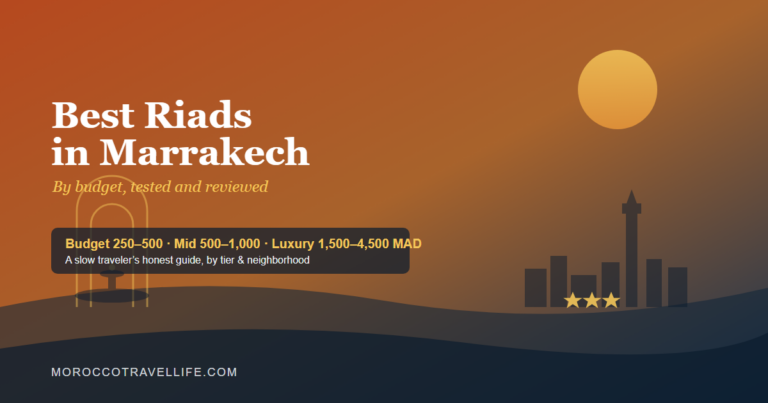
Marrakech is where most trips start, and its medina holds the largest riad market anywhere in Morocco. Local counts run into the high hundreds and beyond, though no official register is published. Not all properties are licensed, so booking a well-reviewed one matters (Morocco Travel Life field observation, July 2026). My tested, budget-banded picks live in best riads in Marrakech, with the wider city covered in my Marrakech travel guide. To choose the neighborhood first, see where to stay in Marrakech, area by area.
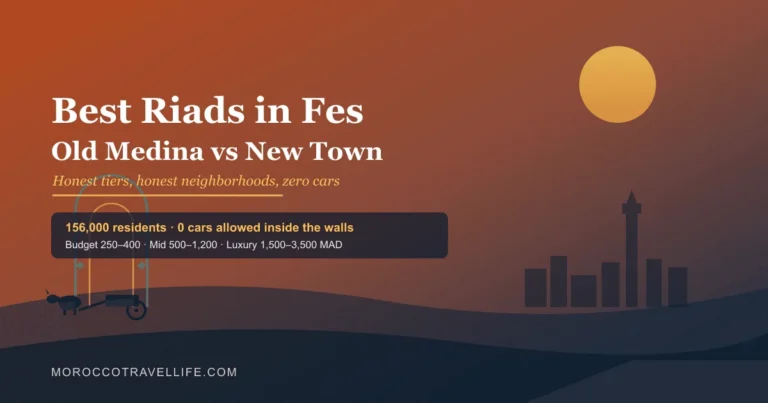
Fes rewards a stay inside its labyrinthine medina: see best riads in Fes and the full Fes travel guide. On the coast, Essaouira’s riads and guesthouses pair with my Essaouira travel guide. For the blue city, my Chefchaouen travel guide covers where to sleep. If you are still deciding which cities make the cut, start with the best Moroccan cities to visit.
That regional concentration is worth seeing as a picture. Marrakech-Safi and the Agadir region together soaked up nearly 60% of all Moroccan tourist nights in 2025. That is why those two areas have by far the most beds, and the most competition for the good ones.
How Do You Choose the Right Stay?
Deciding where to stay in Morocco comes down to four questions, in order, and the choice makes itself. First, what do you most want from the trip? If it is atmosphere and immersion, book riads and kasbahs. If it is convenience and predictability, lean toward hotels. If it is the landscape, prioritize a desert camp and a mountain lodge.
Second, who is traveling? Solo travelers and couples are happiest in small riads, and families want pools and space. Older travelers, or anyone with mobility needs, should favor hotels with elevators and cars to the door, because medina riads mean walking in over uneven lanes.
Third, how long are you in each place? One or two nights suits a characterful riad or a single desert camp; a week in one city tilts toward an apartment with a kitchen. Fourth, when are you going? Spring and autumn are peak season, when the best riads sell out and prices sit at the top of every band.
Summer is hot inland, so make a pool non-negotiable in Marrakech, though the coast stays pleasant. Winter is quiet and cheap in the cities, and genuinely cold in the desert and mountains at night. My best time to visit Morocco guide breaks the seasons down region by region.
The itinerary I recommend most often to first-timers mixes exactly these. Two or three nights in a Marrakech riad, a night in a kasbah on the drive south, a night in a desert camp, then a coastal guesthouse to finish. It costs less than an all-hotel trip, and it shows people four different Moroccos instead of one. First-timers should also read my first-time-in-Morocco tips before they lock anything in.
Booking Basics Worth Knowing Before You Reserve
A few Morocco-specific habits save money and headaches once you have settled where to stay in Morocco. Book the best-reviewed riads early. The good small ones, often just six or eight rooms, genuinely sell out in spring and autumn, which is the costliest where to stay in Morocco mistake. Compare the direct rate against the big platforms. Many riads are cheaper if you email them, since they save the platform commission. A direct booking also lets you arrange the crucial medina pickup and any airport transfer.
Read recent reviews for the words that matter here: “easy to find,” “quiet room,” “hot water,” “help with taxis,” rather than just the star average.
Always confirm two practical things in writing before you arrive. First, how you actually reach the door, since most riads send someone to meet you at the nearest car-accessible point. Second, whether breakfast and any dinners are included, because half-board is common and often excellent value outside the cities.
For the full money comparison (direct versus Booking.com versus Airbnb, with real price examples) see my guide to how to book a riad. And to slot accommodation into an overall trip budget, my Morocco travel budget guide and the master Morocco travel guide for 2026 tie it all together.
Frequently Asked Questions
What is the best type of accommodation in Morocco?
There is no single best type: the right choice depends on the place. In the medina cities like Marrakech and Fes, a riad is the standout stay for character and location. In the desert, a Sahara camp is the only way to sleep in the dunes. On the southern routes, a restored kasbah wins, and on the coast a guesthouse or beach hotel suits best. Most good Morocco trips deliberately mix three or four types.
How much does accommodation cost per night in Morocco?
As of July 2026, budget guesthouses and dars run about 250–500 MAD ($25–50). Mid-range riads and 3–4 star hotels sit around 500–1,500 MAD ($50–150), while luxury riads or ultra desert camps climb past 4,000 MAD ($400+). The average Airbnb night nationally is roughly 850–1,050 MAD. Desert camps are usually priced per person with dinner and breakfast, not per room.
What is the difference between a riad and a dar?
Both are traditional houses built inward around a central courtyard. Strictly, a riad has a planted garden courtyard (the name means “garden”), while a dar has a plainer tiled patio and is often simpler and smaller. In practice, hospitality listings use “riad” loosely for almost any converted courtyard house, so read the description and photos rather than trusting the label alone.
Is it safe and worth staying in a Sahara desert camp?
Yes on both counts, provided you book a reputable operator and reach the real dunes. Camps range from simple standard tents (about 400–800 MAD per person, half-board) to luxury and ultra-luxury setups with private bathrooms (1,500–5,000+ MAD per person). A night in the Sahara is the highlight of most Morocco trips. The main pitfalls are booking a camp far from the tall dunes, or confusing Merzouga’s Erg Chebbi with the lower dunes near Zagora.
Should I book a riad directly or through Booking.com?
Compare both. Many riads are cheaper booked directly by email because they avoid platform commission, and a direct booking makes it easier to arrange the medina pickup you will almost certainly need. Platforms offer buyer protection and easy cancellation, which is worth something for a first trip. The safest approach is to find the riad on a platform, read recent reviews, then check whether the direct rate beats it.
Do I need to book accommodation in Morocco in advance?
For the best small riads in spring and autumn peak season, yes: six- and eight-room properties sell out weeks or months ahead, especially in Marrakech, which alone takes about 38% of Morocco’s tourist nights. Off-season and outside the two big regions you have far more flexibility. Desert camps and popular kasbahs also fill up around holidays, so lock those in early even if you leave city nights loose.
Putting It Together
Where to stay in Morocco is really a series of small, satisfying choices rather than one big one. A riad for the medina, a kasbah for the mountains, a camp for the desert, a guesthouse for the coast, and a hotel when you want the elevator and the pool. Get the where to stay in Morocco matches right and your accommodation stops being a place to sleep. It becomes half the trip: the courtyard you remember, the terrace dinner, the morning you woke up in the dunes.
From here, go deeper on whichever stay pulls you. Try the riad versus hotel comparison if you are torn on your city nights, or Sahara desert camps compared if the desert is the dream. Once you know what you want and just need the best price, read how to book a riad. For the trip around the beds (routes, timing, and budget) my Morocco travel guide is the place to start. My rundown of the best things to do in Morocco turns a stack of good stays into an actual itinerary.