
Your first Morocco trip is easier to plan than the internet makes it look. The problem isn’t a lack of advice. It’s that most of it contradicts the next tab you open. One blog swears by ten days, another by five. Budgets swing from shoestring to splurge with no dirhams attached. And a lot of “insider tips” were written by someone who passed through once, years ago.
Disclosure: Some links in this guide may earn us a commission, at no extra cost to you. It never changes what we recommend.
I’ve spent enough time in Marrakech to price things in dirhams, not guesswork, and I keep those numbers current every time I’m back. This Morocco travel guide is the short, honest version of what I tell friends before they fly in: the five or six decisions that actually shape a first trip, each linking out to a deeper guide when you want it.
Key Takeaways
- Morocco drew a record 19.8 million visitors in 2025, up 14% year on year, overtaking Egypt as Africa’s most-visited country (ATTA, 2026).
- Citizens of 60+ countries, US, UK, all EU states, Canada, Australia, get 90 days visa-free, stamped free on arrival.
- Spring (March–May) and autumn (September–October) are the sweet spot to visit Morocco; skip inland July–August heat.
- Real 2026 daily budgets: ~350–500 MAD backpacker, 1,000–2,000 MAD mid-range per person, before flights.
- Morocco sits at US State Department Level 2, “Exercise Increased Caution,” the same advisory tier as France, Spain, Germany, and the UK.
Here’s the honest headline before we start. Morocco is friendlier to first-timers than its reputation suggests, and far more rewarding than a rushed schedule allows. Nail timing, budget, trip length, transport, and a little cultural prep, and the rest sorts itself out. Think of this Morocco travel guide as the trailhead. Every section below opens onto a deeper resource.
Morocco Travel Guide
Is Morocco Worth Visiting in 2026?
Short answer: yes, and the numbers back up why so many people visit Morocco every year. Morocco welcomed a record 19.8 million visitors in 2025, a 14% jump on 2024, with tourism receipts topping 124 billion dirhams (ATTA, 2026). That was enough to pass Egypt and make Morocco the most-visited country in Africa.
That momentum carried straight into 2026. In the first quarter alone, the country hosted 4.3 million tourists, up 7% year on year, while receipts climbed a striking 24% to 31 billion dirhams (Hespress, 2026). The pace held through spring. By the end of May, arrivals reached 7.7 million, up 7% year on year, with May alone posting a 13% jump (Morocco World News, 2026). Visitors aren’t just arriving in bigger numbers. They’re spending more per trip.
What’s driving it? Cheaper, more frequent flights from Europe, a weak dirham that stretches a foreign budget, and a national tourism push ahead of the 2030 FIFA World Cup, which Morocco co-hosts with Spain and Portugal. The government is aiming for 26 million visitors by 2030 (ATTA, 2026).
In 2026, Morocco extended its tourism boom: it drew a record 19.8 million visitors in 2025 (up 14%) and a further 4.3 million in the first quarter of 2026, with Q1 receipts up 24% year on year (Hespress, 2026). It is now Africa’s most-visited country.
For a first-timer, that growth cuts both ways: more direct flights, more English in tourist zones, better-signed sights, but busier headline attractions. The trade-off is real yet easy to manage. The crowds concentrate in maybe six spots. Step one lane off the main souk axis in Marrakech or Fes, and the country feels exactly as it did before the record year. Few destinations pack this much range (medinas, the High Atlas, the Sahara, Atlantic surf towns) into so short a flight from Europe. My guide to the ten Moroccan cities worth building a trip around covers which ones suit which kind of traveler.
When Is the Best Time to Visit Morocco?
The best time to visit Morocco is spring (March–May) or autumn (September–October), when Marrakech daytime highs sit in the 22–30°C range with only four to six rainy days a month (Weather2Travel, 2026). Those shoulder months are warm enough for a desert night and cool enough to walk a medina at midday without melting.
Summer is the trap most first-timers fall into. Through July and August, Marrakech and Fes sit around 36°C and push past 40°C in the worst August spells, while Sahara daytime highs reach 42–46°C and many desert camps simply close (Weather Spark, 2026). Locked into summer dates? Go coast-heavy and skip the dunes. Essaouira holds near 23°C year-round on the Atlantic breeze (Climates to Travel, 2026).
One calendar note worth planning around: Ramadan ran 19 February to 19 March in 2026, its start confirmed by the Ministry of Habous. It shifts about 11 days earlier each year, so Ramadan 2027 is expected around 8 February to 9 March. Traveling during Ramadan is entirely doable and, honestly, fascinating. Daytime café hours shrink and the rhythm slows, so read up first and it lands as a feature rather than a surprise. My guide to visiting Morocco during Ramadan covers what actually changes on the ground. Winter (December–February) is mild by day on the coast but genuinely cold in the High Atlas, with snow on the peaks. Pack layers and it’s still a fine window.
Want the full month-by-month breakdown, including shoulder-season sweet spots and crowd levels? See my Best Time to Visit Morocco guide.
Do You Need a Visa for Morocco?
For most first-time visitors, no visa is required. As of 2026, citizens of 60+ countries, including the US, UK, all 27 EU states, Canada, and Australia, get 90 days visa-free, stamped at any official port of entry at no cost (Visa policy of Morocco, Wikipedia, 2026). There’s no landing fee and nothing to register online beforehand.
Two rules catch people out, so memorize them. First, treat six months of passport validity beyond entry as the safe standard, because that’s what airlines enforce at check-in. Official minimums vary by nationality, and the UK lists three months (GOV.UK, 2026). Second, the 90 days is per entry, counted from your entry stamp, not a loose “three months.” Overstaying brings real penalties, from fines to multi-year entry bans. The rolling 180-day window some blogs mention applies only to a handful of nationalities, not to US, UK, EU, Canadian, or Australian passports.
A small thing that speeds up the border: know your first night’s address. Officers occasionally ask where you’re staying, and having a riad name written on your phone turns a two-minute exchange into a ten-second one. Keep the little paper slip you fill in on arrival, too. You may need it on the way out.
Unsure whether your nationality qualifies, or planning to stay past 90 days? The country-by-country list and the extension process are in my complete Morocco visa requirements guide.
How Much Does a Morocco Trip Cost?
Morocco is one of the best-value destinations within a short flight of Europe or North America. In 2026, a backpacker travels comfortably on about 350–500 MAD (~$38–54) a day, while a mid-range traveler spends 1,000–2,000 MAD (~$108–215) a day on nicer riads, sit-down meals, and the odd guided tour (Morocco Travel Life field pricing, 2026). Those figures leave out international flights, so budget those separately.
The exchange rate is on your side: 1 USD buys roughly 9.1–9.4 MAD in 2026 (Bank Al-Maghrib, 2026). A tagine at a neighborhood spot runs 40–70 MAD, a dorm bed 100–150 MAD, and a lovely mid-range riad room 500–900 MAD. Sahara tours and long-distance transport are the line items that swing a budget the most.
I keep a full itemized dirham budget covering flights, riads, food, tours, and tips, updated after each trip back: real dirham budget breakdown.
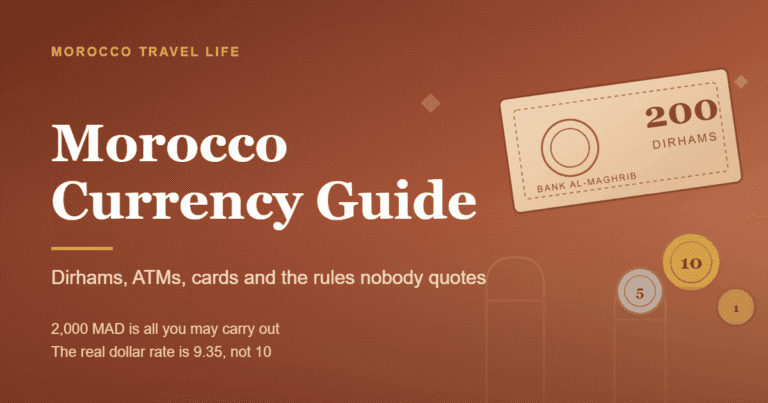
Over a full week, that works out to roughly $265–630 per person on a backpacker pace and $800–2,170 mid-range, excluding international flights (Morocco Travel Life field pricing, 2026). One logistics note that catches people out: the dirham is a closed currency, so you can’t buy it abroad and shouldn’t leave with more than 2,000 MAD. Withdraw as you go from bank-attached ATMs, and take one larger withdrawal rather than several small ones, since each carries a fixed local fee. Carry cash for taxis, small guesthouses, and rural stops.
How Many Days Do You Need in Morocco?
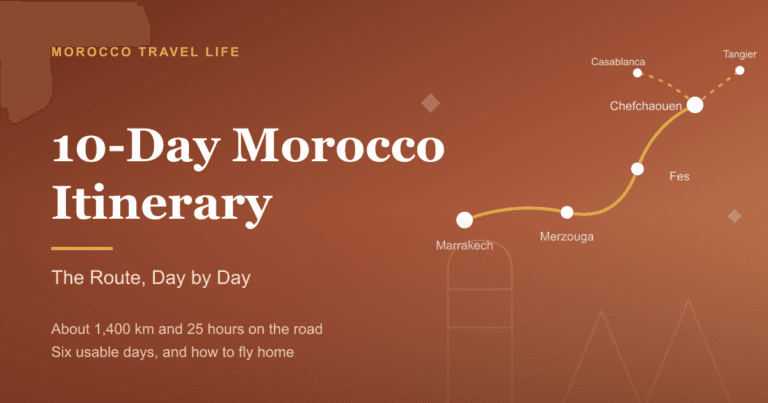
For a first trip, seven days is the honest minimum and ten is the sweet spot. One week covers the classic Marrakech–Sahara–Fes loop at a humane pace; ten days lets you add Chefchaouen or a coastal town without leaving exhausted (Rough Guides, 2026). Fourteen days opens up the Atlantic coast and the north.
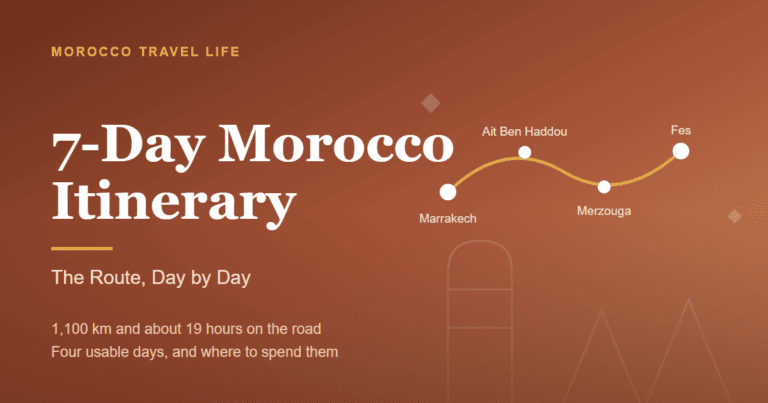
The most popular first-timer route is a loop: two days in Marrakech, a day crossing the High Atlas to the Hollywood-famous kasbah of Aït Benhaddou, a night in the Sahara dunes near Merzouga, then on to Fes for two days. It bundles a great city, mountains, desert, and a second cultural capital into one efficient arc. I have written that week out day by day, with drive times and real dirham costs, in my 7-day Morocco itinerary. If Marrakech is your only stop, I’ve mapped three days in Marrakech day by day, with costs and closing days.
Can you go faster? People attempt Morocco in three or four days, and they leave frazzled, having spent half of it in a van. My rule of thumb: don’t try the Sahara on fewer than seven days total. Zagora is a two-day round trip from Marrakech and Merzouga needs at least three, so rushing it defeats the entire point of going.
Want the full route-by-route breakdown of what each length actually buys you? I compare all three side by side in my comparison of 7, 10 and 14 day trips.
Is Morocco Safe for First-Time Travelers?
Yes, and it’s one of the safest countries in the region for tourists. Morocco sits at US State Department Level 2, “Exercise Increased Caution,” the same advisory tier as France, Spain, Germany, and the UK (U.S. State Department, reissued 21 April 2025). Violent crime against visitors is rare. The realistic risks are petty scams and, for women, verbal harassment.
Let me be candid rather than reassuring for its own sake. Busy medinas in Marrakech and Fes come with hustle: unsolicited “guides,” steered shopping, the occasional inflated price. None of it is dangerous. It’s friction, and a firm, polite “la, shukran” (no, thank you) handles ninety percent of it. The Level 2 rating is driven by terrorism risk rather than street crime, which is the same reason France, Spain, and the UK sit on that tier. Worth knowing, but it shouldn’t change how you plan a normal trip.
For solo female travelers the picture is more nuanced but generally positive. Harassment is real, and it’s overwhelmingly verbal rather than physical, so the country asks for a bit more vigilance than, say, Portugal. Covering shoulders and knees, walking with intent, and booking your first night’s arrival in advance all go a long way. Agadir, Essaouira, and Rabat consistently feel calmer than Marrakech’s most touristed lanes.
For the longer, franker version, including neighborhood-level notes, see my honest Morocco safety guide. For the city-by-city read and real dirham costs, see my Morocco solo female travel guide.
Morocco holds a US State Department Level 2 “Exercise Increased Caution” travel advisory, reissued 21 April 2025, the same tier as France, Spain, Germany, and the UK, with violent crime against tourists rare (U.S. State Department, 2025). The main issues are petty scams and catcalling, not serious crime.
How Do You Get Around Morocco?
Morocco’s public transport is genuinely good, and you don’t need a rental car for the route most first-timers follow. In 2026 the ONCF train network links Casablanca, Rabat, Marrakech, Fes, Meknes, Tangier, and Oujda with modern, air-conditioned trains from around 50 MAD second class (ONCF, 2026). The Al Boraq high-speed line, the first in Africa, runs Tangier to Casablanca in 2 hours 10 minutes at up to 320 km/h (Morocco World News, 2026).
Chefchaouen, the desert gateways, Essaouira, and Ouarzazate have no rail access at all (Wikipedia, 2026). There, CTM and Supratours buses take over, with comfortable reservable seats and long-haul fares from around 180 MAD (Morocco Travel Life field pricing, 2026). For short regional hops, shared grand taxis (usually six passengers, leaving when full) are cheap and quick. Within cities, petit taxis and trams handle the rest.
Budget travelers manage transport on 50–150 MAD a day across most itineraries. Book trains at oncf.ma or the ONCF app. International cards work and you get a phone e-ticket. The Sahara is the exception. Most first-timers book a multi-day tour out of Marrakech rather than piecing it together, and it’s the one leg where a guided vehicle genuinely earns its cost.
I break down every mode in more depth, including booking links, station tips, and when to just grab a taxi, in my complete guide to getting around Morocco.
What Should You Pack, and What Etiquette Should You Know?
Pack for range and modesty. Morocco spans desert heat and mountain chill, sometimes in the same week, so layers plus one modest outfit that covers shoulders and knees are the non-negotiables. They serve both respect and cool desert nights. Comfortable walking shoes matter more than anything fashionable; medina lanes are uneven and seem to go on forever.
On etiquette, a handful of basics smooth every interaction. Greet with “salam” and a smile. Eat and give with your right hand. Ask before photographing people, especially in rural areas. During Ramadan, don’t eat or drink conspicuously in the street. None of this requires study. A little awareness reads as respect, and respect opens more doors here than money does. My Morocco etiquette guide has the full set of dos and don’ts.
The single most useful thing I tell every visitor: learn five words of Darija. “Salam” (hello), “shukran” (thanks), “la” (no), “bghit” (I want), “bshhal” (how much). Locals light up when a visitor tries, and it quietly resets the dynamic in any souk negotiation. Isn’t that a better souvenir than another fridge magnet?
For a full season-by-season Morocco travel checklist, see my what to pack for Morocco guide.
What Scams and Mistakes Should First-Timers Avoid?
Most “scams” you’ll meet are low-stakes and easy to sidestep once you know the pattern. The classic three, which I’ve watched play out on every trip: the fake “this way is closed” detour toward a shop, the unsolicited guide who then demands payment, and the “free” gift (henna, a sprig of mint) that isn’t free. Recognize them and they lose all their power.
Here’s what I wish someone had told me before my first trip here: agree the price out loud, before anything happens. Before the taxi moves, before the “guide” walks, before the henna touches your hand. Nearly all the friction here comes from a price that was never actually stated. Say the number first, and most problems simply evaporate.
The bigger first-timer mistakes aren’t scams at all. They’re over-stuffing the itinerary, underestimating the Sahara’s travel time, not carrying enough cash for rural stretches, and assuming everyone’s out to fleece you (they’re not; genuine hospitality is the norm). Balance healthy caution with an open mind, and you’ll be fine.
My full, dated warning list of the scams actually circulating this season lives in my Morocco tourist scams guide.
The most common Morocco tourist scams, meaning fake “road closed” detours, unsolicited paid guides, and “free” gifts, are all defused by agreeing any price out loud before a service begins, since most friction stems from an unstated fare. Violent crime against tourists remains rare.
Putting It Together: Your First Morocco Trip
So what does a well-planned Morocco travel itinerary actually look like? Fly into Marrakech in April, May, September, or October. Budget around 1,000–1,500 MAD a day for comfort without splurging. Give yourself seven to ten days. Take trains and CTM buses between cities, and book one guided desert overnight. Pack modest layers, carry cash, and learn five words of Darija.
That’s the whole framework. Everything else, meaning which riad, which medina to get lost in first, whether to squeeze in Chefchaouen, is detail you can happily improvise once you’re on the ground. Morocco rewards the traveler who plans the skeleton and leaves room for the country to surprise them.
Staying connected matters too, so see my Morocco SIM card and eSIM guide. And if you want the fuller list of small things that catch first-timers off guard, I cover 15 more in First Time in Morocco: 15 Things I Wish Someone Told Me.
Frequently Asked Questions
Is Morocco safe to visit in 2026?
Yes, it’s safe to visit Morocco in 2026. Morocco holds a US State Department Level 2 “Exercise Increased Caution” advisory, reissued 21 April 2025, the same tier as France, Spain, Germany, and the UK, and violent crime against tourists is rare (U.S. State Department, 2025). The realistic risks are petty scams and, for women, verbal harassment, both manageable with basic awareness.
How many days do you need in Morocco for a first trip?
For a first trip to Morocco, seven days is the honest minimum and ten is ideal. One week covers the Marrakech–Sahara–Fes loop comfortably, while ten days adds Chefchaouen or the coast without rushing (Rough Guides, 2026). Avoid attempting the Sahara on fewer than seven days total.
How much does a week in Morocco cost?
Most weekly budgets run about $265–630 per person on a backpacker pace and $800–2,170 mid-range, excluding international flights (Morocco Travel Life field pricing, 2026). Backpackers manage on about 350–500 MAD (~$38–54) a day; mid-range travelers spend 1,000–2,000 MAD (~$108–215) daily.
Do US and UK citizens need a visa for Morocco?
No, most nationalities can visit Morocco visa-free. As of 2026, US, UK, EU, Canadian, and Australian citizens receive 90 days visa-free per entry, stamped at the port of arrival at no cost (Visa policy of Morocco, Wikipedia, 2026). Treat six months of passport validity beyond entry as the safe standard, since that is what airlines enforce; official minimums vary by nationality.
When is the cheapest time to visit Morocco?
Winter (December–February, outside the holidays) and high summer (July–August) are cheapest, as demand drops. The trade-off is weather: summer inland heat tops 40°C, while winter is cold in the mountains (Lonely Planet, 2026). Shoulder-season value in May and late September is the smarter balance for most budgets.
The Bottom Line
Morocco earned its record 19.8 million visitors in 2025 for a reason, and this guide exists to help the next wave plan well: nowhere else packs cities, mountains, desert, and coast into so short a flight, at such friendly prices (ATTA, 2026). For a first trip, get five things right: go in spring or autumn, budget in dirhams, allow seven to ten days, lean on trains and buses, and pack a little cultural respect. Do that and the country does the rest. Bookmark this guide before your trip, since prices and details get rechecked as they change.