
“Morocco cities to visit” sounds like a simple search, but Morocco doesn’t give a simple answer. Ten different towns could top that list, and each one delivers a completely different week. Morocco pulled in a record 19.8 million visitors in 2025, and nearly all of them funneled through some combination of the same ten hubs (ATTA, 2026).
Disclosure: Some links in this guide may earn us a commission, at no extra cost to you. It never changes what we recommend.
I’ve spent enough time in Marrakech to know it well, and “which city should I actually see” is the question I get most from friends booking flights. This guide runs through the ten Moroccan destinations worth building a trip around, from the imperial capitals to the Sahara gateways, with a dedicated deeper guide linked from each one. If this is your first Morocco trip, my complete Morocco travel guide covers timing, visas, and budget before you get into destinations.
Key Takeaways
- Morocco drew a record 19.8 million visitors in 2025, funneled mostly through the ten cities on this list (ATTA, 2026).
- Morocco holds 9 UNESCO World Heritage Sites, and more than half sit inside cities covered here (Wikipedia, List of World Heritage Sites in Morocco, 2026).
- Marrakech and Fes anchor most first trips; Chefchaouen, Essaouira, and a Sahara gateway round out a solid 10-14 day route.
- Rabat, Casablanca, and Tangier suit travelers who want a quieter, more modern side of Morocco.
- Budget 2-3 nights per hub city plus one Sahara overnight; seeing all 10 in under two weeks means a lot of driving.
Morocco Cities to Visit
How Should You Decide Which Morocco Cities to Visit?
Most first-time visitors build their trip around 3 to 5 cities, not all 10. Morocco packs imperial capitals, a blue mountain town, a windsurfing coast, and two Sahara gateways into a country roughly the size of California, and more than half of its 9 UNESCO World Heritage Sites sit in the cities below (Wikipedia, List of World Heritage Sites in Morocco, 2026). Your shortlist depends on trip length, travel style, and how much driving you can stomach.
I’ve helped enough first-time travelers plan a route to notice a pattern: people who sort by destination “type” rather than city name end up happier with their trip. Here’s how I actually organize it when a friend asks me to help plan.
| Destination | Type | Best For | Minimum Nights |
|---|---|---|---|
| Marrakech | Imperial city | First-timers, souks, day trips | 2-3 |
| Fes | Imperial city | Culture, craft, car-free medina | 2 |
| Chefchaouen | Blue mountain town | Photography, slow travel | 1-2 |
| Essaouira | Atlantic coast | Surfers, seafood, relaxed pace | 2 |
| Rabat & Casablanca | Modern capital / economic hub | Architecture, fewer tourists | 1-2 each |
| Merzouga & Zagora | Sahara gateways | Desert camps, dunes | 1 (+2 travel) |
| Tangier | Port gateway | Ferry travelers, quick Europe link | 1-2 |
| Atlas Mountains | Berber villages | Hikers, day trips from Marrakech | 1-3 |
| Ouarzazate | Film studio hub | Movie fans, en route to the Sahara | 0-1 |
Source: Morocco Travel Life field observations, 2026, based on repeat visits and advising first-time travelers.
Travel time is usually the deciding factor, more than distance on a map. Marrakech and Essaouira sit close together, and even Tangier, in the far northern corner, is now about a 6-hour train ride with one change in Casablanca. The Sahara gateways are the real commitment. My guide to getting around Morocco compares trains, buses, and grand taxis for every leg.
Morocco’s ten most-visited destinations range from a 2.5-hour drive (Marrakech to Essaouira) to a 9.5-10 hour haul to the Merzouga dunes, which is why most first-time itineraries pick one region cluster rather than crossing the whole country (Morocco Travel Life route planning, 2026).
Marrakech: Morocco’s Red City and the Country’s Best First Stop
Marrakech is the single most common entry point for Morocco travel, home to just over 1 million residents as of Morocco’s 2024 census and the country’s busiest medina, built around the UNESCO-listed Jemaa el-Fnaa square (Wikipedia, Marrakesh, 2026). It’s also the city I know best on this list.
The draw is density: souks, riads, palaces, gardens, and day-trip access to the Atlas Mountains and the Agafay desert all sit within a 20-minute walk or a short taxi ride.
I’ve taken visiting friends through the same three medina lanes on their first afternoon, because you can feel the whole city’s rhythm in about two hours without getting lost.
Marrakech suits nearly every traveler type: first-timers who want an easy landing, couples wanting boutique riads, and budget travelers who want cheap street food and an easy bus and train hub. It’s the weakest fit only for travelers actively trying to avoid crowds.
Want the neighborhood-by-neighborhood breakdown? My Marrakech travel guide covers the medina and souks, and my day trips from Marrakech guide ranks the excursions worth your time.
Is Fes Worth the Detour to Morocco’s Largest Car-Free Medina?
Yes, if you want the version of Morocco that existed before cars did. Fes el-Bali, a UNESCO World Heritage Site since 1981, is one of the world’s largest car-free urban zones, and greater Fes is home to roughly 1.26 million people as of the 2024 census (Wikipedia, Fez, Morocco, 2026).
Where Marrakech feels like a performance, Fes feels like a working city that happens to be stunning. Tanneries, metalworking souks, and the University of al-Qarawiyyin, often cited as one of the oldest continuously operating universities in the world, all sit inside walls that have barely changed shape in centuries.
Fes rewards travelers with a few extra days and a genuine interest in craft and history over nightlife. It’s a harder city to “do” quickly. Plan on getting lost at least once, on purpose.
My Fes travel guide has the tannery etiquette, guide-hiring advice, and a walking route that won’t leave you hopelessly lost.
Chefchaouen: What Makes Morocco’s Blue City Worth the Trip?
Chefchaouen is a small mountain town of just over 46,000 residents, founded in 1471 and painted in shades of blue for decades, though the reason is genuinely disputed: some locals trace the tradition to a 1970s push to attract tourists, while an older, vaguer explanation holds that the blue symbolizes the sky and heaven and wards off mosquitoes (Wikipedia, Chefchaouen, 2026). It’s the most photographed town in Morocco, and it earns that reputation honestly.
The blue isn’t a gimmick. It’s genuinely calming to walk through, and the pace here is slower than anywhere else on this list. There’s less to “do” in a checklist sense and more to simply absorb: rooftop cafes, a small kasbah, and hiking trails into the Rif Mountains just beyond town.
Most people I travel with tell me Chefchaouen was their favorite stop, not because it has the most to do, but because it’s the only city on this list with nothing to rush toward.
It’s best for travelers with flexible time who don’t mind that it sits far from Marrakech. Most people reach it from Fes or Tangier, not directly.
For getting-there logistics and the best photo spots, see my Chefchaouen guide.
Essaouira: Morocco’s Windsurfing and Seafood Coastal Town
Essaouira is a UNESCO-listed Atlantic port town of just under 78,000 residents as of the 2014 census, kept cool year-round by steady Atlantic trade winds (Wikipedia, Essaouira, 2026). Those same winds have made it one of North Africa’s more reliable windsurfing and kitesurfing spots, a draw decades before “digital nomad” was a phrase. It’s roughly a 2.5-hour drive from Marrakech.
Where inland Morocco can hit 40°C in summer, Essaouira barely notices. That same breeze is why the seafood is caught the same morning it’s grilled at the port-side stalls. The medina is smaller and calmer than Marrakech’s: whitewashed walls and blue shutters instead of red stone.
It’s the right call for travelers craving a slower, coastal contrast after a few busy inland days, and for surfers who want real swell without leaving the country.
My Essaouira travel guide covers the best surf spots and where to eat that seafood.
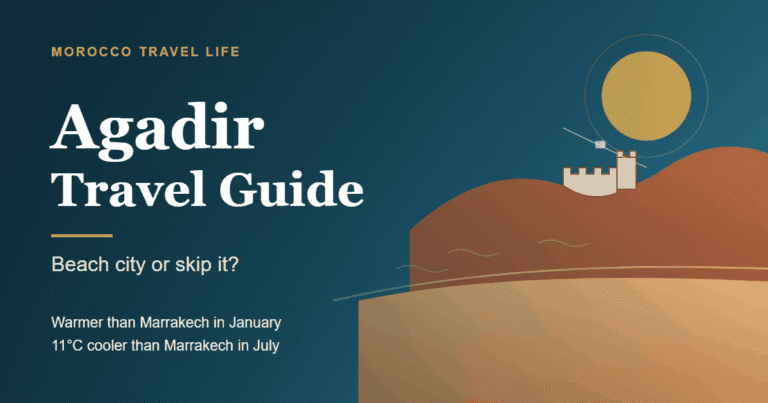
If you’d rather have an easy beach base than a medina, Agadir sits about three hours further south, and my Agadir travel guide weighs whether it deserves a place on your route.
Rabat vs Casablanca: Which Deserves More of Your Itinerary?
Rabat is Morocco’s political capital with roughly 516,000 residents and a UNESCO listing since 2012 for its planned modern districts alongside its historic core; Casablanca is the economic capital and Morocco’s largest city, with about 3.2 million residents per the 2024 census (Wikipedia, Rabat; Wikipedia, Casablanca, 2026).
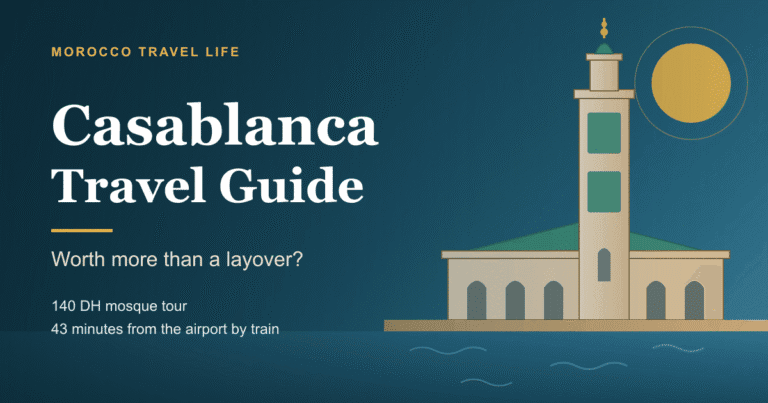
Neither city ranks with Marrakech or Fes for tourist infrastructure, and that’s precisely their appeal. Rabat feels calm and orderly, with wide boulevards, the Kasbah of the Udayas, and far fewer souvenir touts. Casablanca feels genuinely modern, anchored by the Hassan II Mosque and its 200-meter minaret, one of the tallest religious structures in the world (Hassan II Mosque Foundation, 2026). My Casablanca travel guide covers what fits in a layover, one day or two.
| Rabat | Casablanca | |
|---|---|---|
| Role | Political capital | Economic capital, largest city |
| Population | ~516,000 | ~3.2M |
| Best for | Calm, planned architecture | Modern skyline, business travelers |
| Typical stay | 1 night | 1-2 nights |
If you have one spare night on a Casablanca-Marrakech flight route, give it to Rabat. If you want to see a working, modern Moroccan city instead, stay in Casablanca.
The full head-to-head, including which one fits a layover better, is in my Rabat vs Casablanca comparison.
Merzouga vs Zagora: Which Sahara Gateway Should You Choose?
Merzouga sits beside the Erg Chebbi dunes, which rise up to 150 meters and are the tallest, most photogenic dunes accessible from Marrakech (Wikipedia, Erg Chebbi, 2026); Zagora sits in the Draa Valley, long wrapped up in trans-Saharan caravan lore, marked by a roadside sign reading “Tombouctou 52 jours,” a nod to the supposed 52-day camel journey to Timbuktu (Wikipedia, Zagora, Morocco, 2026).
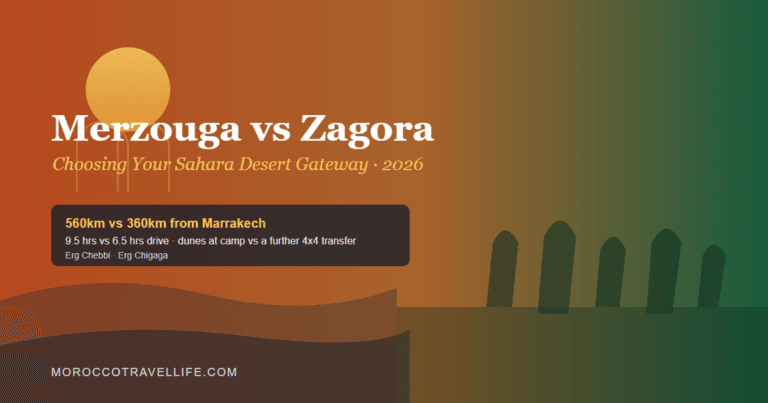
The two gateways ask for different commitments. Merzouga sits 9.5 to 10 hours from Marrakech, usually split across two days with an overnight in the Dades Valley or Ouarzazate; Zagora is closer, about 6 to 6.5 hours. Merzouga’s dunes are taller and more dramatic; Zagora’s shorter route passes through more oasis towns.
| Merzouga | Zagora | |
|---|---|---|
| Dune height | Up to 150m (Erg Chebbi) | Smaller, Erg Lehoudi dunes |
| Drive from Marrakech | ~9.5-10h | ~6-6.5h |
| Best for | Serious dune photography, luxury camps | Shorter Sahara taste, budget trips |
I generally point first-timers with a full week toward Merzouga. The taller dunes are worth the extra driving. Zagora works better if the Sahara is a bonus, not the main event.
Merzouga’s Erg Chebbi dunes reach up to 150 meters, taller than the smaller Erg Lehoudi dunes near Zagora. The drives differ: about 9.5-10 hours from Marrakech to Merzouga versus 6-6.5 hours to Zagora, and Zagora’s larger Erg Chigaga sits a further 4×4 leg beyond M’Hamid (Wikipedia, Erg Chebbi; Wikipedia, Zagora, Morocco, 2026).
For the full comparison, including camp pricing and which route fits a 7-day trip, see my Merzouga vs Zagora guide.
How Do You Travel Between Chefchaouen and Fes?
Chefchaouen and Fes sit roughly 200 kilometers apart via Ouezzane, with no rail on the route at all, and CTM’s direct bus covers it in just over 4 hours (Morocco Travel Life route planning, 2026). It’s the standard link for anyone doing a northern-Morocco loop.
Shared grand taxis undercut the bus on price but add a change in Ouezzane, often stretching the trip past 5 hours door to door. A private transfer booked through your riad is the fastest option, closer to 3 hours. None of the options are difficult. This is one of the more straightforward intercity legs in the country.
I tell anyone doing the northern loop to book the morning bus, not the afternoon one. Fes traffic near the medina gates gets noticeably worse after 2pm, and you’ll want daylight left to find your riad on arrival.
Full booking details, station names, and grand taxi pricing live in my Chefchaouen to Fes travel guide.
Tangier: Why Visit Morocco’s Gateway to Europe?
Tangier sits just 14 kilometers from Spain across the Strait of Gibraltar, and its port, Tanger Med, ranks among the largest in Africa and the Mediterranean by container capacity (Wikipedia, Tangier; Wikipedia, Tanger Med, 2026). Home to nearly 1.28 million residents as of Morocco’s 2024 census (Wikipedia, Tangier, 2026), it’s Morocco’s most international city by history and by feel.
Tangier has a different texture than Marrakech or Fes. Decades as an international zone left it with a literary, slightly bohemian reputation (Paul Bowles and the Beat writers famously passed through), plus genuinely excellent seafood and a medina that slopes straight down to the port.
It suits ferry travelers arriving from Spain, travelers connecting north to Chefchaouen, and anyone who wants a quick, walkable city stop rather than a full multi-day base.
My Tangier travel guide covers ferry timing, the medina, and day trips to Cape Spartel.
Atlas Mountains: Imlil, Toubkal, and Berber Village Escapes
The High Atlas rises to 4,167 meters at Jebel Toubkal, the highest peak in North Africa, reached via the trailhead village of Imlil, about a 90-minute drive from Marrakech (Wikipedia, Toubkal, 2026). It’s the easiest genuine mountain escape from any imperial city on this list.
Most visitors don’t summit Toubkal. They come for a day hike or an overnight in a Berber village, walnut groves, terraced fields, and mule trains still doing the delivery work trucks handle elsewhere. Snow closes the higher trails from roughly November through March.
It’s the right add-on for travelers who want one clear contrast to the medinas: cool air, quiet villages, and a genuinely different Morocco within day-trip range of Marrakech.
For trailheads, guide costs, and village etiquette, see my Atlas Mountains guide.
Ouarzazate: Is Morocco’s “Hollywood of Africa” Worth the Detour?
Yes, if you’re passing through anyway on the road to the Sahara. Ouarzazate is a small city of around 70,000 people, home to Atlas Studios, recognized as one of the world’s largest film studio complexes, where scenes from Gladiator, Lawrence of Arabia, and Game of Thrones were shot (Wikipedia, Ouarzazate; Wikipedia, Atlas Studios, 2026).
It sits about 4 hours from Marrakech over the Tizi n’Tichka pass, directly on the route most travelers take toward Merzouga or Zagora. Beyond the studios, it’s also near the Noor Ouarzazate Solar Complex, one of the world’s largest concentrated solar power installations, with a combined capacity of about 580 megawatts (Wikipedia, Ouarzazate Solar Power Station, 2026).
It’s not a standalone destination for most trip lengths. It’s a smart half-day or overnight stop layered onto a Sahara route, not a dedicated multi-day base.
Ouarzazate’s Atlas Studios is recognized as one of the largest film studio complexes on Earth, having hosted productions from Gladiator to Game of Thrones, and sits directly on the standard Marrakech-to-Sahara driving route (Wikipedia, Atlas Studios, 2026).
My Ouarzazate travel guide covers studio tours, timing it into a Sahara route, and the solar plant viewpoint.
Putting Together Your Morocco City Itinerary
No single itinerary fits every traveler, but the same pattern works for most first trips. Pick one imperial city (Marrakech or Fes), one contrast (Chefchaouen or Essaouira), and one Sahara gateway (Merzouga or Zagora). Add Rabat, Casablanca, Tangier, the Atlas, or Ouarzazate only once your trip runs past 10 days.
Ready your dates and your dirhams next: my real dirham budget breakdown prices out exactly what each of these stops costs per day, updated on my most recent stay.
Frequently Asked Questions
Which Moroccan city should I visit first?
Marrakech is the standard first stop for most travelers, since it has the most direct international flights, the widest range of riads, and the easiest access to day trips into the Atlas Mountains (ATTA, 2026). Fes is the strongest alternative if you want fewer crowds.
How many Morocco cities can I realistically see in 10 days?
Most travelers comfortably cover 3-4 cities in 10 days, typically Marrakech, one Sahara gateway, and either Fes or a coastal stop like Essaouira. Adding Chefchaouen or Tangier usually means dropping something else. I’ve written a full ten-day route, day by day, and my comparison of 7, 10 and 14 day trips breaks it down by trip length.
Which Morocco city is best for a family trip?
Marrakech and Essaouira work best for families. Marrakech has short taxi rides between sights, and Essaouira’s calmer medina and beach suit kids better than a desert overnight (Wikipedia, Essaouira, 2026). Save the Sahara camp for kids over about 8.
Is it worth visiting both Marrakech and Fes?
Yes, if you have 7 or more days. The two cities feel genuinely different, imperial history and craft in Fes against energy and souks in Marrakech, and both are UNESCO-listed medinas (Wikipedia, List of World Heritage Sites in Morocco, 2026). The direct train between them takes about 7 hours.
Which Morocco city is least touristy?
Rabat and Zagora see noticeably fewer foreign visitors than Marrakech or Merzouga, since Rabat lacks a single “must-see” landmark on most checklists and Zagora sits further from the tallest Sahara dunes (Wikipedia, Rabat, 2026). Both reward travelers who’ve already covered the highlights once.
The Bottom Line
Ten Moroccan cities, ten different trips. Marrakech and Fes give you the imperial core; Chefchaouen and Essaouira give you contrast; Merzouga or Zagora give you the Sahara. Rabat, Casablanca, Tangier, the Atlas, and Ouarzazate round things out once your trip runs long enough to use them.
Start with 3-5 cities that match how you actually like to travel, not the longest possible checklist. I re-check these routes on every trip back, since a guide is only as useful as the day it was verified. Your next Moroccan sunset, over a red medina, a blue one, or a dune, is closer than you think.